Erhalten Sie Zugang zu diesem und mehr als 300000 Büchern ab EUR 5,99 monatlich.
- Herausgeber: Musaicum Books
- Kategorie: Geisteswissenschaft
- Sprache: Englisch
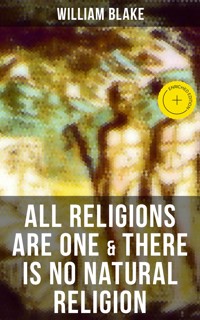
In William Blake's enlightening work 'All Religions are One & There is No Natural Religion', the artist and poet delves into the essence of religion and spirituality, presenting a series of aphorisms that explore the commonality and interconnectedness of all faiths. Blake's writing is characterized by its visionary and mystical quality, echoing his unique blend of Romanticism and spiritual beliefs. Rooted in the literary context of 18th century England, this work challenges traditional religious doctrine and promotes a universal understanding of divinity. Through his profound insights, Blake invites readers to contemplate the transcendent nature of religion and the unity that underlies all belief systems. As an artist, poet, and visionary, Blake's exploration of religious themes reflects his deep connection to the spiritual realm and his desire to inspire others to seek a higher truth. 'All Religions are One & There is No Natural Religion' is a thought-provoking and enlightening read for those interested in exploring the inherent unity of diverse religious traditions and expanding their spiritual horizons. In this enriched edition, we have carefully created added value for your reading experience: - A comprehensive Introduction outlines these selected works' unifying features, themes, or stylistic evolutions. - The Author Biography highlights personal milestones and literary influences that shape the entire body of writing. - A Historical Context section situates the works in their broader era—social currents, cultural trends, and key events that underpin their creation. - A concise Synopsis (Selection) offers an accessible overview of the included texts, helping readers navigate plotlines and main ideas without revealing critical twists. - A unified Analysis examines recurring motifs and stylistic hallmarks across the collection, tying the stories together while spotlighting the different work's strengths. - Reflection questions inspire deeper contemplation of the author's overarching message, inviting readers to draw connections among different texts and relate them to modern contexts. - Lastly, our hand‐picked Memorable Quotes distill pivotal lines and turning points, serving as touchstones for the collection's central themes.
Sie lesen das E-Book in den Legimi-Apps auf:
Seitenzahl: 41
Veröffentlichungsjahr: 2017
Das E-Book (TTS) können Sie hören im Abo „Legimi Premium” in Legimi-Apps auf:
Ähnliche


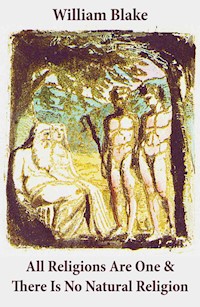
ALL RELIGIONS ARE ONE & THERE IS NO NATURAL RELIGION
Published by
Books
Table of Contents
Introduction
This collection brings together William Blake’s paired illuminated works All Religions Are One and There Is No Natural Religion, both created in 1788. Rather than assembling an entire oeuvre, the volume focuses on a compact, formative moment in Blake’s career, presenting the complete sequences as they have come down to us. The aim is to let readers encounter these brief yet ambitious tracts side by side, as Blake conceived them within his new medium of text-and-image. Read together, they introduce the concerns that animate his later books: the grounds of belief, the powers and limits of perception, and the indispensability of creative imagination to human understanding.
The genres represented here are hybrid. These are not conventional poems, essays, or sermons, though they share features with each. They are aphoristic propositions engraved on plates, arranged as Arguments, Principles, and concise sections that develop a chain of thought. Their voice is oracular and compressed rather than discursive. The texts belong to Blake’s “illuminated” mode, in which verbal statements appear within designed pages. They engage philosophical and theological debate, but do so with the cadence of visionary utterance. Readers may recognize elements of manifesto, catechism, and epigram, fused into a distinctive short-form experiment in prophetic prose.
Historically, these works stand among Blake’s earliest surviving productions in the relief-etching process he called illuminated printing. In 1788 he began to write, design, and print his own books by inscribing text and motifs on copper plates, then inking and hand-finishing impressions. This enabled him to control every aspect of presentation and to circulate ideas that were difficult to accommodate in conventional formats. The method is inseparable from the message: form and content reinforce one another. These compact plates trailblaze the integration of argument and image that would soon expand in Songs of Innocence and The Marriage of Heaven and Hell.
The unifying themes are clear. Blake challenges the notion that religion can be derived solely from external observation, insisting instead on the primacy of the human imaginative faculty in apprehending the divine. He frames religious diversity not as contradiction but as varied expression of a single creative source. He probes how perception, desire, and reason relate to infinity, and why any system that restricts vision to the senses alone risks impoverishing human life. The result is a philosophy of imagination that is both epistemological and ethical, shaping how we know and how we ought to live.
All Religions Are One unfolds as an Argument followed by seven Principles. The sequence proposes that the wellspring of religious expression is a universal imaginative capacity sometimes named the Poetic Genius. It suggests that specific creeds are forms of this larger power, which works in individuals and cultures with differing emphasis. The presentation is deliberately concise, offering propositions that invite reflection more than they demand assent. By articulating these Principles, Blake sets a foundation for reading religious difference through likeness, and for understanding artistic creativity as continuous with spiritual insight.
There Is No Natural Religion appears here in two related sequences that scholars often describe as Series A and Series B. The contents listed in this volume reflect that dual structure, presenting an Argument and sections I–VI alongside a second run of propositions I–VII, with a Conclusion and Application. Read together, they frame a dialectic: one side addresses the consequences of limiting knowledge to sensory data; the other asserts the human capacity to reach beyond such limits. The second sequence’s Conclusion and Application underscore the practical stakes Blake finds in his premises, moving from abstract claim to lived implication.
Stylistically, these works are marked by antithesis, paradox, and incremental progression. Each proposition is plain in diction yet reverberant in implication, accumulating force by contrast and reversal. Blake’s compressed style places pressure on Enlightenment commonplaces without engaging in pedantic dispute. He does not rehearse syllogisms so much as stage a series of visionary turnings, where terms like reason, desire, and infinity are set into new relations. The brevity can be disarming; it is meant to be read slowly, with attention to how each statement modifies the last and prepares the next.