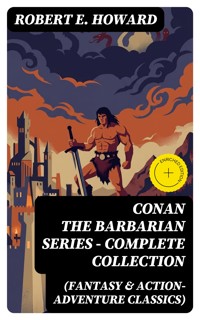
CONAN THE BARBARIAN SERIES – Complete Collection (Fantasy & Action-Adventure Classics) E-Book
Robert E. Howard
1,49 €
Mehr erfahren.
- Herausgeber: DigiCat
- Kategorie: Fantasy und Science-Fiction
- Sprache: Englisch
The "Conan the Barbarian Series – Complete Collection" epitomizes Robert E. Howard's visionary contribution to the sword and sorcery genre, celebrating the trials of its indomitable hero, Conan. Set in the imaginary Hyborian Age, these tales are imbued with visceral action, lush descriptions, and Howard's distinctive prose style that blends poetic cadence with brutal realism. Each story meticulously explores themes of civilization versus barbarism, destiny, and moral ambiguity, while inviting readers into a rich tapestry of mythical creatures, formidable adversaries, and vast landscapes. Robert E. Howard, a prolific writer of pulp fiction in the early 20th century, was deeply influenced by a diverse range of cultures, history, and personal experiences that shaped his vivid imagination. A resident of Texas, his works reflect his fascination with adventure and heroism, alongside the complexities of human nature. The creation of Conan emerged from Howard's desire to forge an archetypal hero that defied the conventional norms of character development of his time, positioning Conan as an ensign of raw strength and primal instincts. This complete collection is a must-read for enthusiasts of fantasy and action-adventure literature. It serves not only as an adrenaline-fueled escape but also as a profound commentary on human nature, inviting readers to reflect on the undying conflict between chaos and order. Whether a newcomer or a seasoned fan of Howard's work, this compilation promises an exhilarating journey through the Hyborian Age that will captivate the imagination. In this enriched edition, we have carefully created added value for your reading experience: - A comprehensive Introduction outlines these selected works' unifying features, themes, or stylistic evolutions. - The Author Biography highlights personal milestones and literary influences that shape the entire body of writing. - A Historical Context section situates the works in their broader era—social currents, cultural trends, and key events that underpin their creation. - A concise Synopsis (Selection) offers an accessible overview of the included texts, helping readers navigate plotlines and main ideas without revealing critical twists. - A unified Analysis examines recurring motifs and stylistic hallmarks across the collection, tying the stories together while spotlighting the different work's strengths. - Reflection questions inspire deeper contemplation of the author's overarching message, inviting readers to draw connections among different texts and relate them to modern contexts. - Lastly, our hand‐picked Memorable Quotes distill pivotal lines and turning points, serving as touchstones for the collection's central themes.
Das E-Book können Sie in Legimi-Apps oder einer beliebigen App lesen, die das folgende Format unterstützen:
Veröffentlichungsjahr: 2023
Ähnliche
















CONAN THE BARBARIAN SERIES – Complete Collection (Fantasy & Action-Adventure Classics)
Table of Contents
Introduction
This collection assembles Robert E. Howard’s complete cycle of Conan the Barbarian narratives as a unified reading experience, presenting the breadth of the character’s adventures across the imagined prehistory Howard called the Hyborian Age. It includes the mood-setting Cimmeria – A Poem and the world-building survey The Hyborian Age, alongside the full range of Conan’s exploits from early episodic tales to the novel-length The Hour of the Dragon. Gathered together, these works reveal the scope of Howard’s conception: a hero seen at many stations of life—wanderer, thief, mercenary, pirate, and king—moving through cities, wildernesses, and haunted ruins in a tapestry of peril and wonder.
The volume represents multiple literary forms. It contains a single poem, Cimmeria, that evokes the stark homeland from which Conan hails; a prose essay, The Hyborian Age, that sets the historical and cultural backdrop; and a sequence of short stories, novelettes, and novellas that constitute the main body of Conan’s adventures. The cycle culminates in a novel, The Hour of the Dragon, offering a more expansive canvas while remaining faithful to the swift, hard-driving movement of the shorter pieces. The result is not merely a series but a varied portfolio of genres and text types within Howard’s singular imaginative design.
Howard wrote Conan’s adventures in the early to mid-1930s, with most first appearing in pulp magazines, notably Weird Tales. He composed the episodes non-chronologically, each functioning as a self-contained window into Conan’s life. This design allows readers to enter anywhere without loss, while gradually accumulating a sense of the hero’s career and the setting’s deep time. Some stories appeared during Howard’s lifetime, while a few were published posthumously, but all bear his unmistakable voice. Read together, they form a mosaic whose pieces interlock by tone, geography, and recurring concerns rather than by a fixed, linear sequence.
Across these works, Howard explores enduring themes that give the series its coherence. Civilization confronts barbarism, not as simple opposites but as rival modes of survival; decadent courts and ancient cults test the endurance of an outsider whose strength is tempered by cunning and a personal code. Freedom, fate, and the seduction of power recur as Conan moves through empires poised between vigor and decay. Sorcery and forgotten science appear as hostile, often amoral forces that civilized minds seek to command and that untamed spirits resist. The landscapes—wild rivers, black coasts, desert caravan routes—mirror the moral terrains the hero must navigate.
Stylistically, Howard’s prose is renowned for velocity, clarity of action, and an imagery that renders steel, stone, and storm with tactile intensity. He fuses adventure with the weird, letting uncanny presences intrude upon human ambition at decisive moments. Scenes unfold with a cinematic sense of staging and momentum, yet are grounded in concrete detail—sweat, dust, torchlight, and the press of crowds. Dialogue and description work in concert to accelerate the narrative rather than pause it. The result is a muscular, economical style that makes each encounter feel immediate, while hinting at vast histories and older terrors just outside the frame.
Cimmeria – A Poem introduces a somber, elemental mood that resonates through the series, while The Hyborian Age provides the scaffolding of peoples, kingdoms, and migrations that support the fiction. The essay’s prehistory is not a rulebook but a stage, enabling Howard to shift Conan through Aquilonian courts, Stygian tombs, Pictish forests, and far eastern frontiers without breaking plausibility. The combination of lyrical evocation and pseudo-historical outline grants the tales a coherence rare in pulp-era storytelling, allowing readers to sense that each city and coastline carries a layered past even when the immediate plot races forward.
Political peril and urban intrigue form a vital strand of the cycle. The Phoenix on the Sword introduces Conan as a king whose throne is imperiled by conspiracy. The Scarlet Citadel sets him against a web of captivity and sorcery that tests his resilience. Rogues in the House navigates a city’s underworld of hired knives and shifting loyalties. The God in the Bowl frames a nocturnal crime amid relics and suspicion, blending detection with the uncanny. Together these tales show Howard’s range in building tension from courts and alleys as effectively as from jungles and wastelands.
Other narratives press into myth and wonder. The Frost Giant’s Daughter places a young Conan on a frozen battlefield and lures him toward a supernatural encounter. The Tower of the Elephant follows a thief’s ascent toward a fabled jewel and an enigma older than men. The Slithering Shadow, also known as Xuthal of the Dusk, carries him into a dream-drenched city of perilous enchantments. Black Colossus thrusts him into command amid impending invasion. The People of the Black Circle pits mortal will against masters of sorcery whose power reaches across mountain borders and courts alike.
Seas, islands, and lost coasts furnish some of Conan’s most vivid episodes. Queen of the Black Coast casts him as a corsair upon unnamed waters and into a fierce alliance that shapes his legend. The Pool of the Black One confronts him with mysteries in a remote archipelago. Shadows in the Moonlight, often titled Iron Shadows in the Moon, strands fugitives among statues and shadows on a haunted isle. The Devil in Iron brings an awakening horror to a steppe-girded island, while The Black Stranger drives pirates, treasure hunters, and the wilderness into collision along a storm-lashed shore.
Desert roads, frontier forts, and buried cities add further tones. Shadows in Zamboula, also known as Man-Eaters of Zamboula, places Conan in a city of perilous hospitality and masked agendas. Beyond the Black River carries him to a borderland where settlers face relentless pressure from the wild. A Witch Shall Be Born examines tyranny, resistance, and endurance under a ruthless regime. Red Nails encloses rival factions within a dim, ancient city. Jewels of Gwahlur, also called The Teeth of Gwahlur, centers on a quest for sacred treasure amid rumor, ritual, and deception.
The Hour of the Dragon, also published as Conan the Conqueror, stands as the novel-length culmination of Howard’s design. Drawing on motifs established across the shorter works, it places a seasoned king against a remorseless combination of political upheaval and sorcery. The story ranges widely across the Hyborian world, weaving war, intrigue, and the uncanny into a single, sustained narrative. Yet it remains of a piece with the rest: the same hard-edged prose, the same refusal to guarantee safety, and the same insistence that courage and resourcefulness must answer forces far older than any crown.
Taken together, these works defined and helped popularize what later came to be called sword and sorcery. Their influence has extended across modern fantasy, inspiring adaptations in various media and generations of readers and creators. This collection presents the essential corpus in which that legacy originates, preserving the variety of forms and the breadth of settings through which Howard pursued his themes. Approached in any order, the tales reward attention to their recurring patterns of power, peril, and endurance. Read consecutively, they offer a panoramic journey through one of imaginative fiction’s most enduring landscapes.
Author Biography
Robert E. Howard (1906–1936) was an American author whose vivid, hard-charging prose helped define twentieth‑century pulp fiction and the sword‑and‑sorcery mode. Working largely for magazines during the interwar years, he fused adventure, horror, and historical imagination into enduring tales, most famously those featuring Conan the Cimmerian. The pieces gathered in this collection trace that achievement: from the atmospheric poem Cimmeria and the world‑building essay The Hyborian Age to a run of narrative experiments that refined his vision. Written primarily in the early to mid‑1930s, these stories exemplify Howard’s ability to combine mythic sweep with relentless momentum and a keen sense of place.
Raised in small Texas towns and educated locally, Howard read voraciously rather than pursuing extended formal study, immersing himself in histories, sagas, and travel narratives. He admired adventure writers such as Harold Lamb and followed the broader pulp tradition, absorbing lessons in swift pacing and colorful incident. Boxing, frontier lore, and the rhythms of the American Southwest informed his diction and themes. Equally formative was his wide correspondence, including an energetic exchange with H. P. Lovecraft, through which he sharpened ideas about the tension between “barbarism” and “civilization.” These interests coalesced in an invented prehistory—the Hyborian Age—that provided both variety and coherence.
Howard began publishing professionally in the mid‑1920s and soon became a mainstay of Weird Tales. In late 1932 he introduced Conan in The Phoenix on the Sword, followed quickly by The Scarlet Citadel. To anchor the cycle he drafted The Hyborian Age, situating the tales within a grand, cyclical history. The concept let him move Conan across borders and roles—thief, mercenary, general, and king—while maintaining an internally consistent backdrop. The poem Cimmeria distilled the mood of exile and ancestral memory that shadows the fiction. From this foundation, Howard produced a rapid succession of episodes that tested different tones: caper, siege, frontier survival, and cosmic dread.
The early and middle Conan stories display remarkable range. The Tower of the Elephant and Rogues in the House explore urban intrigue and strange wonder. Shadows in the Moonlight (also known as Iron Shadows in the Moon), Black Colossus, and Queen of the Black Coast push outward to island ruins, battlefield strategy, and tragic romance. The Slithering Shadow (Xuthal of the Dusk), Shadows in Zamboula (Man‑Eaters of Zamboula), and The Pool of the Black One emphasize exotic menace. The God in the Bowl and The Frost Giant’s Daughter (also circulated as Gods of the North) show how even compact pieces could deepen atmosphere and myth.
Howard matched shorter adventures with ambitious longer narratives. The People of the Black Circle stretches into political sorcery and shifting alliances, while A Witch Shall Be Born and The Devil in Iron refine his patterns of treachery, ordeal, and revenge. Beyond the Black River recasts frontier experience as grim border horror. The Black Stranger ranges across piracy and haunted coastlines. At novel length, The Hour of the Dragon (often titled Conan the Conqueror) gathers motifs from the cycle into a single, sweeping campaign. Red Nails, among his last Conan stories, compresses themes of civil decay and ferocity into a tightly coiled, late masterpiece.
Across these works Howard’s style is muscular yet rhythmic, built from vigorous verbs, tactile detail, and a bardic cadence that suggests oral saga. His central preoccupation—the rise and fall of cultures—becomes a dramatic engine rather than a thesis, with The Hyborian Age offering an almost Gibbon‑like frame for cycles of conquest and ruin. Conan’s world is less a map than a pressure system of tribes, priesthoods, and city‑states, and Howard keeps stakes immediate: survival, honor, and hard‑won freedom. The poem Cimmeria functions as a credo, invoking memory and fatalism. Even at their most fantastic, the stories feel grounded in physical risk.
Howard’s career was brief; he died in Texas in 1936, leaving a substantial body of manuscripts and magazine texts. Posthumous editions brought sustained readership, and later revivals introduced Conan to new audiences in paperbacks, comics, and screen adaptations. Scholars and editors have worked to present versions faithful to his submissions and Weird Tales appearances, clarifying chronology and restoring wording. His influence on modern fantasy is pervasive: the very label “sword‑and‑sorcery,” later popularized by Fritz Leiber, describes a field he helped inaugurate. The tales in this collection remain vital for their drive, clarity of action, and hard, haunting sense of history.
Historical Context
Robert E. Howard’s Conan cycle emerged in the interwar decades, when inexpensive pulp magazines connected a mass audience to fast-moving fiction. Written largely between 1932 and 1936 and set in Howard’s invented Hyborian Age, these tales combine archaic milieus with modern anxieties. The collection spans pseudo-history and poetry such as Cimmeria and The Hyborian Age, early foundational adventures like The Phoenix on the Sword and The Tower of the Elephant, and later epics including The Hour of the Dragon. Across them, readers encounter a world of city-states, frontier wildernesses, and maritime routes that mirror contemporary debates about empire, decay, and survival during the Great Depression and its political unrest.
Howard wrote primarily for Weird Tales, edited by Farnsworth Wright, where word-rate economics, deadlines, and reader letters shaped content and pacing. Pulp production methods—cheap paper, sensational cover art by illustrators such as Margaret Brundage, and newsstand distribution—encouraged stories that opened quickly, shifted settings often, and promised striking images. These market conditions help explain the crisp, episodic intensity of The God in the Bowl, Rogues in the House, and Shadows in Zamboula, as well as the larger canvas of serials like The Hour of the Dragon. Editorial preferences favored exotic locales, strong action, and distinctive atmospheres, all hallmarks of Conan’s world.
Howard’s upbringing in small-town West Texas, notably Cross Plains amid oil booms and busts, informed his fascination with border violence, boomtown lawlessness, and the ethic of toughness. Frontier memory—Texas Rangers lore, cattle trails, and contested borderlands—provided a cultural lens for Beyond the Black River and The Black Stranger, where settlement meets wilderness and alliances shift under pressure. In these stories, raiding, scouting, and survival tactics echo U.S. frontier narratives familiar to early twentieth-century readers. The tension between a precarious outpost and the surrounding wilds resonates with the lived volatility of extractive economies and rough-and-tumble communities Howard observed in his region.
The Phoenix on the Sword, the first published Conan tale, reworked elements from Howard’s earlier kingly hero material and immediately raised questions of legitimate rule, conspiracy, and the burden of sovereignty. Appearing in late 1932, it arrived as economic contraction eroded public trust in institutions. The Scarlet Citadel soon explored prison, treachery, and shifting alliances among rulers. These depictions of palace intrigue were not direct allegories but found readers attuned to headlines about failed governments, coups, and strongmen worldwide. The interplay of charismatic authority and fragile institutions would recur, providing a political undertone to sword-and-sorcery adventure.
Interwar politics supplied further background to The Hour of the Dragon, Howard’s only Conan novel, which moves through diplomatic entanglements, usurpations, and mobilized armies. Contemporary audiences had watched authoritarian regimes consolidate power and smaller states maneuver for survival. Howard’s fiction, while rooted in prehistory, reflects this climate through rival polities, hired companies, and the unstable legitimacy of crowns. Black Colossus, with its massed forces and anxious councils, similarly channels public awareness of mobilization and sudden campaigns. Though not written as commentary on specific nations, these tales dialogue with a world where plebiscites, dictatorships, and military juntas dominated analysis and conversation.
Urban corruption and criminal syndicates—staples of Prohibition-era reportage—surface in Rogues in the House and The God in the Bowl. The former’s feuding factions, hired killers, and compromised officials mirror the gangster journalism of the late 1920s and early 1930s. The latter borrows procedures from detective fiction, another thriving pulp genre, situating Conan within a quasi-police inquiry. Shadows in Zamboula looks to a bustling trade city where predation, graft, and sensational urban legends flourish. These narratives transpose contemporary anxieties about racketeering, vice, and municipal graft into antique city-states whose alleyways and palaces operate by rules familiar to readers of crime pulps.
Maritime adventure, smuggling, and piracy—well-known from nineteenth-century sea tales and interwar shipping news—animate Queen of the Black Coast and The Pool of the Black One. Ports, caravans, and sea-lanes connect the Hyborian world as effectively as rail and steam had connected the modern one, and Howard adapts those rhythms to oared galleys and black-sailed corsairs. The sea offers escape from landbound hierarchies and a stage for cosmopolitan exchange and conflict. Queen of the Black Coast, in particular, presents maritime freedom and peril as inseparable, reflecting a popular fascination with globe-spanning commerce and the darker economies that shadow it.
The global archaeology boom shaped pulp imaginations after the 1922 discovery of Tutankhamun’s tomb and widely publicized digs in the Near East and Central Asia. Howard channels this excitement into The Tower of the Elephant, The Slithering Shadow, and Jewels of Gwahlur, where jewels, relics, and desert ruins lure treasure seekers into ancient precincts. He also inverts museum culture in The God in the Bowl, situating danger within a curated collection. Such stories convert newspaper photos of sarcophagi and temple reliefs into narrative engines, while dramatizing tensions between scholarly catalogs, tomb robbing, and the allure of forbidden knowledge marketed in travelogues and newsreels.
The Hyborian Age essay supplies a mock-chronicle of migrations, cultural syncretism, and civilizational cycles. Its grand tapestry reflects early twentieth-century popular anthropology, diffusionist models, and world-history syntheses then circulating in general-interest books and magazines. Howard borrowed freely from classical and medieval sources, creating kingdoms that evoke recognizable geographies without binding the tales to documented history. The framework allowed him to stage rises and collapses of states—sovereignties that crest and fall—echoing contemporary historical writing fascinated by cycles of decadence and renewal. It also gave readers a structured atlas for adventures scattered across deserts, steppes, jungles, and fortified city-states.
Cimmeria—a poem—introduces a brooding northern landscape indebted to Romantic poetry and the era’s revived interest in Celtic and Norse antiquity. The Frost Giant’s Daughter similarly draws on saga imagery and mythic duels in a stark, glacial setting. Early twentieth-century English-language culture circulated translations of the Eddas and sagas, and popular fiction mined them for atmosphere and archetypes. Howard fuses this with his own frontier sensibility, creating a mythic North that is both sublime and menacing. The result is a poetic and narrative vocabulary that balances elegy and ferocity, situating Conan’s origins within a cultural conversation about ancestral memory and harsh terrains.
American frontier myth and its literature—James Fenimore Cooper, dime novels, and Western reportage—provided a template for Beyond the Black River. Settlers, scouts, palisades, and forest warfare would have felt familiar to readers raised on frontier narratives and to Texans like Howard steeped in regional legend. The story’s insistence that civilization’s border is fragile echoes national debates about expansion, defense, and the costs of settlement. The Black Stranger returns to this coastal-wilderness edge, where traders and raiders test the limits of order. These works transpose frontier tropes into prehistory, illuminating persistent American concerns about security, land, and the tenuous nature of law.
Central and South Asian frontiers, subjects of interwar journalism and travel writing, inform The People of the Black Circle and The Devil in Iron. Set against Vendhya and Afghulistan analogues, the former weaves espionage, mountain redoubts, and arcane power into a drama reminiscent of the era’s coverage of imperial borderlands. The Devil in Iron, with its island on the Vilayet Sea and steppe horsemen, reflects a Eurasian geography popularized by accounts of the Caspian region and nomad histories. While refracted through fantasy, both stories evoke the geopolitics of chokepoints, caravan routes, and rival sovereignties that fascinated contemporary readers.
Gender expectations in the 1920s–1930s—shaped by the New Woman, flapper culture, and debates over propriety—surface in the forceful women of Queen of the Black Coast and Red Nails, and in the rulership and spectacle of A Witch Shall Be Born. Pulp cover art often emphasized sensational femininity, yet Howard’s narratives allowed women to command ships, wield swords, and dictate strategy. The result is a contradictory archive: agency and stereotype coexist, reflecting broader cultural crosscurrents in which women entered workplaces, sports, and mass culture while encountering enduring double standards. These figures registered with readers negotiating modernity’s shifting social roles.
A craze for physical culture, weightlifting, and boxing shaped interwar ideals of masculinity, and Howard—who published numerous boxing tales—transferred that kinetic realism to Conan. Grapples, throws, and footwork described in The Tower of the Elephant, The Pool of the Black One, and Rogues in the House recall prizefighting reportage and strongman magazines widely circulated in the 1920s–1930s. This emphasis on the body’s capabilities countered a perceived softness of modern urban life. It also dovetailed with pulps’ appetite for visceral action, making combat a narrative language through which questions of character, will, and survival could be dramatized without overt polemic.
Anxieties about bureaucratic decadence and the fragility of complex societies recur in stories of decaying or deserted cities such as Shadows in the Moonlight and Red Nails. Interwar readers, surrounded by headlines on failed banks, austerity, and political purges, readily engaged tales where ossified elites confront crisis. The Black Colossus and The Scarlet Citadel show councils wavering, mercenaries bargaining, and charismatic leaders seizing moments of opportunity. The Black Stranger, too, frames contested spaces where fragile truces collapse. Rather than endorsing a program, these stories stage a debate between vigor and stagnation, asking how communities respond when prosperity turns brittle.
Sensational travel writing and popular ethnography also shaped depictions of cosmopolitan hubs and their prejudices. Shadows in Zamboula hinges on rumors, trade, and urban fear-mongering; Queen of the Black Coast’s ports teem with sailors of many backgrounds; The People of the Black Circle navigates cross-cultural diplomacy and mistrust. Modern readers have scrutinized how such tales reproduce contemporary orientalist habits and racial stereotypes common to interwar Anglophone media. This context explains both the original allure—exoticism promised wonder—and the ongoing reevaluation, as scholars situate the fiction within broader patterns of representation in magazines, newsreels, and illustrated features.
Publication pathways further conditioned the corpus. Some stories, including The Frost Giant’s Daughter and The God in the Bowl, were first published posthumously, and The Black Stranger circulated in altered form after Howard’s death in 1936. Mid-century editors like L. Sprague de Camp and Lin Carter assembled hardcovers at Gnome Press in the 1950s and popular Lancer paperbacks in the 1960s, with Frank Frazetta’s covers catalyzing a revival. This afterlife influenced interpretation: reordered texts, pastiches, and wide paperback distribution brought Conan to new audiences and critical frameworks, prompting debates about authorial intent, editorial intervention, and canon formation within sword-and-sorcery history. Red Nails, serialized in 1936, is often read through the lens of civil wars and cultural exhaustion, themes broadly legible to audiences that had witnessed the Spanish Civil War and the deepening global crisis. Jewels of Gwahlur, with its temple intrigues and disputed relics, echoed headline-grabbing contests over cultural patrimony and museum ethics—questions sharpened by colonial-era collecting and repatriation debates already underway. Together with The Pool of the Black One and The Slithering Shadow, these tales highlight how contested heritage and ritual authority became narrative engines in a century of competing claims over artifacts and memory. Taken together, the collection functions as an imaginative mirror of the early twentieth century’s preoccupations: economic shocks, imperial borderlands, urban crime, frontier myth, and mass culture’s hunger for discovery. Later readers—shaped by decolonization, civil rights movements, feminist criticism, and genre scholarship—have reread these stories as documents of their production moment and as engines of the sword-and-sorcery mode (a term popularized in the 1960s). The result is a layered archive: exhilarating adventure that also records interwar fears and desires, continually reinterpreted by new audiences.
Synopsis (Selection)
Worldbuilding Foundations (Cimmeria – A Poem; The Hyborian Age)
Cimmeria – A Poem distills the harsh, mist-shrouded ethos of Conan’s homeland, setting a brooding mood of fatalism, rugged beauty, and ancestral memory. The Hyborian Age sketches a mythic prehistory that frames the cycle’s cultures, rise-and-fall of empires, and the tension between decadent civilization and untamed frontiers, establishing the stage on which Conan’s varied careers unfold.
Initiations in Cities of Thieves (The God in the Bowl; The Tower of the Elephant; Rogues in the House)
These urban adventures follow a younger Conan through labyrinthine streets, temples, and towers where theft leads to encounters with the uncanny. A murder investigation in a reliquary, a perilous climb toward a forbidden jewel, and a tangled web of double-crosses among nobles and killers reveal a pulp-noir world of corrupt authority and occult peril. The tone is tense and claustrophobic, emphasizing quick-witted survival, moral ambiguity, and sudden eruptions of the weird.
Seas, Jungles, and Lost Cities (Queen of the Black Coast; The Pool of the Black One; The Slithering Shadow/Xuthal of the Dusk; Jewels of Gwahlur/The Teeth of Gwahlur)
Conan’s seafaring turn brings romance, raiding, and elegy as he becomes a pirate and sails into realms where legend bleeds into daily life. His voyages lead to sinister islands, dream-drugged desert cities, and jungle temples where treasure, prophecy, and illusion collide. Lush and feverish in atmosphere, these tales balance headlong action with themes of desire, greed, and the thin line between worship and manipulation.
Eastern Intrigue and Sorcerous Warfare (Black Colossus; The Devil in Iron; The People of the Black Circle)
Hired blades and outlaw chieftains are thrust into continental crises as ancient powers awaken and kingdoms totter. Conan is drawn into campaigns against resurrected menaces, trapped on an island where an iron nightmare stirs, and entangled in mountain strongholds where sorcerers vie with rulers. The scale widens to armies and statecraft while retaining ruthless duels and perilous magic, stressing willpower, tactical cunning, and the costs of decadence.
Cruelties of Civilization (A Witch Shall Be Born; Shadows in Zamboula/Man-Eaters of Zamboula; The Black Stranger)
These stories confront tyranny, urban predation, and the precarious lives of frontier settlers and outlaws. From a usurped throne enabling sadistic rule, to a nightmarish city where travelers are preyed upon, to a storm-tossed coast where pirates and refugees circle hidden spoils, Conan navigates treachery with practical honor. The mood is brutal and gothic, exposing the rot beneath pomp and the frailty of order in the face of fear and greed.
Frontier War and the Wild (Beyond the Black River)
At the ragged edge of empire, Conan joins hard-pressed borderers against relentless tribes and forest sorcery. The tale’s stark, survivalist tone underscores a recurring theme: civilization survives only so long as the brave hold the line.
Late, Grim Masterwork (Red Nails)
Conan and a formidable ally enter a sealed city locked in ritualized feuds, where splendor masks exhaustion and cruelty. Intimate, labyrinthine conflict and a mood of terminal decadence emphasize Howard’s dark meditation on societies that outlive their virtues.
The Royal Cycle (The Phoenix on the Sword; The Scarlet Citadel; The Hour of the Dragon/Conan the Conqueror)
As king, Conan faces conspirators, dungeons, and continent-spanning plots driven by resurrected sorcery. One tale tests his legitimacy and burden of rule, another plunges him through a sorcerous underworld of captivity, and the longest work sends him across the world to reclaim a realm from ancient evil. The register shifts to epic while preserving visceral combat, exploring how personal valor contends with power, history, and fate.
Northern Vision and Mythic Temptation (The Frost Giant’s Daughter/Gods of the North)
In the bloody aftermath of battle on a frozen plain, Conan pursues an otherworldly apparition toward a perilous encounter with the divine. Spare, icy imagery and a dreamlike cadence explore pride, seduction, and the nearness of gods to human fury.
Iron Idols and Night Terrors (Shadows in the Moonlight/Iron Shadows in the Moon)
Fleeing cruelty, Conan and a survivor reach an island fortress strewn with eerie statues and hints of a vanished people. Romance, nocturnal dread, and sudden action intertwine as living and unliving threats close in, embodying Howard’s signature blend of speed, atmosphere, and weird menace.
CONAN THE BARBARIAN SERIES – Complete Collection (Fantasy & Action-Adventure Classics)
Cimmeria - A Poem
It was gloomy land that seemed to hold All winds and clouds and dreams that shun the sun, With bare boughs rattling in the lonesome winds, And the dark woodlands brooding over all, Not even lightened by the rare dim sun Which made squat shadows out of men; they called it Cimmeria, land of Darkness and deep Night. It was so long ago and far away I have forgotten the very name men called me. The axe and flint-tipped spear are like a dream, And hunts and wars are like shadows. I recall Only the stillness of that sombre land; The clouds that piled forever on the hills, The dimness of the everlasting woods. Cimmeria, land of Darkness and the Night.
The Hyborian Age
OF that epoch known by the Nemedian chroniclers as the Pre-Cataclysmic Age, little is known except the latter part, and that is veiled in the mists of legendry. Known history begins with the waning of the Pre-Cataclysmic civilization, dominated by the kingdoms of Kamelia, Valusia, Verulia, Grondar, Thule and Commoria. These peoples spoke a similar language, arguing a common origin. There were other kingdoms, equally civilized, but inhabited by different, and apparently older races.
The barbarians of that age were the Picts, who lived on islands far out on the western ocean; the Adanteans, who dwelt on a small continent between the Pictish Islands and the main, or Thurian Continent; and the Lemurians, who inhabited a chain of large islands in the eastern hemisphere.
There were vast regions of unexplored land. The civilized kingdoms, though enormous in extent, occupied a comparatively small portion of the whole planet. Valusia was the western-most kingdom of the Thurian Continent; Grondar the eastern-most. East of Grondar, whose people were less highly cultured than those of their kindred kingdoms, stretched a wild and barren expanse of deserts. Among the less arid stretches of desert, in the jungles, and among the mountains, lived scattered clans and tribes of primitive savages. Far to the south there was a mysterious civilization, unconnected with the Thurian culture, and apparently pre-human in its nature. On the far-eastern shores of the Continent there lived another race, human, but mysterious and non-Thurian, with which the Lemurians from time to time came in contact. They apparently came from a shadowy and nameless continent lying somewhere east of the Lemurian Islands.
The Thurian civilization was crumbling; their armies were composed largely of barbarian mercenaries. Picts, Atlanteans and Lemurians were their generals, their statesmen, often their kings. Of the bickerings of the kingdoms, and the wars between Valusia and Commoria, as well as the conquests by which the Atlanteans founded a kingdom on the mainland, there were more legends than accurate history.
Then the Cataclysm rocked the world[1q]. Atlantis and Lemuria sank, and the Pictish Islands were heaved up to form the mountain peaks of a new continent. Sections of the Thurian Continent vanished under the waves, or sinking, formed great inland lakes and seas. Volcanoes broke forth and terrific earthquakes shook down the shining cities of the empires. Whole nations were blotted out.
The barbarians fared a little better than the civilized races. The inhabitants of the Pictish Islands were destroyed, but a great colony of them, settled among the mountains of Valusia's southern frontier, to serve as a buffer against foreign invasion, was untouched. The Continental kingdom of the Atlanteans likewise escaped the common ruin, and to it came thousands of their tribesmen in ships from the sinking land. Many Lemurians escaped to the eastern coast of the Thurian Continent, which was comparatively untouched. There they were enslaved by the ancient race which already dwelt there, and their history, for thousands of years, is a history of brutal servitude.
In the western part of the Continent, changing conditions created strange forms of plant and animal life. Thick jungles covered the plains, great rivers cut their roads to the sea, wild mountains were heaved up, and lakes covered the ruins of old cities in fertile valleys. To the Continental kingdom of the Atlanteans, from sunken areas, swarmed myriads of beasts and savages ape-men and apes. Forced to battle continually for their lives, they yet managed to retain vestiges of their former state of highly advanced barbarism. Robbed of metals and ores, they became workers in stone like their distant ancestors, and had attained a real artistic level, when their struggling culture came into contact with the powerful Pictish nation. The Picts had also reverted to flint, but had advanced more rapidly in the matter of population and war-science. They had none of the Atlanteans' artistic nature; they were a ruder, more practical, more prolific race. They left no pictures painted or carved on ivory, as did their enemies, but they left remarkably efficient flint weapons in plenty.
These stone-age kingdoms clashed, and in a series of bloody wars, the outnumbered Atlanteans were hurled back into a state of savagery, and the evolution of the Picts was halted. Five hundred years after the Cataclysm the barbaric kingdoms have vanished. It is now a nation of savagesthe Pictscarrying on continual warfare with tribes of savagesthe Atlanteans. The Picts had the advantage of numbers and unity, whereas the Atlanteans had fallen into loosely knit clans. That was the west of that day.
In the distant east, cut off from the rest of the world by the heaving up of gigantic mountains and the forming of a chain of vast lakes, the Lemurians are toiling as slaves of their ancient masters. The far south is still veiled in mystery. Untouched by the Cataclysm, its destiny is still pre-human. Of the civilized races of the Thurian Continent, a remnant of one of the non-Valusian nations dwells among the low mountains of the southeastthe Zhemri. Here and there about the world are scattered clans of apish savages, entirely ignorant of the rise and fall of the great civilizations. But in the far north another people are slowly coming into existence.
At the time of the Cataclysm, a band of savages, whose development was not much above that of the Neanderthal, fled to the north to escape destruction. They found the snow-countries inhabited only by a species of ferocious snow-apeshuge shaggy white animals, apparently native to that climate. These they fought and drove beyond the Arctic circle, to perish, as the savages thought. The latter, then, adapted themselves to their hardy new environment and throve.
After the Pictish-Atlantean wars had destroyed the beginnings of what might have been a new culture, another, lesser cataclysm further altered the appearance of the original continent, left a great inland sea where the chain of lakes had been, to further separate west from east, and the attendant earthquakes, floods and volcanoes completed the ruin of the barbarians which their tribal wars had begun.
A thousand years after the lesser cataclysm, the western world is seen to be a wild country of jungles and lakes and torrential rivers. Among the forest- covered hills of the northwest exist wandering bands of ape-men, without human speech, or the knowledge of fire or the use of implements. They are the descendants of the Atlanteans, sunk back into the squalling chaos of jungle- bestiality from which ages ago their ancestors so laboriously crawled. To the southwest dwell scattered clans of degraded, cave-dwelling savages, whose speech is of the most primitive form, yet who still retain the name of Picts, which has come to mean merely a term designating menthemselves, to distinguish them from the true beasts with which they contend for life and food. It is their only link with their former stage. Neither the squalid Picts nor the apish Atlanteans have any contact with other tribes or peoples.
Far to the east, the Lemurians, levelled almost to a bestial plane themselves by the brutishness of their slavery, have risen and destroyed their masters. They are savages stalking among the ruins of a strange civilization. The survivors of that civilization, who have escaped the fury of their slaves, have come westward. They fall upon that myterious pre-human kingdom of the south and overthrow it, substituting their own culture, modified by contact with the older one. The newer kingdom is called Stygia, and remnants of the older nation seemed to have survived, and even been worshipped, after the race as a whole had been destroyed.
Here and there in the world small groups of savages are showing signs of an upward trend; these are scattered and unclassified. But in the north, the tribes are growing. These people are called Hyborians, or Hybori; their god was Borisome great chief, whom legend made even more ancient as the king who led them into the north, in the days of the great Cataclysm, which the tribes remember only in distorted folklore.
They have spread over the north, and are pushing southward in leisurely treks. So far they have not come in contact with any other races; their wars have been with one another. Fifteen hundred years in the north country have made them a tall, tawny-haired, grey-eyed race, vigorous and warlike, and already exhibiting a well-defined artistry and poetism of nature. They still live mostly by the hunt, but the southern tribes have been raising cattle for some centuries. There is one exception in their so far complete isolation from other races: a wanderer into the far north returned with the news that the supposedly deserted ice wastes were inhabited by an extensive tribe of ape-like men, descended, he swore, from the beasts driven out of the more habitable land by the ancestors of the Hyborians. He urged that a large war-party be sent beyond the arctic circle to exterminate these beasts, whom he swore were evolving into true men. He was jeered at; a small band of adventurous young warriors followed him into the north, but none returned.
But tribes of the Hyborians were drifting south, and as the population increased this movement became extensive. The allowing age was an epoch of wandering and conquest. Across the history of the world tribes and drifts of tribes move and shift in an everchanging panorama.
Look at the world five hundred years later. Tribes of tawny-red Hyborians have moved southward and westward, conquering and destroying many of the small unclassified clans.
Absorbing the blood of conquered races, already the descendants of the older drifts have begun to show modified racial traits, and these mixed races are attacked fiercely by new, purer-blooded drifts, and swept before them, as a broom sweeps debris impartially, to become even more mixed and mingled in the tangled debris of races and tag-ends of races.
As yet the conquerors have not come in contact with the older races. To the southeast the descendants of the Zhemri, given impetus by new blood resulting from admixture with some unclassified tribe, are beginning to seek to revive some faint shadow of their ancient culture. To the west the apish Atlanteans are beginning the long climb upward. They have completed the cycle of existence; they have long forgotten their former existence as men; unaware of any other former state, they are starting the climb unhelped and unhindered by human memories. To the south of them the Picts remain savages, apparently defying the laws of Nature by neither progressing nor retrogressing. Far to the south dreams the ancient mysterious kingdom of Stygia. On its eastern borders wander clans of nomadic savages, already known as the Sons of Shem.
Next to the Picts, in the broad valley of Zingg, protected by great mountains, a nameless band of primitives, tentatively classified as akin to the Shemites, has evolved an advanced agricultural system and existence.
Another factor has added to the impetus of Hyborian drift. A tribe of that race has discovered the use of stone in building, and the first Hyborian kingdom has come into beingthe rude and barbaric kingdom of Hyperborea, which had its beginning in a crude fortress of boulders heaped to repel tribal attack. The people of this tribe soon abandoned their horse-hide tents for stone houses, crudely but mightily built, and thus protected, they grew strong. There are few more dramatic events in history than the rise of the rude, fierce kingdom of Hyperborea, whose people turned abruptly from their nomadic life to rear dwellings of naked stone, surrounded by cyclopean walls a race scarcely emerged from the polished stone age, who had by a freak of chance, learned the first rude principles of architecture.
The rise of this kingdom drove forth many other tribes, for, defeated in the war, or refusing to become tributary to their castle-dwelling kinsmen, many clans set forth on long treks that took them halfway around the world. And already the more northern tribes are beginning to be harried by gigantic blond savages, not much more advanced than ape-men.
The tale of the next thousand years is the tale of the rise of the Hyborians, whose warlike tribes dominate the western world. Rude kingdoms are taking shape. The tawny-haired invaders have encountered the Picts, driving them into the barren lands of the west. To the northwest, the descendants of the Atlanteans, climbing unaided from apedom into primitive savagery, have not yet met the conquerors. Far to the east the Lemurians are evolving a strange semi-civilization of their own. To the south the Hyborians have founded the kingdom of Koth, on the borders of those pastoral countries known as the Lands of Shem, and the savages of those lands, partly through contact with the Hyborians, partly through contact with the Stygians who have ravaged them for centuries, are emerging from barbarism. The blond savages of the far north have grown in power and numbers so that the northern Hyborian tribes move southward, driving their kindred clans before them. The ancient kingdom of Hyperborea is overthrown by one of these northern tribes, which, however, retains the old name. Southeast of Hyperborea a kingdom of the Zhemri has come into being, under the name of Zamora. To the southwest, a tribe of Picts have invaded the fertile valley of Zingg, conquered the agricultural people there, and settled among them. This mixed race was in turn conquered later by a roving tribe of Hybori, and from these mingled elements came the kingdom of Zingara.
Five hundred years later the kingdoms of the world are clearly defined. The kingdoms of the HyboriansAquilonia, Nemedia, Brythunia, Hyperborea, Koth, Ophir, Argos, Corinthia, and one known as the Border Kingdom dominate the western world. Zamora lies to the east, and Zingara to the southwest of these kingdomspeople alike in darkness of complexion and exotic habits, but otherwise unrelated. Far to the south sleeps Stygia, untouched by foreign invasion, but the peoples of Shem have exchanged the Stygian yoke for the less galling one of Koth.
The dusky masters have been driven south of the great river Styx, Nilus, or Nile, which, flowing north from the shadowy hinterlands, turns almost at right angles and flows almost due west through the pastoral meadowlands of Shem, to empty into the great sea. North of Aquilonia, the western-most Hyborian kingdom, are the Cimmerians, ferocious savages, untamed by the invaders, but advancing rapidly because of contact with them; they are the descendants of the Atlanteans, now progressing more steadily than their old enemies the Picts, who dwell in the wilderness west of Aquilonia.
Another five centuries and the Hybori peoples are the possessors of a civilization so virile that contact with it virtually snatched out of the wallow of savagery such tribes as it touched. The most powerful kingdom is Aquilonia, but others vie with it in strength and mixed race; the nearest to the ancient root-stock are the Gundermen of Gunderland, a northern province of Aquilonia. But this mixing has not weakened the race. They are supreme in the western world, though the barbarians of the wastelands are growing in strength.
In the north, golden-haired, blue-eyed barbarians, descendants of the blond arctic savages, have driven the remaining Hyborian tribes out of the snow countries, except the ancient kingdom of Hyperborea, which resists their onslaught. Their country is called Nordheim, and they are divided into the red- haired Vanir of Vanaheim, and the yellow-haired Aesir of Asgard.
Now the Lemurians enter history again as Hyrkanians. Through the centuries they have pushed steadily westward, and now a tribe skirts the southern end of the great inland seaVilayetand establishes the kingdom of Turan on the southwestern shore. Between the inland sea and the eastern borders of the native kingdoms lie vast expanses of steppes and in the extreme north and extreme south, deserts. The non-Hyrkanian dwellers of these territories are scattered and pastoral, unclassified in the north, Shemitish in the south, aboriginal, with a thin strain of Hyborian blood from wandering conquerors. Toward the latter part of the period other Hyrkanian clans push westward, around the northern extremity of the inland sea, and clash with the eastern outposts of the Hyperboreans.
Glance briefly at the peoples of that age. The dominant of Hyborians are no longer uniformly tawny-haired and grey-eyed. They have mixed with other races. There is a strong Shemitish, even a Stygian strain among the peoples of Koth, and to a lesser extent, of Argos, while in the case of the latter, admixture with the Zingarans has been more extensive than with the Shemites. The eastern Brythunians have intermarried with the dark-skinned Zamorians, and the people of southern Aquilonia have mixed with the brown Zingarans until black hair and brown eyes are the dominant type hi Poitain, the southern-most province. The ancient kingdom of Hyperborea is more aloof than the others, yet there is alien blood in plenty in its veins, from the capture of foreign women Hyrkanians, Aesir and Zamorians. Only in the province of Gunderland, where the people keep no slaves, is the pure Hyborian stock found unblemished. But the barbarians have kept their bloodstream pure; the Cimmerians are tall and powerful, with dark hair and blue or grey eyes. The people of Nordheim are of similar build, but with white skins, blue eyes and golden or red hair. The Picts are of the same type as they always wereshort, very dark, with black eyes and hair. The Hyrkanians are dark and generally tall and slender, though a squat slant-eyed type is more and more common among them, resulting from mixture with a curious race of intelligent, though stunted, aborigines, conquered by them among the mountains east of Vilayet, on their westward drift. The Shemites are generally of medium height, though sometimes when mixed with Stygian blood, gigantic, broadly and strongly built, with hook noses, dark eyes and blue-black hair. The Stygians are tall and well made, dusky, straight- featuredat least the ruling classes are of that type. The lower classes are a down-trodden, mongrel horde, a mixture of negroid, Stygian, Shemitish, even Hyborian bloods. South of Stygia are the vast black kingdoms of the Amazons, the Kushites, the Atlaians and the hybrid empire of Zembabwei.
Between Aquilonia and the Pictish wilderness lie the Bossonian marches, peopled by descendants of an aboriginal race, conquered by a tribe of Hyborians, early in the first ages of the Hyborian drift. This mixed people never attained the civilization of the purer Hyborians, and was pushed by them to the very fringe of the civilized world. The Bossonians are of medium height and complexion, their eyes brown or grey, and they are mesocephalic. They live mainly by agriculture, in large walled villages, and are part of the Aquilonian kingdom. Their marches extend from the Border kingdom in the north to Zingara in the southwest, forming a bulwark for Aquilonia against both the Cimmerians and the Picts. They are stubborn defensive fighters, and centuries of warfare against northern and western barbarians have caused them to evolve a type of defense almost impregnable against direct attack.
Five hundred years laters the Hyborian civilization was swept away. Its fall was unique in that it was not brought about by internal decay, but by the growing power of the barbarian nations and the Hyrkanians. The Hyborian peoples were overthrown while their vigorous culture was in its prime.
Yet it was Aquilonia's greed which brought about that overthrow, though indirectly. Wishing to extend their empire, her kings made war on their neighbors. Zingara, Argos and Ophir were annexed outright, with the western cities of Shem, which had, with their more eastern kindred, recently thrown off the yoke of Koth. Koth itself, with Corinthia and the eastern Shemitish tribes, was forced to pay Aquilonia tribute and lend aid in wars. An ancient feud had existed between Aquilonia and Hyperborea, and the latter now marched to meet the armies of her western rival. The plains of the Border Kingdom were the scene of a great and savage battle, in which the northern hosts were utterly defeated, and retreated into their snowy fastnesses, whither the victorious Aquilonians did not pursue them. Nemedia, which had successfully resisted the western kingdom for centuries, now drew Brythunia and Zamora, and secretly, Koth, into an alliance which bade fair to crush the rising empire. But before their armies could join battle, a new enemy appeared in the east, as the Hyrkanians made their first real thrust at the western world. Reinforced by adventurers from east of Vilayet, the riders of Turan swept over Zamora, devastated eastern Corinthia, and were met on the plains of Brythunia by the Aquilonians who defeated them and hurled them flying eastward. But the back of the alliance was broken, and Nemedia took the defensive in future wars, aided occasionally by Brythunia and Hyperborea, and, secretly, as usual, by Koth. This defeat of the Hyrkanians showed the nations the real power of the western kingdom, whose splendid armies were augmented by mercenaries, many of them recruited among the alien Zingarans, and the barbaric Picts and Shemites. Zamora was reconquered from the Hyrkanians, but the people discovered that they had merely exchanged an eastern master for a western master. Aquilonian soldiers were quartered there, not only to protect the ravaged country, but also to keep the people in subjection. The Hyrkanians were not convinced; three more invasions burst upon the Zamorian borders, and the Lands of Shem, and were hurled back by the Aquilonians, though the Turanian armies grew larger as hordes of steel-clad riders rode out of the east, skirting the southern extremity of the inland sea.
But it was in the west that a power was growing destined to throw down the kings of Aquilonia from their high places. In the north there was incessant bickering along the Cimmerian borders between the black-haired warriors and the Nordheimir; and the Aesir, between wars with the Vanir, assailed Hyperborea and pushed back the frontier, destroying city after city. The Cimmerians also fought the Picts and Bossonians impartially, and several times raided into Aquilbnia itself, but their wars were less invasions than mere plundering forays.
But the Picts were growing amazingly in population and power. By a strange twist of fate, it was largely due to the efforts of one man, and he an alien, that they set their feet upon the ways that led to eventual empire. This man was Arus, a Nemedian priest, a natural-born reformer. What turned his mind toward the Picts is not certain, but this much is historyhe determined to go into the western wilderness and modify the rude ways of the heathen by the introduction of the gentle worship of Mitra. He was not daunted by the grisly tales of what had happened to traders and explorers before him, and by some whim of fate he came among the people he sought, alone and unarmed, and was not instantly speared.
The Picts had benefited by contact with Hyborian civilization, but they had always fiercely resisted that contact. That is to say, they had learned to work crudely in copper and tin, which were found scantily in their country, and for which latter metal they raided into the mountains of Zingara, or traded hides, whale's teeth, walrus tusks and such few things as savages have to trade. They no longer lived in caves and tree-shelters, but built tents of hides, and crude huts, copied from those of the Bossonians. They still lived mainly by the chase, since their wilds swarmed with game of all sorts, and the rivers and sea with fish, but they had learned how to plant grain, which they did sketchily, preferring to steal it from their neighbors the Bossonians and Zingarans. They dwelt in clans which were generally at feud with each other, and their simple customs were blood-thirsty and utterly inexplicable to a civilized man, such as Arus of Nemedia. They had no direct contact with the Hyborians, since the Bossonians acted as a buffer between them. But Arus maintained that they were capable of progress, and events proved the truth of his assertionthough scarcely in the way he meant.
Arus was fortunate in being thrown in with a chief of more than usual intelligenceGorm by name. Gorm cannot be explained, any more than Genghis Khan, Othman, Attila, or any of those individuals, who, born in naked lands among untutored barbarians, yet possess the instinct for conquest and empire-building. In a sort of bastard-Bossonian, the priest made the chief understand his purpose, and though extremely puzzled, Gorm gave him permission to remain among his tribe unbutchereda case unique in the history of the race. Having learned the language Arus set himself to work to eliminate the more unpleasant phases of Pictish lifesuch as human sacrifice, blood- feud, and the burning alive of captives. He harangued Gorm at length, whom he found to be an interested, if unresponsive listener. Imagination reconstructs the scenethe black-haired chief, in his tiger-skins and necklace of human teeth, squatting on the dirt floor of the wattle hut, listening intently to the eloquence of the priest, who probably sat on a carven, skin-covered block of mahogany provided in his honorclad in the silken robes of a Nemedian priest, gesturing with his slender white hands as he expounded the eternal rights and justices which were the truths of Mitra. Doubtless he pointed with repugnance at the rows of skulls which adorned the walls of the hut and urged Gorm to forgive his enemies instead of putting their bleached remnants to such use. Arus was the highest product of an innately artistic race, refined by centuries of civilization; Gorm had behind him a heritage of a hundred thousand years of screaming savagerythe pad of the tiger was in his stealthy step, the grip of the gorilla in his black-nailed hands, the fire that burns in a leopard's eyes burned in his.
Arus was a practical man. He appealed to the savage's sense of material gain; he pointed out the power and splendor of the Hyborian kingdoms, as an example of the power of Mitra, whose teachings and works had lifted them up to their high places. And he spoke of cities, and fertile plains, marble walls and iron chariots, jeweled towers, and horsemen in their glittering armor riding to battle. And Gorm, with the unerring instinct of the barbarian, passed over his words regarding gods and their teachings, and fixed on the material powers thus vividly described. There in that mud-floored wattle hut, with the silk-robed priest on the mahogany block, and the dark-skinned chief crouching in his tiger- hides, was laid the foundations of empire.
As has been said, Arus was a practical man. He dwelt among the Picts and found much that an intelligent man could do to aid humanity, even when that humanity was cloaked in tiger-skins and wore necklaces of human teeth. Like all priests of Mitra, he was instructed in many things. He found that there were vast deposits of iron ore in the Pictish hills, and he taught the natives to mine, smelt and work it into implementsagricultural implements, as he fondly believed. He instituted other reforms, but these were the most important things he did: he instilled in Gorm a desire to see the civilized lands of the world; he taught the Picts how to work in iron; and he established contact between them and the civilized world. At the chiefs request he conducted him and some of his warriors through the Bossonian marches, where the honest villagers stared in amazement, into the glittering outer world.
Arus no doubt thought that he was making converts right and left, because the Picts listened to him, and refrained from smiting him with their copper axes. But the Pict was little calculated to seriously regard teachings which bade him forgive his enemy and abandon the warpath for the ways of honest drudgery. It has been said that he lacked artistic sense; his whole nature led to war and slaughter. When the priest talked of the glories of the civilized nations, his dark-skinned listeners were intent, not on the ideals of his religion, but on the loot which he unconsciously described in the narration of rich cities and shining lands. When he told how Mitra aided certain kings to overcome their enemies, they paid scant heed to the miracles of Mitra, but they hung on the description of battle-lines, mounted knights, and maneuvers of archers and spearmen. They harkened with keen dark eyes and inscrutable countenances, and they went their ways without comment, and heeded with flattering intentness his instructions as to the working of iron, and kindred arts.
Before his coming they had filched steel weapons and armor from the Bossonians and Zingarans, or had hammered out their own crude arms from copper and bronze. Now a new world opened to them, and the clang of sledges re-echoed throughout the land. And Gorm, by virtue of this new craft, began to assert his dominance over other clans, partly by war, partly by craft and diplomacy, in which latter art he excelled all other barbarians.
Picts now came and went freely into Aquilonia, under safe-conduct, and they returned with more information as to armor-forging and sword-making. More, they entered Aquilonia's mercenary armies, to the unspeakable disgust of the sturdy Bossonians. Aquilonia's kings toyed with the idea of playing the Picts against the Cimmerians, and possibly thus destroying both menaces, but they were too busy with their policies of aggression in the south and east to pay much heed to the vaguely known lands of the west, from which more and more stocky warriors swarmed to take service among the mercenaries.
These warriors, their service completed, went back to their wilderness with good ideas of civilized warfare, and that contempt for civilization which arises from familiarity with it. Drums began to beat in the hills, gathering- fires smoked on the heights, and savage sword-makers hammered their steel on a thousand anvils. By intrigues and forays too numerous and devious to enumerate, Gorm became chief of chiefs, the nearest approach to a king the Picts had had in thousands of years. He had waited long; he was past middle age. But now he moved against the frontiers, not in trade, but in war.
Arus saw his mistake too late; he had not touched the soul of the pagan, in which lurked the hard fierceness of all the ages. His persuasive eloquence had not caused a ripple in the Pictish conscience. Gorm wore a corselet of silvered mail now, instead of the tiger-skin, but underneath he was unchanged the everlasting barbarian, unmoved by theology or philosophy, his instincts fixed unerringly on rapine and plunder.
The Picts burst on the Bossonian frontiers with fire and sword, not clad in tiger-skins and brandishing copper axes as of yore, but in scale-mail, wielding weapons of keen steel. As for Arus, he was brained by a drunken Pict, while making a last effort to undo the work he had unwittingly done. Gorm was not without gratitude; he caused the skull of the slayer to be set on the top of the priest's cairn. And it is one of the grim ironies of the universe that the stones which covered Arus's body should have been adorned with that last touch of barbarityabove a man to whom violence and blood-vengeance were revolting.
But the newer weapons and mail were not enough to break the lines. For years the superior armaments and sturdy courage of the Bossonians held the invaders at bay, aided, when necessary, by imperial Aquilonian troops. During this time the Hyrkanians came and went, and Zamora was added to the empire.