0,49 €
Mehr erfahren.
- Herausgeber: DigiCat
- Kategorie: Geisteswissenschaft
- Sprache: Englisch
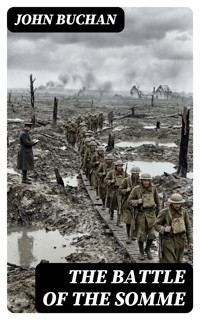
John Buchan's "The Battle of the Somme" is an incisive narrative that delves into the harrowing landscapes of one of World War I's most pivotal confrontations. Through a blend of vivid prose and meticulous research, Buchan captures both the strategic complexities and the human experiences embedded in the battle, illustrating the gruesome reality faced by soldiers on the front lines. Reflecting the early 20th-century literary style, his work intertwines historical facts with poignant personal accounts, elevating the text beyond mere documentation to a profound commentary on war, sacrifice, and the indomitable spirit of those involved. Born in 1875 in Perth, Scotland, Buchan's background as a soldier, journalist, and politician deeply influenced his perspective on the Great War. His experiences and insights lend an authenticity to his writing, as he grapples with the implications of war on national identity and personal valor. Known for his distinct ability to weave suspense and adventure, Buchan's literary trajectory uniquely positioned him to explore the intricacies of military history and the psychological depths of its participants. "The Battle of the Somme" is a vital read for anyone interested in understanding the profound consequences of World War I. Buchan's evocative storytelling not only informs the reader about historical events but also invites reflection on the broader themes of humanity and resilience in the face of adversity. This work stands as an essential contribution to both literature and historical scholarship, making it a recommended addition to the library of any discerning reader. In this enriched edition, we have carefully created added value for your reading experience: - A succinct Introduction situates the work's timeless appeal and themes. - The Synopsis outlines the central plot, highlighting key developments without spoiling critical twists. - A detailed Historical Context immerses you in the era's events and influences that shaped the writing. - A thorough Analysis dissects symbols, motifs, and character arcs to unearth underlying meanings. - Reflection questions prompt you to engage personally with the work's messages, connecting them to modern life. - Hand‐picked Memorable Quotes shine a spotlight on moments of literary brilliance. - Interactive footnotes clarify unusual references, historical allusions, and archaic phrases for an effortless, more informed read.
Das E-Book können Sie in Legimi-Apps oder einer beliebigen App lesen, die das folgende Format unterstützen:
Veröffentlichungsjahr: 2023
Ähnliche











THE BATTLE OF THE SOMME
Table of Contents
Introduction
At the heart of this book lies the question of how a modern state turns massed resources and fragile human resolve into a purpose on a battlefield that seems built to break both.
John Buchan’s The Battle of the Somme is a work of nonfiction military history that concentrates on the 1916 offensive on the Western Front, presented by an author writing in the midst of the First World War. Its setting is the trench-scarred region around the River Somme in northern France, and its publication belongs to the wartime era when contemporaries were still interpreting events as they unfolded. The book operates within the early twentieth-century context of British narrative history, aiming for clarity and accessibility while addressing a general readership.
Readers encounter a concise chronicle that explains the strategic background, sketches the battlefield’s character, and follows the opening movements of the campaign through a controlled, steady narrative. The voice is authoritative without being technical, the style brisk and lucid, and the tone sober, with a patriotic restraint typical of contemporary writing. Rather than minute tactical reconstruction, the emphasis is on intelligibility and momentum—how intentions, terrain, and method intersect. This creates a reading experience that feels immediate yet composed, offering orientation and perspective without overwhelming the reader with specialist detail.
Buchan’s approach privileges orientation over spectacle. He introduces the aims and constraints shaping commanders, foregrounds the slog of preparation, and marks the rhythm of artillery and infantry action as parts of a single design. The book balances panoramic description with pointed observations about endurance and adaptation, showing how logistics, weather, and the geometry of trenches affect what is possible. It invites readers to observe a campaign as a linked sequence of decisions and responses, rather than a single decisive moment, and it keeps attention on the relationship between material means and moral stamina without preempting the evolving fortunes of the fighting.
Several themes guide the account and continue to resonate. The work explores the collision between nineteenth-century expectations and twentieth-century industrial warfare, the tension between meticulous planning and battlefield friction, and the moral weight placed on individuals within vast organizations. It considers coalition warfare and national effort, tracing how collective purpose is sustained under pressure. It also reflects on the language used to make sense of violence, suggesting how narratives of duty, endurance, and sacrifice emerge alongside strategy and operations, and how those narratives shape understanding even as the facts on the ground remain stubbornly complex.
For contemporary readers, the book matters because it shows how history is written in real time, with all the urgency, clarity, and limitations that entails. It is a study in how democracies communicate purpose during crisis, how public understanding can be built from partial knowledge, and how the rhetoric of resolve interacts with the mechanics of attrition. Beyond its military subject, it prompts reflection on the responsibilities of narration: what is emphasized, what is left unsaid, and how frameworks of meaning form while outcomes remain uncertain.
Approached today, The Battle of the Somme offers both guidance and caution. Its lucid synthesis helps newcomers grasp why this campaign became emblematic, while its contemporaneous vantage encourages critical reading about perspective and emphasis. Engaging with it can deepen appreciation of the costs and claims of collective endeavor, and of the distance between planning and experience. Read as history and as historical artifact, the book opens a space to consider memory, accountability, and the perennial challenge of describing war without simplifying it—an undertaking that remains as necessary now as when the guns were still within earshot.
Synopsis
John Buchan’s The Battle of the Somme is a concise, contemporary account of the 1916 Allied offensive on the Western Front. Written during the war for a general readership, it situates the operation within the pressures of coalition strategy and the demands of a vast industrial conflict. Buchan sketches the origins of the campaign and the expectations that accompanied it, describing how planners balanced political imperatives with military realities. The work introduces the terrain, the opposing forces, and the logistical foundations of a modern offensive, preparing readers for a narrative that tracks the battle’s phases while considering discipline, leadership, and the strain placed upon citizen armies.
Buchan begins by tracing the strategic background that led the Allies to choose the Somme front. He emphasizes the need to relieve pressure elsewhere on the line and to exert sustained force against a fortified adversary. The book explains the expansion of the British field armies and the close cooperation with French forces, noting the scale of artillery and materiel assembled for the attack. He outlines German defenses in depth and the challenge they posed to infantry advances. Throughout, Buchan stresses preparation and supply, presenting the offensive as an experiment in coordination at a level unprecedented in European warfare.
Turning to the opening phase, Buchan describes the lengthy bombardment intended to cut wire, silence batteries, and shatter forward positions. He follows the initial assault as it unfolds unevenly across the front, recording heavy losses in certain sectors and more encouraging progress in others. The text highlights variations in terrain and preparation that affected outcomes, and the critical role of communication under fire. French formations operating alongside the British are shown undertaking effective, methodical attacks. Rather than focusing on isolated episodes, Buchan traces how initial results shaped the commanders’ judgment about how and where to continue pressing the offensive.
As the action settles into a series of methodical pushes, Buchan details the Allied learning curve. He outlines the refinement of artillery-infantry cooperation, the growing precision of counter-battery fire, and the adoption of tactics designed to secure limited objectives and consolidate them. Aviation’s reconnaissance value, the importance of engineers, and the strains of rotation and reinforcement appear as recurring themes. The narrative underscores the cumulative character of operations: localized gains, costly counterattacks, and the constant effort to knit together small advances into a firmer line. Through this, Buchan conveys how attrition became both a method and an outcome of the campaign.
Buchan marks the introduction of new instruments and procedures, including novel armored vehicles that attracted attention out of proportion to their early numbers and reliability. He treats them as one element among many in a complex system that still depended on infantry and artillery. The book describes the struggle for key ridges and strongpoints, where even minor successes required exacting preparation. Weather, terrain churned by shellfire, and the burden on supply columns are presented not as incidental details but as determinants of pace. The narrative remains focused on coordination across formations and the steady, deliberate pressure maintained against a resilient defense.
The German response occupies a central place in Buchan’s analysis. He outlines the defenders’ adaptation, from deepened positions to rapid counterattacks, and the constant movement of reserves. Allied persistence meets a shifting defensive scheme that seeks to trade ground for time while inflicting losses. Buchan depicts command decisions as calibrated to conditions: where to renew efforts, where to hold fast, and how to marshal firepower under deteriorating weather. As autumn advances, the practical limits of movement emerge alongside the cumulative impact of the offensive. The account closes this phase with attention to the line’s reconfiguration rather than a single decisive moment.
Buchan concludes by assessing the campaign’s meaning within the war’s broader arc. He presents the Somme as a crucible that accelerated the transformation of armies, methods, and expectations, while imposing a profound human cost. The book’s enduring value lies in its contemporaneity: it records how participants framed aims, measured progress, and understood sacrifice while outcomes were still unfolding. Without offering a dramatic resolution, it stresses durability, adaptation, and alliance cooperation. As such, The Battle of the Somme stands as an accessible synthesis that illuminates both the conduct of a major offensive and the temper of the society that waged it.
Historical Context
John Buchan’s The Battle of the Somme addresses the 1916 Allied offensive on the Western Front in northern France, centered on the River Somme in Picardy. The setting is the entrenched stalemate stretching from the North Sea to Switzerland, where the British Expeditionary Force (BEF) and French armies coordinated operations. Strategic decisions were led by General Sir Douglas Haig, Commander-in-Chief of the BEF, and General Joseph Joffre, French commander-in-chief, with General Sir Henry Rawlinson commanding the British Fourth Army on the main sector. Allied planning sought to relieve pressure on Verdun and to wear down German strength while, if possible, achieving a breakthrough.
Preparations reflected Britain’s rapid transformation into a mass army. Kitchener’s volunteer formations—often “Pals” battalions—stood beside Regulars and Territorials, while the 1916 Military Service Acts introduced conscription. The Ministry of Munitions, created in 1915 under David Lloyd George, expanded artillery and shell supply, enabling an unprecedented preliminary bombardment. Allied staffs refined the creeping barrage and mining operations along a roughly 25-mile front shared with the French south of the river. The Somme sector’s villages, ridges, and fortified lines—Hawthorn Ridge, Thiepval, Fricourt, and Mametz among them—formed a dense defensive belt the Allies aimed to rupture through methodical assault supported by massed guns.
Launched on 1 July 1916, the opening assault produced the heaviest one-day losses in British Army history, with about 57,000 casualties, including more than 19,000 killed. German deep dugouts, intact wire in many sectors, and concentrated machine-gun fire blunted attacks that advanced across open ground. French forces, attacking on the southern flank with more heavy guns per yard, made greater initial gains. Despite the shock of the first day, the BEF persisted with limited advances on a narrower front, learning to coordinate artillery, infantry waves, and consolidation of captured trenches under continuous counter-attack.
Through July to November 1916, the battle unfolded in phases—Bazentin Ridge and High Wood, the attrition around Delville Wood and Pozières, the struggles for Guillemont and Ginchy, and the September operations at Flers–Courcelette. On 15 September, the British introduced the Mark I tank, achieving tactical surprise at points though in small numbers and with mechanical limits. Autumn rains and churned ground hampered movement, but the Allies pressed toward the Ancre. By the time operations ended in mid-November, total casualties on all sides reached around a million, reflecting the battle’s industrial scale and the strain imposed on German reserves.
The Somme also marked a maturation of combined arms. The Royal Flying Corps undertook extensive aerial photography, artillery spotting, and contact patrols, enabling more precise fire planning and post-attack assessment. Observation balloons, flash spotting, and sound ranging improved counter-battery work against German guns. Air fighting intensified as German fighter formations contested the airspace, but the RFC maintained a level of reconnaissance that sustained the artillery-led method. Trench mortars, machine guns, and more flexible small-unit tactics were gradually emphasized. These adaptations, uneven in 1916, informed subsequent British doctrine and contributed to greater effectiveness in 1917 initiatives.
German defenses on the Somme featured multiple trench lines, concrete machine-gun positions, and deep shelters that survived much of the preliminary fire. Commanded initially by General Fritz von Below’s Second Army and, as the battle widened, by General Max von Gallwitz, German forces absorbed heavy casualties while trading ground for time. In August 1916, Paul von Hindenburg and Erich Ludendorff replaced Erich von Falkenhayn at the head of the German High Command. Over the winter, they organized the fortified Hindenburg Line and prepared an early 1917 withdrawal, a strategic consequence of attrition pressures sharpened by the Somme.
The battle unfolded amid tight control of information. The Defence of the Realm regulations governed censorship, and the War Propaganda Bureau at Wellington House coordinated messaging. Official communiqués and accredited correspondents shaped newspaper reportage, while the documentary film The Battle of the Somme (August 1916) reached mass audiences with unprecedented frontline images. John Buchan, already known for fiction and for the serial Nelson’s History of the War, wrote The Battle of the Somme drawing on official sources and public information. In 1917 he was appointed Director of the Department of Information, further situating his wartime writing within state communication structures.
Published close to events, Buchan’s narrative mirrors its moment’s priorities: explaining aims, honoring endurance, and recording incremental gains without revealing operational secrets. It highlights organization, logistics, air–artillery cooperation, and the contributions of volunteers and Dominion units, echoing contemporary emphasis on imperial unity. By presenting the Somme as a test of attrition undertaken to relieve Verdun and wear down German power, the book aligns with the official understanding of 1916 strategy. In doing so, it offers an immediate history that also serves as public reassurance, illustrating how wartime writing framed sacrifice while documenting methods that would shape later campaigns.