Erhalten Sie Zugang zu diesem und mehr als 300000 Büchern ab EUR 5,99 monatlich.
- Herausgeber: Musaicum Books
- Kategorie: Geisteswissenschaft
- Sprache: Englisch
Woodrow Wilson's 'The Congressional Government' provides a detailed analysis of the US political system, critiquing the inefficiencies and complexities of the American government. Wilson's writing style is scholarly and thought-provoking, delving into the interplay between the executive and legislative branches. This book sheds light on the challenges faced by the US government in achieving effective governance and offers insightful commentary on the need for reform. 'The Congressional Government' is a seminal work in political science, influencing debates on government structure and functionality. Wilson's critique of the US political system is presented with clarity and precision, making it essential reading for anyone interested in American politics. Woodrow Wilson, a former President of the United States and prominent political theorist, draws on his firsthand experience in government to provide a comprehensive analysis of the challenges facing the US Congress. Wilson's expertise and deep understanding of American politics give 'The Congressional Government' a unique perspective that sets it apart from other political commentaries. In this enriched edition, we have carefully created added value for your reading experience: - A succinct Introduction situates the work's timeless appeal and themes. - The Synopsis outlines the central plot, highlighting key developments without spoiling critical twists. - A detailed Historical Context immerses you in the era's events and influences that shaped the writing. - An Author Biography reveals milestones in the author's life, illuminating the personal insights behind the text. - A thorough Analysis dissects symbols, motifs, and character arcs to unearth underlying meanings. - Reflection questions prompt you to engage personally with the work's messages, connecting them to modern life. - Hand‐picked Memorable Quotes shine a spotlight on moments of literary brilliance. - Interactive footnotes clarify unusual references, historical allusions, and archaic phrases for an effortless, more informed read.
Sie lesen das E-Book in den Legimi-Apps auf:
Seitenzahl: 434
Veröffentlichungsjahr: 2018
Das E-Book (TTS) können Sie hören im Abo „Legimi Premium” in Legimi-Apps auf:
Ähnliche


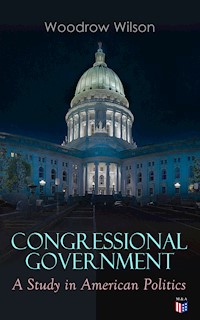




The Congressional Government
Published by
Books
Table of Contents
Introduction
This book peers into the crowded engine room of American democracy, where power is parceled out in pieces and yet expected to move as one. From that image of divided energy, Woodrow Wilson begins a measured exploration of how the United States governs itself in practice, not merely in constitutional theory. He invites readers to watch the daily work of Congress, to notice the habits and incentives that accumulate into national policy, and to consider how responsibility is claimed or obscured along the way. The result is a study at once institutional and human, precise in focus but sweeping in implication.
Woodrow Wilson’s The Congressional Government, first published in 1885, is a landmark analysis of American political institutions by a young scholar who would later become the twenty-eighth president of the United States. Composed in the late nineteenth century, the book examines how Congress organizes and exercises authority, especially through its committees and party arrangements. Its central premise is straightforward yet provocative: the lived constitution of American governance can diverge from its written plan, and that divergence carries profound consequences for accountability and effectiveness. Without dramatization, Wilson describes how procedures shape policy, inviting readers to judge institutional design by its practical outcomes.
Its classic status rests partly on craft. Wilson writes with clarity and compression, combining constitutional interpretation, historical perspective, and shrewd observation of legislative routines. He renders the abstractions of separation of powers into concrete scenes—hearings, reports, caucuses—so that structure becomes visible through behavior. The prose is exact without being dry, serious without being heavy. He balances diagnosis with restraint, avoiding polemic while still framing issues that demand attention. Readers encounter analysis that is rigorous yet accessible, a rare balance that helps explain why the book has endured in classrooms, public debates, and scholarly conversations about how American institutions actually work.
Historical context heightens the book’s resonance. The 1880s were years of rapid industrial expansion, party organization, and intricate legislative bargaining. National politics relied heavily on congressional committees to process complex issues and on party leadership to coordinate them. In that setting, Wilson set out to map the power centers inside Congress and to show how those centers mediated between public will and enacted law. He observed a government that was formally divided but practically concentrated in certain rooms, calendars, and rules. The portrait is specific to its era yet framed in terms that travel well across time.
The book’s central inquiry is institutional and procedural. Wilson tracks how committees gather information, shape bills, and channel debate; how party structures coordinate or frustrate action; and how oversight and publicity operate in a system that disperses responsibility. He asks what kinds of leadership a separated system permits and what kinds it resists. Rather than simply cataloging rules, he shows how incentives and routines produce characteristic outcomes. Readers are invited to consider whether a government organized in this way can be fully accountable, and what reforms or habits might improve the fit between authority and responsibility.
The enduring appeal of The Congressional Government also lies in its themes. It probes accountability in a system designed for restraint, transparency in institutions built on negotiation, and energy in government without abandoning deliberation. Wilson’s investigation of the gap between constitutional text and governing practice continues to animate discussions in political science and law. Scholars have returned to his arguments when analyzing parties, committees, and executive–legislative relations. The book’s questions—about who decides, who is answerable, and how democratic choice is translated into policy—retain their clarity and force.
Wilson’s literary method deepens its impact. He writes not as a partisan advocate but as a patient reader of institutions, translating procedural detail into insight without sacrificing nuance. His analogies illuminate without oversimplifying; his judgment is firm but never glib. That measured tone encourages readers to think, not merely to agree. The work’s careful structure—moving from institutional anatomy to functional implications—models an approach to political analysis that later writers have emulated: start from the facts of process, then test constitutional ideals against observed outcomes.
Because of that method, the book has influenced generations of writers who study American political development, legislative behavior, and public administration. It became a touchstone for debates about party responsibility, committee power, and the role of leadership in a separated system, especially as reformers assessed what kinds of institutional change might yield clearer lines of accountability. Authors across disciplines have engaged its arguments, building upon or contesting them, and in doing so kept its questions active. The book’s longevity within scholarly and civic discussions testifies to the durability of its insights and the clarity of its frame.
Its status as a classic is also literary. Wilson’s sentences carry an exactness that invites re-reading; his chapters progress with the calm logic of a legal brief informed by lived observation. He avoids the extremes of satire and romance that once framed writing on politics, opting instead for disciplined exposition that still leaves room for irony and moral concern. As a result, the book profits both specialists and general readers: it offers tools to the analyst and perspective to the citizen. This dual usefulness—a readable style serving a rigorous argument—helps explain its continued circulation.
Reading The Congressional Government today means entering a study that is descriptive rather than sensational. Wilson does not depend on scandal or personalities to make his case. He examines patterns, incentives, and constraints, showing how these elements generate recurring outcomes. The reader comes away with a map: not a complete atlas, but a precise chart of features that matter for navigation. That map invites comparison with one’s own observations of government, encouraging inquiry rather than prescribing a simple conclusion. The approach dignifies the reader’s judgment and keeps the book’s analysis alive beyond its original moment.
At the heart of the narrative are enduring democratic tensions: efficiency versus deliberation, leadership versus accountability, expertise versus publicity. Wilson’s attention to these tensions gives the study its philosophical depth. He suggests that institutions inevitably trade among goods and that wise design recognizes those trades. By keeping the focus on how choices are structured and responsibility is distributed, the book equips readers to ask better questions of any reform proposal or political claim. Its lessons are not bound to a single period; they are principles for evaluating how power is organized in a republic.
The relevance of The Congressional Government has only grown as legislative workloads, media ecosystems, and party dynamics have evolved. Contemporary readers will find in its pages a framework for thinking about checks and balances, the quality of oversight, and the conditions under which leadership can be both energetic and answerable. The book endures because it marries careful observation to enduring concerns about liberty, competence, and trust. By showing how institutions shape behavior—and how behavior reshapes institutions—Wilson offers a guide that is as useful for civic reflection now as it was at its publication, ensuring the work’s lasting appeal.
Synopsis
Woodrow Wilson’s The Congressional Government, first published in 1885, is a sustained analysis of how the United States actually governs itself in practice rather than as the Constitution formally describes. Writing as a political scientist, Wilson surveys the late nineteenth-century national institutions and observes the routines by which laws are framed and authority is exercised. He frames the study as an inquiry into operating habits, incentives, and arrangements that distribute power. The book’s organizing question is how responsibility is located and who, in fact, sets public policy. Across its chapters, it proceeds institution by institution, showing how congressional procedures and habits define national governance.
Wilson opens by contending that Congress, rather than the presidency, centers national policy, and that the pivotal mechanisms are committees that draft, screen, and steer proposals. This “government by committee,” as he describes it, fragments policy across many small jurisdictions, making it difficult for citizens to trace decisions to accountable hands. Floor debate often ratifies committee work more than it shapes it. The result is a system rich in expertise and procedural control but thin in unified leadership. Wilson’s early chapters set out this architecture and its implications for transparency, continuity, and the distribution of influence among members and organized interests.
Turning to the House of Representatives, Wilson details a body whose size and workload necessitate tight procedural management. Bills are channeled to specialized committees, and the steering of business depends on internal rules and leadership recognition. He notes the rhythms of calendars, the crowded docket, and the reliance on reports that compress complex choices into manageable votes. The Speaker and party managers influence the flow, yet deliberation often yields to expedient processing. Wilson underscores the tension between the representative ideal of open debate and the practical need to expedite legislation in a large assembly, a tension resolved largely through committee reliance.
In the Senate, Wilson finds a chamber with different incentives and styles. Its smaller membership and longer terms encourage extended discussion and personal initiative, while standing committees still command substantial authority over measure drafting and scheduling. The Senate’s constitutional functions regarding appointments and treaties add dimensions of negotiation distinct from the House. Wilson remarks on the body’s capacity both for careful scrutiny and for obstructing action, depending on circumstances. Its traditions and autonomy complicate coordination with the House, creating a bicameral negotiation that often culminates in conference committees and informal understandings rather than comprehensive, publicly aired settlements.
Wilson’s analysis of the committee system is the book’s core. He examines how jurisdictions are carved, how chairs dominate agendas, and how reports become privileged vehicles for policy. Because committees meet largely outside public view, much legislative craftsmanship occurs before general debate. Conference committees reconcile differences between chambers, frequently shaping final language beyond earlier floor discussions. This structure generates specialized knowledge and continuity within policy areas, but it disperses responsibility and obscures lines of authorship. Wilson stresses how committee incentives—control of time, hearings, and drafting—produce a polity governed by fragments, each with its own practices and alliances.
The study then concentrates on finance, appropriations, and administration of expenditures, areas where fragmentation becomes particularly consequential. Wilson describes how estimates arrive from departments, how appropriations are divided among multiple bills, and how authorizing and spending decisions can diverge. Without a single, coherent budget authority, overall fiscal direction is difficult to discern, and oversight is episodic. He notes bargaining across measures and the tendency for local claims to shape national outlays. The fiscal process exemplifies his larger theme: the absence of centralized responsibility makes policy cumulative and piecemeal, even as technical demands require competence that committees partially supply.
Wilson situates these institutional features within party organization in Congress. Party caucuses and majorities distribute committee places and leadership, yet discipline varies, and local constituencies heavily influence member behavior. Patronage and particularistic aims complicate the translation of national party platforms into legislative programs. As a result, parties provide the skeleton of organization without consistently furnishing a coherent governing will. Wilson’s inquiry highlights the gap between electoral mandates and legislative output, not as a matter of individual intent but as a function of arrangements that diffuse control and create multiple veto points across the committee network.
Addressing the executive, Wilson underscores that department heads wield information and administrative expertise but lack direct responsibility to the legislative floor. Oversight comes through hearings and reports rather than continuous debate with ministers. To clarify the contrast, he considers parliamentary systems, where a cabinet leads the legislative agenda and stands in visible responsibility to the assembly. Wilson uses this comparison to probe trade-offs: integrated leadership and publicity may enhance accountability, yet they alter balances that Americans value. He does not reduce the choice to a single prescription; instead he assesses how institutional design affects clarity, efficiency, and public control.
The book closes by urging greater publicity, concentration of responsibility, and steadier coordination between policy formation and administration, aims Wilson suggests can arise through changes in practice as much as through formal amendment. His study’s enduring significance lies in revealing how procedures become power and how committee-centered processes shape what citizens ultimately receive as law. By tracing decisions to their institutional sources, he invites readers to judge American governance not against abstract diagrams but by its capacity to make responsibility visible. The work remains a foundational examination of congressional government and the perennial quest for democratic accountability.
Historical Context
Woodrow Wilson’s Congressional Government appeared in 1885, at the high tide of the Gilded Age in the United States. The setting was Washington, D.C., but the institutions under scrutiny stretched across the federal system: a bicameral Congress, an executive branch with limited initiative, and a judiciary exercising review within post–Civil War constitutional settlements. Power in national politics was fragmented among parties, committees, departments, and regional blocs. The Constitution’s formal separation of powers operated amid informal practices—caucuses, patronage, and seniority—that shaped outcomes. Wilson wrote as these practices, rather than constitutional text alone, determined how policy was made, allowing him to depict American government as it actually worked.
The decades after the Civil War and Reconstruction (roughly 1865–1877) left a political order in which Congress asserted primacy. The Compromise of 1877 ended federal occupation of the South and signaled a retreat from Reconstruction’s broad national aims. Sectional wounds persisted, and partisan alignments hardened along regional lines. In this environment, legislative bargaining and committee control of policy substituted for grand national programs. Wilson’s study reflects that settlement: he examined how congressional leaders and committees—not presidents—defined the agenda, supervised administration, and translated regional interests into statute, often without clear public visibility or unified responsibility.
Party organization in the late nineteenth century relied heavily on patronage and machine politics. The assassination of President James A. Garfield in 1881 by a disgruntled office seeker jolted public opinion and accelerated civil service reform. The Pendleton Civil Service Reform Act of 1883 began merit-based hiring and curbed some spoils practices. Yet party networks remained central to distributing offices and mobilizing voters. Wilson’s analysis echoes reformers’ concerns: he argued that unchecked patronage and caucus arrangements obscured accountability, allowing decisions to be made by insiders shielded from scrutiny, even as parties loudly contested elections on slogans more than coherent programs.
Within Congress, the standing committee system dominated. Committees controlled hearings, drafted bills, and shaped floor debate through rules and reports. Seniority often determined leadership, and closed-door deliberations limited transparency. Conference committees resolved differences between House and Senate versions, frequently producing complex compromises with minimal public explanation. Wilson dissected this “government by committee” as the true engine of national policy, contending that fragmentation diffused responsibility. He suggested that citizens could not easily identify who was answerable for outcomes when authority lay scattered among chairs and subcommittees rather than in ministers or a cabinet accountable to a unified majority.
The Senate of the era was often dubbed a “millionaires’ club,” reflecting the influence of corporate wealth and the fact that senators were chosen by state legislatures, not popular vote, until the Seventeenth Amendment (ratified 1913). Legislative deadlocks over Senate seats and allegations of bribery periodically drew attention in the 1870s–1890s. Business interests, especially railroads and finance, were deeply enmeshed in state politics that selected senators. Wilson’s critique noted the Senate’s independence and secrecy relative to the House, its long terms, and committee power, all of which, in his view, complicated democratic control and blurred lines of responsibility to the electorate.
The presidency in the post-Reconstruction period was comparatively weak as a policy leader. Andrew Johnson’s clashes with Congress, scandals in Ulysses S. Grant’s administration, and the limited programmatic ambitions of Rutherford B. Hayes and Chester A. Arthur reinforced congressional dominance. Grover Cleveland’s election in 1884 brought a reform-minded Democrat to the White House for the first time since before the war, with tariff reform and civil service on the agenda. Wilson wrote at this hinge moment, questioning whether a president, lacking cabinet responsibility to the legislature, could direct policy effectively against entrenched committees and party brokers.
Comparative constitutional analysis shaped Wilson’s method. He drew on British experience, particularly arguments popularized by Walter Bagehot’s The English Constitution (published 1867), which praised cabinet government’s clarity of responsibility. By contrasting parliamentary practice—where executive and legislative leadership were fused and regularly answerable—to America’s separation of powers, Wilson highlighted the costs of diffusion. He stopped short of advocating wholesale constitutional transplant, but he used the British model to illuminate how committee government in the United States concealed power centers and frustrated the public’s ability to reward or punish governing majorities.
The book emerged as political science professionalized in the United States. Johns Hopkins University, founded in 1876, imported German seminar methods and historical-institutional analysis. Wilson studied there in the early 1880s and received his doctorate in 1886, situating him within a new cohort that approached politics as a field for empirical, comparative study. Under influences such as historian Herbert Baxter Adams, scholars emphasized archival work, administrative history, and the evolution of institutions. Congressional Government embodied this approach, privileging process and structure over rhetoric, and helping to define American political science’s early agenda.
Administrative reform was a central contemporary movement. The creation of the Department of Justice in 1870, expansion of the Post Office, and growth of the Interior’s responsibilities signaled a more complex federal apparatus. The Pendleton Act established a Civil Service Commission and protected classified positions from partisan pressures. Wilson’s analysis joined this administrative turn: he argued that responsible government required mechanisms linking legislative oversight, executive administration, and public judgment. He suggested that invisible committee control over departments invited drift and inconsistency, while a clearer chain of responsibility—ideally through party leadership—could discipline the civil service without reverting to spoils.
Industrialization transformed the economy between the 1870s and 1890s. National railroad networks, large corporations in oil, steel, and meatpacking, and integrated capital markets created regulatory challenges beyond state capacity. Judicial decisions such as Munn v. Illinois (1877) upheld certain state regulations, while Wabash, St. Louis & Pacific Railway Co. v. Illinois (1886) limited state power over interstate commerce, paving the way for federal action. The Interstate Commerce Act of 1887 established the Interstate Commerce Commission. Wilson’s book, appearing just before these developments, diagnosed why fragmented committee control struggled to produce coherent national responses to such sprawling economic issues.
Technological and communications changes reshaped political life. The telegraph facilitated rapid coordination of party operations and news dissemination; the telephone, patented in 1876, spread in urban centers during the 1880s; and urban newspapers and magazines expanded circulation. Public debate intensified, but congressional work remained largely in committee rooms and party caucuses, with limited reporting of the full process. Wilson emphasized the gap between a more informed mass public and opaque legislative machinery. He implied that modern conditions required publicity, leadership, and programmatic clarity that committee-dominated legislating rarely provided in a timely or intelligible manner.
Urbanization and immigration were defining social forces. Cities swelled with domestic migrants and new arrivals from Europe, while the Chinese Exclusion Act of 1882 marked a restrictive turn in federal immigration policy. Labor organization surged: the Knights of Labor grew rapidly in the mid-1880s, and strikes highlighted tensions over wages, hours, and safety. These pressures demanded policy attention in areas such as labor standards, municipal services, and infrastructure. Wilson’s critique of congressional government connected to these realities: without visible leadership or integrated policy platforms, he argued, Congress met complex social problems with piecemeal, negotiated outputs lacking a sense of collective responsibility.
The constitutional landscape of the 1880s also framed Wilson’s concerns. The Supreme Court’s Civil Rights Cases (1883) narrowed federal protections against private discrimination, signaling judicial limits on national remedies. At the same time, doctrines about commerce and due process were being tested as regulation grew. Wilson did not write a treatise on constitutional law; rather, he showed how practical arrangements within Congress conditioned whether legislative authority—however construed by the courts—could be exercised consistently. His focus on procedure and responsibility complemented, rather than duplicated, contemporaneous judicial debates over the scope of national power.
State and local party machines, epitomized by Tammany Hall in New York City, connected neighborhood patronage to national coalitions. Caucuses and conventions translated grassroots mobilization into committee assignments and floor strategies. Because senators were selected by state legislatures and representatives depended on party organizations for renomination, federal legislators were embedded in local networks. Wilson traced how this web fostered bargaining that rewarded insiders and complicated accountability. He emphasized that when committees answered primarily to party organizations rather than to a national program presented to voters, electoral judgment could not easily compel policy coherence.
Reformist currents contested this order. “Mugwumps,” often middle-class professionals and journalists, bolted the Republican Party in 1884 over corruption issues and supported Democrat Grover Cleveland. Civic groups pushed for merit-based administration, tariff reform, and fiscal prudence. Comparative observers, including James Bryce in The American Commonwealth (published 1888), soon analyzed American institutions with a similar empirical spirit. Wilson’s book fit this reform milieu by offering diagnosis rather than denunciation: he cataloged the mechanisms that dispersed responsibility and invited corruption, hoping that clearer party leadership and public oversight could discipline congressional practice without dismantling constitutional foundations.
Wilson’s personal trajectory sharpened his perspective. Born in 1856 in Virginia and raised in the South during and after the Civil War, he studied law and then turned to scholarship. By the time Congressional Government appeared, he had begun an academic career and soon received a Ph.D. from Johns Hopkins. Later writings, such as Constitutional Government in the United States (1908), would place greater emphasis on presidential leadership, reflecting evolving views. Yet the through line remained: modern conditions, he believed, demanded visible, responsible leadership and institutions that allowed voters to identify who governed and to register approval or blame.
Everyday life in the 1880s underscored the stakes of institutional design. Rail travel compressed distances, mail-order catalogs broadened consumer markets, and electric lighting spread in cities after the late 1870s. Inequalities widened alongside prosperity, and regional differences persisted in law, culture, and race relations. While Wilson’s 1885 study did not center on social policy, it implicitly argued that a nation undergoing rapid economic and technological change needed governmental forms capable of coherent action. Committee government, as he described it, was better at incremental bargaining than at articulating national programs responsive to a modern industrial society’s needs and risks. The book thus serves as both a critique and a mirror of its era.
Author Biography
Thomas Woodrow Wilson (1856–1924) was an American scholar, reform-minded executive, and the 28th president of the United States. He rose to prominence during the Progressive Era, first as a political scientist and university leader, then as governor of New Jersey and president from 1913 to 1921. His administrations reshaped U.S. financial regulation and antitrust policy, steered the nation through the First World War, and advanced a vision of international order centered on collective security. Wilson’s reputation is complex: celebrated for institutional innovation and advocacy of a rules-based world, yet widely criticized for racially discriminatory policies and harsh wartime measures against dissent at home.
Wilson’s education shaped both his scholarship and statecraft. He studied at the College of New Jersey (now Princeton University), graduating in 1879, attended the University of Virginia School of Law, and practiced briefly before pursuing graduate study. He earned a Ph.D. from Johns Hopkins University, the only U.S. president to do so, where he studied history and political science under scholars including Herbert Baxter Adams. Influences included British constitutional analysis—especially Walter Bagehot’s work—and German historicist methods. Early teaching appointments at Bryn Mawr College and Wesleyan University preceded his return to Princeton, where he became a prominent lecturer and author on government and constitutional development.
Wilson’s writings helped define early American political science. Congressional Government (1885) criticized the committee-dominated U.S. Congress and argued for clearer, accountable leadership. The State (1889) surveyed comparative constitutional systems and political theory, while his essay “The Study of Administration” (1887) called for a professional, merit-based public administration distinct from partisan patronage. Later works included A History of the American People (1902) and Constitutional Government in the United States (1908). Collectively, these books and essays argued for energetic executive leadership within constitutional limits and placed Wilson among the era’s leading interpreters of American governance and institutional reform.
As president of Princeton University from 1902 to 1910, Wilson pursued curricular modernization, emphasizing preceptorial instruction and broad undergraduate reform, though his efforts sparked notable campus conflicts. His national political career accelerated when he was elected governor of New Jersey in 1910. In office, he supported progressive measures such as primary election laws, utility regulation, and labor protections, gaining a reputation as a reformer independent of entrenched party machines. These achievements, coupled with his scholarly prominence, propelled him to the Democratic presidential nomination and a successful national campaign in 1912.
Wilson’s domestic agenda, known as the New Freedom, sought to curb concentrated economic power while preserving competition. Major enactments included the Federal Reserve Act (1913), which created a central banking system; the Clayton Antitrust Act (1914); and the establishment of the Federal Trade Commission (1914). Tariff reform and a modern income tax followed the ratification of the Sixteenth Amendment. His administration, however, instituted segregationist practices in federal offices and tolerated discriminatory policies that harmed Black Americans. During World War I, the Espionage Act (1917) and the Sedition Act (1918) curtailed civil liberties, drawing sustained criticism from contemporaries and later historians.
Wilson initially maintained U.S. neutrality in the European war, then led the nation into World War I in 1917 after unrestricted submarine warfare and other provocations. In January 1918 he announced the Fourteen Points, outlining principles for a postwar order, including self-determination, open diplomacy, and a League of Nations. He played a central role at the Paris Peace Conference and helped shape the Treaty of Versailles, but the U.S. Senate refused to ratify it. Awarded the Nobel Peace Prize in 1919 for his peacemaking efforts, Wilson suffered a severe stroke later that year, which significantly limited his capacity during the final phase of his presidency.
In retirement, Wilson lived quietly in Washington, D.C., writing occasional reflections and remaining committed to the ideals of collective security despite political defeat. He died in 1924. His legacy endures in multiple, often competing, strands: “Wilsonianism” influenced later international institutions and helped inspire the vision behind the United Nations, while his academic works remain foundational in public administration and constitutional analysis. At the same time, his record on race and civil liberties has prompted reevaluation, including institutional name changes in the 21st century, ensuring that debates over his achievements and failures remain active and instructive.
The Congressional Government
Preface
The object of these essays is not to exhaust criticism of the government of the United States, but only to point out the most characteristic practical features of the federal system. Taking Congress as the central and predominant power of the system, their object is to illustrate everything Congressional. Everybody has seen, and critics without number have said, that our form of national government is singular, possessing a character altogether its own; but there is abundant evidence that very few have seen just wherein it differs most essentially from the other governments of the world. There have been and are other federal systems quite similar, and scarcely any legislative or administrative principle of our Constitution was young even when that Constitution was framed. It is our legislative and administrative machinery which makes our government essentially different from all other great governmental systems. The most striking contrast in modern politics is not between presidential and monarchical governments, but between Congressional and Parliamentary governments. Congressional government is Committee government; Parliamentary government is government by a responsible Cabinet Ministry. These are the two principal types which present themselves for the instruction of the modern student of the practical in politics: administration by semi-independent executive agents who obey the dictation of a legislature to which they are not responsible, and administration by executive agents who are the accredited leaders and accountable servants of a legislature virtually supreme in all things. My chief aim in these essays has been, therefore, an adequate illustrative contrast of these two types of government, with a view to making as plain as possible the actual conditions of federal administration. In short, I offer, not a commentary, but an outspoken presentation of such cardinal facts as may be sources of practical suggestion.
WOODROW WILSON
JOHNS HOPKINS UNIVERSITY, October 7, 1884.
I. Introductory.
The laws reach but a very little way[1q]. Constitute government how you please, infinitely the greater part of it must depend upon the exercise of powers, which are left at large to the prudence and uprightness of ministers of state. Even all the use and potency of the laws depends upon them. Without them your commonwealth is no better than a scheme upon paper; and not a living, active, effective organization.—BURKE.
The great fault of political writers is their too close adherence to the forms of the system of state which they happen to be expounding or examining. They stop short at the anatomy of institutions, and do not penetrate to the secret of their functions.—JOHN MORLEY.
IT would seem as if a very wayward fortune had presided over the history of the Constitution of the United States, inasmuch as that great federal charter has been alternately violated by its friends and defended by its enemies. It came hard by its establishment in the first place, prevailing with difficulty over the strenuous forces of dissent which were banded against it. While its adoption was under discussion the voices of criticism were many and authoritative, the voices of opposition loud in tone and ominous in volume, and the Federalists[1] finally triumphed only by dint of hard battle against foes, formidable both in numbers and in skill. But the victory was complete,—astonishingly complete. Once established, the new government had only the zeal of its friends to fear. Indeed, after its organization very little more is heard of the party of opposition; they disappear so entirely from politics that one is inclined to think, in looking back at the party history of that time, that they must have been not only conquered but converted as well. There was well-nigh universal acquiescence in the new order of things. Not everybody, indeed, professed himself a Federalist, but everybody conformed to federalist practice. There were jealousies and bickerings, of course, in the new Congress of the Union, but no party lines, and the differences which caused the constant brewing and breaking of storms in Washington's first cabinet were of personal rather than of political import. Hamilton[2] and Jefferson[3] did not draw apart because the one had been an ardent and the other only a lukewarm friend of the Constitution, so much as because they were so different in natural bent and temper that they would have been like to disagree and come to drawn points wherever or however brought into contact. The one had inherited warm blood and a bold sagacity, while in the other a negative philosophy ran suitably through cool veins. They had not been meant for yoke-fellows.
There was less antagonism in Congress, however, than in the cabinet; and in none of the controversies that did arise was there shown any serious disposition to quarrel with the Constitution itself; the contention was as to the obedience to be rendered to its provisions. No one threatened to withhold his allegiance, though there soon began to be some exhibition of a disposition to confine obedience to the letter of the new commandments, and to discountenance all attempts to do what was not plainly written in the tables of the law. It was recognized as no longer fashionable to say aught against the principles of the Constitution; but all men could not be of one mind, and political parties began to take form in antagonistic schools of constitutional construction. There straightway arose two rival sects of political Pharisees, each professing a more perfect conformity and affecting greater "ceremonial cleanliness" than the other. The very men who had resisted with might and main the adoption of the Constitution became, under the new division of parties, its champions, as sticklers for a strict, a rigid, and literal construction.
They were consistent enough in this, because it was quite natural that their one-time fear of a strong central government should pass into a dread of the still further expansion of the power of that government, by a too loose construction of its charter; but what I would emphasize here is not the motives or the policy of the conduct of parties in our early national politics, but the fact that opposition to the Constitution as a constitution, and even hostile criticism of its provisions, ceased almost immediately upon its adoption; and not only ceased, but gave place to an undiscriminating and almost blind worship of its principles, and of that delicate dual system of sovereignty, and that complicated scheme of double administration which it established. Admiration of that one-time so much traversed body of law became suddenly all the vogue, and criticism was estopped. From the first, even down to the time immediately preceding the war, the general scheme of the Constitution went unchallenged; nullification itself did not always wear its true garb of independent state sovereignty, but often masqueraded as a constitutional right; and the most violent policies took care to make show of at least formal deference to the worshipful fundamental law. The divine right of kings never ran a more prosperous course than did this unquestioned prerogative of the Constitution to receive universal homage. The conviction that our institutions were the best in the world, nay more, the model to which all civilized states must sooner or later conform, could not be laughed out of us by foreign critics, nor shaken out of us by the roughest jars of the system.
Now there is, of course, nothing in all this that is inexplicable, or even remarkable; any one can see the reasons for it and the benefits of it without going far out of his way; but the point which it is interesting to note is that we of the present generation are in the first season of free, outspoken, unrestrained constitutional criticism. We are the first Americans to hear our own countrymen ask whether the Constitution is still adapted to serve the purposes for which it was intended; the first to entertain any serious doubts about the superiority of our own institutions as compared with the systems of Europe; the first to think of remodeling the administrative machinery of the federal government, and of forcing new forms of responsibility upon Congress.
The evident explanation of this change of attitude towards the Constitution is that we have been made conscious by the rude shock of the war and by subsequent developments of policy, that there has been a vast alteration in the conditions of government; that the checks and balances which once obtained are no longer effective; and that we are really living under a constitution essentially different from that which we have been so long worshiping as our own peculiar and incomparable possession. In short, this model government is no longer conformable with its own original pattern. While we have been shielding it from criticism it has slipped away from us. The noble charter of fundamental law given us by the Convention of 1787 is still our Constitution; but it is now our form of government rather in name than in reality, the form of the Constitution being one of nicely adjusted, ideal balances, whilst the actual form of our present government is simply a scheme of congressional supremacy. National legislation, of course, takes force now as at first from the authority of the Constitution; but it would be easy to reckon by the score acts of Congress which can by no means be squared with that great instrument's evident theory. We continue to think, indeed, according to long-accepted constitutional formulae, and it is still politically unorthodox to depart from old-time phraseology in grave discussions of affairs; but it is plain to those who look about them that most of the commonly received opinions concerning federal constitutional balances and administrative arrangements are many years behind the actual practices of the government at Washington, and that we are farther than most of us realize from the times and the policy of the framers of the Constitution. It is a commonplace observation of historians that, in the development of constitutions, names are much more persistent than the functions upon which they were originally bestowed; that institutions constantly undergo essential alterations of character, whilst retaining the names conferred upon them in their first estate; and the history of our own Constitution is but another illustration of this universal principle of institutional change. There has been a constant growth of legislative and administrative practice, and a steady accretion of precedent in the management of federal affairs, which have broadened the sphere and altered the functions of the government without perceptibly affecting the vocabulary of our constitutional language. Ours is, scarcely less than the British, a living and fecund system. It does not, indeed, find its rootage so widely in the hidden soil of unwritten law; its tap-root at least is the Constitution; but the Constitution is now, like Magna Carta and the Bill of Rights, only the sap-centre of a system of government vastly larger than the stock from which it has branched,—a system some of whose forms have only very indistinct and rudimental beginnings in the simple substance of the Constitution, and which exercises many functions apparently quite foreign to the primitive properties contained in the fundamental law.
The Constitution itself is not a complete system; it takes none but the first steps in organization. It does little more than lay a foundation of principles. It provides with all possible brevity for the establishment of a government having, in several distinct branches, executive, legislative, and judicial powers. It vests executive power in a single chief magistrate, for whose election and inauguration it makes carefully definite provision, and whose privileges and prerogatives it defines with succinct clearness; it grants specifically enumerated powers of legislation to a representative Congress, outlining the organization of the two houses of that body and definitely providing for the election of its members, whose number it regulates and the conditions of whose choice it names; and it establishes a Supreme Court with ample authority of constitutional interpretation, prescribing the manner in which its judges shall be appointed and the conditions of their official tenure. Here the Constitution's work of organization ends, and the fact that it attempts nothing more is its chief strength. For it to go beyond elementary provisions would be to lose elasticity and adaptability. The growth of the nation and the consequent development of the governmental system would snap asunder a constitution which could not adapt itself to the new conditions of an advancing society. If it could not stretch itself to the measure of the times, it must be thrown off and left behind, as a by-gone device; and there can, therefore, be no question that our Constitution has proved lasting because of its simplicity. It is a corner-stone, not a complete building; or, rather, to return to the old figure, it is a root, not a perfect vine.
The chief fact, therefore, of our national history is that from this vigorous tap-root has grown a vast constitutional system,—a system branching and expanding in statutes and judicial decisions, as well as in unwritten precedent; and one of the most striking facts, as it seems to me, in the history of our politics is, that that system has never received complete and competent critical treatment at the hands of any, even the most acute, of our constitutional writers. They view it, as it were, from behind. Their thoughts are dominated, it would seem, by those incomparable papers of the "Federalist," which, though they were written to influence only the voters of 1788, still, with a strange, persistent longevity of power, shape the constitutional criticism of the present day, obscuring much of that development of constitutional practice which has since taken place. The Constitution in operation is manifestly a very different thing from the Constitution of the books[2q]. "An observer who looks at the living reality will wonder at the contrast to the paper description. He will see in the life much which is not in the books; and he will not find in the rough practice many refinements of the literary theory."1 It is, therefore, the difficult task of one who would now write at once practically and critically of our national government to escape from theories and attach himself to facts, not allowing himself to be confused by a knowledge of what that government was intended to be, or led away into conjectures as to what it may one day become, but striving to catch its present phases and to photograph the delicate organism in all its characteristic parts exactly as it is to-day; an undertaking all the more arduous and doubtful of issue because it has to be entered upon without guidance from writers of acknowledged authority.
The leading inquiry in the examination of any system of government must, of course, concern primarily the real depositaries and the essential machinery of power. There is always a centre of power: where in this system is that centre? in whose hands is self-sufficient authority lodged, and through what agencies does that authority speak and act? The answers one gets to these and kindred questions from authoritative manuals of constitutional exposition are not satisfactory, chiefly because they are contradicted by self-evident facts. It is said that there is no single or central force in our federal scheme; and so there is not in the federal scheme, but only a balance of powers and a nice adjustment of interactive checks, as all the books say. How is it, however, in the practical conduct of the federal government? In that, unquestionably, the predominant and controlling force, the centre and source of all motive and of all regulative power, is Congress[3q]. All niceties of constitutional restriction and even many broad principles of constitutional limitation have been overridden, and a thoroughly organized system of congressional control set up which gives a very rude negative to some theories of balance and some schemes for distributed powers, but which suits well with convenience, and does violence to none of the principles of self-government contained in the Constitution.
This fact, however, though evident enough, is not on the surface. It does not obtrude itself upon the observation of the world. It runs through the undercurrents of government, and takes shape only in the inner channels of legislation and administration which are not open to the common view. It can be discerned most readily by comparing the "literary theory" of the Constitution with the actual machinery of legislation, especially at those points where that machinery regulates the relations of Congress with the executive departments, and with the attitude of the houses towards the Supreme Court on those occasions, happily not numerous, when legislature and judiciary have come face to face in direct antagonism. The "literary theory" is distinct enough; every American is familiar with the paper pictures of the Constitution. Most prominent in such pictures are the ideal checks and balances of the federal system, which may be found described, even in the most recent books, in terms substantially the same as those used in 1814 by John Adams in his letter to John Taylor. "Is there," says Mr. Adams, "a constitution upon record more complicated with balances than ours? In the first place, eighteen states and some territories are balanced against the national government.... In the second place, the House of Representatives is balanced against the Senate, the Senate against the House. In the third place, the executive authority is, in some degree, balanced against the legislative. In the fourth place, the judicial power is balanced against the House, the Senate, the executive power, and the state governments. In the fifth place, the Senate is balanced against the President in all appointments to office, and in all treaties.... In the sixth place, the people hold in their hands the balance against their own representatives, by biennial ... elections. In the seventh place, the legislatures of the several states are balanced against the Senate by sextennial elections. In the eighth place, the electors are balanced against the people in the choice of the President. Here is a complicated refinement of balances, which, for anything I recollect, is an invention of our own and peculiar to us."2
All of these balances are reckoned essential in the theory of the Constitution; but none is so quintessential as that between the national and the state governments; it is the pivotal quality of the system, indicating its principal, which is its federal characteristic. The object of this balance of thirty-eight States "and some territories" against the powers of the federal government, as also of several of the other balances enumerated, is not, it should be observed, to prevent the invasion by the national authorities of those provinces of legislation by plain expression or implication reserved to the States,—such as the regulation of municipal institutions, the punishment of ordinary crimes, the enactment of laws of inheritance and of contract, the erection and maintenance of the common machinery of education, and the control of other such like matters of social economy and every-day administration,—but to check and trim national policy on national questions, to turn Congress back from paths of dangerous encroachment on middle or doubtful grounds of jurisdiction, to keep sharp, when it was like to become dim, the line of demarcation between state and federal privilege, to readjust the weights of jurisdiction whenever either state or federal scale threatened to kick the beam. There never was any great likelihood that the national government would care to take from the States their plainer prerogatives, but there was always a violent probability that it would here and there steal a march over the borders where territory like its own invited it to appropriation; and it was for a mutual defense of such border-land that the two governments were given the right to call a halt upon one another. It was purposed to guard not against revolution, but against unrestrained exercise of questionable powers.
The extent to which the restraining power of the States was relied upon in the days of the Convention, and of the adoption of the Constitution, is strikingly illustrated in several of the best known papers of the "Federalist;" and there is no better means of realizing the difference between the actual and the ideal constitutions than this of placing one's self at the point of view of the public men of 1787-89. They were disgusted with the impotent and pitiable Confederation, which could do nothing but beg and deliberate; they longed to get away from the selfish feuds of "States dissevered, discordant, belligerent," and their hopes were centred in the establishment of a strong and lasting union, such as could secure that concert and facility of common action in which alone there could be security and amity. They were, however, by no means sure of being able to realize their hopes, contrive how they might to bring the States together into a more perfect confederation. The late colonies had but recently become compactly organized, self-governing States, and were standing somewhat stiffly apart, a group of consequential sovereignties, jealous to maintain their blood-bought prerogatives, and quick to distrust any power set above them, or arrogating to itself the control of their restive wills. It was not to be expected that the sturdy, self-reliant, masterful men who had won independence for their native colonies, by passing through the flames of battle, and through the equally fierce fires of bereavement and financial ruin, would readily transfer their affection and allegiance from the new-made States, which were their homes, to the federal government, which was to be a mere artificial creation, and which could be to no man as his home government. As things looked then, it seemed idle to apprehend a too great diminution of state rights: there was every reason, on the contrary, to fear that any union that could be agreed upon would lack both vitality and the ability to hold its ground against the jealous self-assertion of the sovereign commonwealths of its membership. Hamilton but spoke the common belief of all thinking men of the time when he said: "It will always be far more easy for the state governments to encroach upon the national authorities than for the national government to encroach upon the state authorities;" and he seemed to furnish abundant support for the opinion, when he added, that "the proof of this proposition turns upon the greater degree of influence which the state governments, if they administer their affairs uprightly and prudently, will generally possess over the people; a circumstance which, at the same time, teaches us that there is an inherent and intrinsic weakness in all federal constitutions, and that too much pains cannot be taken in their organization to give them all the force that is compatible with the principles of liberty."3
Read in the light of the present day, such views constitute the most striking of all commentaries upon our constitutional history. Manifestly the powers reserved to the States were expected to serve as a very real and potent check upon the federal government; and yet we can see plainly enough now that this balance of state against national authorities has proved, of all constitutional checks, the least effectual. The proof of the pudding is the eating thereof, and we can nowadays detect in it none of that strong flavor of state sovereignty which its cooks thought they were giving it. It smacks, rather, of federal omnipotence, which they thought to mix in only in very small and judicious quantities. "From the nature of the case," as Judge Cooley says, "it was impossible that the powers reserved to the States should constitute a restraint upon the increase of federal power, to the extent that was at first expected. The federal government was necessarily made the final judge of its own authority, and the executor of its own will, and any effectual check to the gradual amplification of its jurisdiction must therefore be found in the construction put by those administering it upon the grants of the Constitution, and in their own sense of constitutional obligation. And as the true line of division between federal and state powers has, from the very beginning, been the subject of contention and of honest differences of opinion, it must often happen that to advance and occupy some disputed ground will seem to the party having the power to do so a mere matter of constitutional duty."4