0,49 €
Niedrigster Preis in 30 Tagen: 1,99 €
Niedrigster Preis in 30 Tagen: 1,99 €
Mehr erfahren.
- Herausgeber: Booksell-Verlag
- Kategorie: Für Kinder und Jugendliche
- Sprache: Englisch
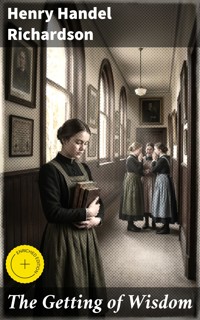
In 'The Getting of Wisdom,' Henry Handel Richardson crafts a poignant coming-of-age narrative set in 19th-century Australia, exploring the complexities of adolescence and the quest for personal identity. The novel is presented through a rich, evocative prose that captures the protagonist'Äôs thoughts and emotions against the rigid backgrounds of a boarding school. Richardson'Äôs keen attention to detail and her ability to evoke the nuances of class, gender, and societal expectations endow the story with both authenticity and relatability, situating it firmly within the broader context of early Australian literature, which grappled with themes of self-discovery and resilience. Henry Handel Richardson, born Ethel Florence Lindon Richardson, was an Australian author whose own experiences in a strict educational environment heavily influenced her writing. Her intricate understanding of gender dynamics and social constructs stemmed from her background and personal struggles, allowing her to illustrate the often-challenging path toward wisdom with a sympathetic yet discerning lens. Richardson's literary prowess is complemented by her intimate knowledge of the Victorian-era educational system and its impact on young women. Readers seeking a profound examination of the journey toward maturity will find 'The Getting of Wisdom' an invaluable exploration of self-awareness amidst societal constraints. As Richardson's insights into the challenges faced by her young protagonist resonate through time, this novel offers not only a compelling story but also an enduring reflection on the human condition, making it a crucial addition to any literary collection. In this enriched edition, we have carefully created added value for your reading experience: - A succinct Introduction situates the work's timeless appeal and themes. - The Synopsis outlines the central plot, highlighting key developments without spoiling critical twists. - A detailed Historical Context immerses you in the era's events and influences that shaped the writing. - A thorough Analysis dissects symbols, motifs, and character arcs to unearth underlying meanings. - Reflection questions prompt you to engage personally with the work's messages, connecting them to modern life. - Hand‐picked Memorable Quotes shine a spotlight on moments of literary brilliance. - Interactive footnotes clarify unusual references, historical allusions, and archaic phrases for an effortless, more informed read.
Das E-Book können Sie in Legimi-Apps oder einer beliebigen App lesen, die das folgende Format unterstützen:
Veröffentlichungsjahr: 2019
Ähnliche















![Tintenherz [Tintenwelt-Reihe, Band 1 (Ungekürzt)] - Cornelia Funke - Hörbuch](https://legimifiles.blob.core.windows.net/images/2830629ec0fd3fd8c1f122134ba4a884/w200_u90.jpg)


The Getting of Wisdom
Table of Contents
Introduction
Growing up often means learning, with discomfort and desire, how much of oneself can be kept intact while trying to belong.
Henry Handel Richardson’s The Getting of Wisdom is a realist coming-of-age novel first published in 1910, set in late nineteenth-century Melbourne, Australia, and centred on life inside a girls’ boarding school. Written in a period when formal education and moral instruction were treated as powerful social engines, the book observes how an institution shapes not only knowledge but manners, aspirations, and self-conception. Its focus is intimate rather than panoramic, using the contained world of the school to reflect wider expectations about class, respectability, and female conduct.
The story follows Laura Rambotham, a bright, imaginative adolescent sent away from home to be educated among her peers and under watchful authority. She arrives with intense curiosity and a romantic hunger for experience, and she quickly discovers that school life is governed by subtle hierarchies and carefully policed behaviour. The premise is simple but fertile: a young person must interpret confusing signals, win acceptance, and decide what kind of person she will become. The narrative keeps attention on everyday episodes and small decisions that accumulate into lasting self-knowledge.
Richardson’s reading experience is marked by psychological closeness and unsentimental precision. The prose is detailed and observant, attentive to gesture, tone, and the shifting textures of embarrassment, pride, and longing. Rather than presenting moral lessons as settled, the novel tests them against lived experience, letting contradictions remain visible. The tone can be wry, sympathetic, and quietly severe in its scrutiny of social performance. Because the book relies on accumulation rather than melodrama, it invites readers to notice how character is formed through repetition, correction, and the pressure of being seen.
A central theme is the friction between inner life and outward conformity: Laura’s imagination offers refuge and possibility, yet it also exposes her to misunderstanding and self-deception. The novel explores how friendship and rivalry entangle, how admiration can blur into imitation, and how status is negotiated through minor privileges and exclusions. It also examines authority, not simply as punishment, but as a system of surveillance and reward that teaches students what to value. Throughout, learning appears as more than academic progress, encompassing social literacy, self-control, and the painful calibration of honesty to convenience.
The Getting of Wisdom also considers what education promises and what it withholds. School is shown as a place where ideals of refinement and morality coexist with gossip, cruelty, and opportunism, complicating any simple faith in institutions. The book’s attention to gendered expectations is especially pointed: the girls are trained to be acceptable, and acceptability is portrayed as a shifting, often opaque standard. At the same time, Richardson refuses to reduce her characters to types, suggesting that agency survives even in constrained settings, though it may be exercised in imperfect and compromising ways.
For contemporary readers, the novel remains strikingly relevant because its social mechanisms are familiar in new forms. The desire to curate an image, the fear of exclusion, and the temptation to bend the truth to fit a narrative are not confined to boarding schools or to the era of its publication. Richardson’s careful portrayal of adolescence helps explain how environments shape ethics and identity long before adulthood feels real. The book still matters as a rigorous study of belonging, authenticity, and the costs of self-invention, rendered with a clarity that resists sentimentality and easy judgment.
Synopsis
Henry Handel Richardson’s The Getting of Wisdom (first published in 1910) follows Laura Rambotham, a bright, imaginative girl sent from rural Victoria to a respectable Melbourne ladies’ school. Removed from her family and familiar freedoms, Laura enters a world governed by timetables, decorum, and constant scrutiny, where teachers and older girls set the standards of taste and behaviour. The novel tracks her efforts to adapt to this new environment while preserving a sense of self, establishing early its central tension between individual impulse and the pressures of social conformity.
paragraphs
At school Laura becomes keenly aware of hierarchies among the pupils and the subtler rules that define belonging. She is drawn to friendship and approval yet frequently misreads situations, acting on impulse or romantic notions that clash with the institution’s expectations. Her intelligence and quickness can win praise, but they also set her apart, and her eagerness to appear sophisticated sometimes exposes her inexperience. Through everyday incidents—lessons, dormitory life, and social occasions—the story shows how small humiliations and triumphs shape her understanding of power, reputation, and the cost of attention.
As Laura tests the boundaries of what is acceptable, she begins to experiment with roles, stories, and attitudes that might secure admiration or sympathy. These attempts bring her into conflict with peers and with authority, not necessarily through grand rebellion but through the cumulative consequences of careless speech, vanity, and wishful thinking. Richardson presents the school as both an educational setting and a training ground for womanhood as it was publicly defined, where moral judgments are swift and where error can be remembered long after its immediate cause has passed.
The novel also follows Laura’s shifting attachments as she measures herself against girls who seem more polished or socially assured. Some relationships offer companionship and brief refuge; others expose rivalry, snobbery, or the precariousness of affection when it is tied to status. Laura’s reading and imagination continue to colour her expectations, and she repeatedly confronts the gap between idealized sentiments and the practical realities of school life. The narrative emphasizes how identity is negotiated through imitation, desire for recognition, and the fear of being singled out.
As time passes, Laura’s ambitions broaden beyond simple acceptance, and she begins to form more complex opinions about her teachers, the curriculum, and the values the school promotes. She learns that success is not solely a matter of talent but also of tact, timing, and understanding what others wish to hear. Episodes that begin as private hopes can quickly become public matters within the enclosed community, and Laura’s growing awareness of this social machinery forces her to weigh honesty against expediency and inward truth against outward performance.
The Getting of Wisdom portrays Laura’s development as uneven and often contradictory, with progress marked as much by setbacks as by achievements. Without turning into a moral fable, the novel observes how discipline, shame, and aspiration contribute to a kind of education not listed on any syllabus. Laura’s sense of independence is repeatedly tested by the demand to be “proper,” and her imaginative energy—both a gift and a liability—drives many of the situations that teach her caution. Richardson’s realism keeps the focus on process rather than neat resolutions, maintaining suspense about what lasting “wisdom” will mean for Laura personally and socially without revealing decisive outcomes here in detail. The book’s broader resonance lies in its clear-eyed account of adolescence under institutional and gendered expectations, and in its depiction of how social worlds are learned through observation, misstep, and adjustment. Richardson captures the way a school can mirror a wider society, compressing its values into a space where reputations form quickly and pressures intensify. Laura’s struggles—between authenticity and approval, imagination and fact, desire and restraint—give the novel enduring relevance for readers interested in coming-of-age narratives, the shaping of character, and the subtle forces that govern belonging.
Historical Context
Henry Handel Richardson’s The Getting of Wisdom (1910) is set in Melbourne, Victoria, during the late nineteenth century, when Australia’s colonies were still part of the British Empire. The novel follows a provincial girl’s move into the city and her schooling within an elite educational institution, drawing on the author’s experiences. Melbourne in this period was a rapidly expanding metropolis shaped by immigration, commerce, and strong cultural ties to Britain. Public life and social aspiration were closely linked to respectability, religion, and class display, conditions that inform the book’s depiction of manners, discipline, and the pressures placed on young women entering metropolitan society.
The novel’s school environment reflects the rise of formal secondary education for girls in the Australian colonies. Victoria had established a state school system in the 1870s (notably through the Education Act 1872), and by the 1880s and 1890s Melbourne supported both government schools and fee-paying private colleges. Middle-class families increasingly saw girls’ education as a means to refinement and social mobility, even when expectations still emphasized marriage and domestic competence. Richardson’s depiction of curricula, examinations, and institutional routines is grounded in this expansion of schooling and in contemporary debates about discipline, character formation, and the acceptable limits of female ambition.
Melbourne’s social setting was shaped by economic volatility. The long boom of the 1880s generated wealth, conspicuous building, and confidence in the colony’s future, followed by the severe banking and financial collapse of 1891–1893 and a prolonged depression. These cycles affected employment, household security, and the social hierarchy, intensifying anxieties about status and respectability. The novel’s attention to appearances, fees, reputations, and the subtle gradations of class resonates with a society where prosperity could be newly made and quickly lost. Such conditions also sharpened the authority of institutions—schools, churches, and families—as guardians of “proper” conduct.
The cultural landscape of colonial Melbourne retained strong British models. Many schools emphasized English literature, European music, and formal deportment as markers of cultivation. The period also saw the consolidation of the “Australian Natives” movement and the growth of local literary culture, including magazines and debates about what an Australian voice might be. Yet elite institutions often treated metropolitan British standards as the measure of taste and achievement. Richardson’s portrayal of school performances, reading, and social rituals reflects this cultural hierarchy. It also captures the tension between imported norms and the local realities of a young society seeking legitimacy through borrowed traditions.
Gender norms in the late nineteenth century strongly shaped girls’ lives and schooling. Middle-class ideals of femininity stressed modesty, obedience, and moral purity, while the “New Woman” debates—circulating across Britain and its settler colonies—raised questions about women’s education, paid work, and autonomy. In Australia, women’s political activism increased, with organisations campaigning for social reform and suffrage; South Australia enfranchised women in 1894, and the Commonwealth Franchise Act 1902 extended the federal vote to most non‑Indigenous women. Against this backdrop, the novel’s focus on a girl negotiating rules, friendship, and reputation reflects broader conflicts between prescribed femininity and emerging possibilities.
Religious and moral instruction played a prominent role in schools and public discourse. Protestant denominations were influential in Victoria, and moral surveillance—of speech, sexuality, and leisure—was often framed as a matter of personal virtue and social order. Schools commonly regulated reading, companionship, and conduct, reinforcing notions of sin, confession, and discipline. Richardson’s narrative attends to the way institutional authority and peer judgment interact, showing how moral codes were enforced not only by teachers but also by students. This reflects a society in which character was treated as both an individual responsibility and a public performance, closely tied to family standing and future prospects.
The novel was written from a distance: Richardson (Ethel Florence Lindesay Richardson) left Australia in 1888 to study music in Leipzig and later lived in England, publishing under a male pseudonym. Its publication in 1910 also places it in the early Commonwealth era, after Australian federation in 1901, when national institutions were forming and cultural commentators debated colonial legacies. The book’s retrospective viewpoint connects late-colonial schooling to the anxieties of a society transitioning from provincial colony to nation. Richardson’s realism aligns with early twentieth-century literary trends that favored psychological observation and social critique over romantic idealization.
The Getting of Wisdom reflects and critiques its era by portraying education as a mechanism for producing socially acceptable women while revealing the costs of conformity. By focusing on institutional routines, competitive achievement, and the policing of reputation, it registers late nineteenth-century Melbourne’s class consciousness and moral formalism. At the same time, its attention to adolescent perception and social performance challenges sentimental views of girlhood and exposes how authority can be internalized through peer culture. Without relying on extraordinary events, the novel uses everyday school life to illuminate wider historical forces—imperial cultural standards, changing opportunities for women, and the uncertainties of a rapidly modernizing society.