0,49 €
Niedrigster Preis in 30 Tagen: 1,99 €
Niedrigster Preis in 30 Tagen: 1,99 €
Mehr erfahren.
- Herausgeber: DigiCat
- Kategorie: Für Kinder und Jugendliche
- Sprache: Englisch
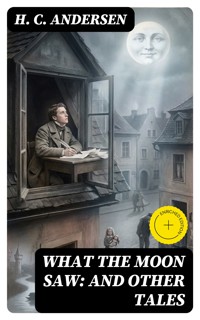
In "What the Moon Saw: and Other Tales," H. C. Andersen presents a captivating collection of stories that epitomize his mastery of fairy tale narrative. The book delves into themes of innocence, imagination, and the supernatural, with a distinctive blend of whimsy and moral underpinning. Andersen's characteristic lyrical prose and vivid imagery invite readers into a fantastical realm where the moon observes human experiences and quandaries, offering wisdom through enchanting tales that bridge the gap between the mundane and the magical. Each story resonates with the essence of Romanticism, reflecting a deep appreciation for nature, emotion, and the complexities of the human condition. H. C. Andersen, a luminary in the realm of fairy tales, drew inspiration from his humble beginnings and early experiences in Denmark. His voracious imagination and keen insight into the human psyche enabled him to weave narratives that resonate across generations. Andersen's own life was steeped in a quest for understanding and acceptance, a theme that often surfaces in his works, including the exploration of societal norms and individual identity. This collection is highly recommended for readers seeking a profound yet whimsical journey through the intricacies of life and the power of dreams. Whether for young readers or the young at heart, "What the Moon Saw" offers timeless lessons that remain relevant, inviting a sense of wonder and reflection on our shared humanity. In this enriched edition, we have carefully created added value for your reading experience: - A comprehensive Introduction outlines these selected works' unifying features, themes, or stylistic evolutions. - The Author Biography highlights personal milestones and literary influences that shape the entire body of writing. - A Historical Context section situates the works in their broader era—social currents, cultural trends, and key events that underpin their creation. - A concise Synopsis (Selection) offers an accessible overview of the included texts, helping readers navigate plotlines and main ideas without revealing critical twists. - A unified Analysis examines recurring motifs and stylistic hallmarks across the collection, tying the stories together while spotlighting the different work's strengths. - Reflection questions inspire deeper contemplation of the author's overarching message, inviting readers to draw connections among different texts and relate them to modern contexts. - Lastly, our hand‐picked Memorable Quotes distill pivotal lines and turning points, serving as touchstones for the collection's central themes.
Das E-Book können Sie in Legimi-Apps oder einer beliebigen App lesen, die das folgende Format unterstützen:
Veröffentlichungsjahr: 2022
Ähnliche














What the Moon Saw: and Other Tales
Table of Contents
Introduction
What the Moon Saw: and Other Tales gathers, in a single-author volume, a substantial selection of H. C. Andersen’s shorter prose, centering on the panoramic cycle What the Moon Saw and extending to many independent tales composed across the nineteenth century. Rather than presenting the author’s complete oeuvre, this anthology assembles representative and contrasting pieces to display Andersen’s range: from brief vignettes to extended narratives, from fable-like parables to historical and legendary sketches. Issued in English for a broad readership and associated with George Routledge and Sons, it offers a coherent doorway into Andersen’s storytelling art, juxtaposing celebrated titles with lesser-known gems to reveal recurring images, voices, and concerns.
The contents reflect an intentionally varied set of genres and text types. Readers will encounter literary fairy tales, allegories, cautionary narratives, comic pieces, seasonal stories, and legends, alongside realist sketches and episodic cycles. Many items are concise tales; others unfold as sequences with numbered parts, while a few approach novella length. There are no novels, plays, diaries, or letters here; rather, the emphasis falls on Andersen’s eventyr og historier—crafted “tales and stories” that draw on folk motifs yet are unmistakably literary. The design allows different modes to sit side by side, highlighting how Andersen reshapes voice, structure, and setting to serve each story’s particular aim.
What the Moon Saw provides the collection’s organizing constellation. Across thirty-two “Evenings,” the Moon becomes an impartial witness, casting its light on city and countryside, palaces and garrets, distant seas and familiar streets. Each glimpse is complete in itself while echoing the others, suggesting a world bound together by attention and compassion. The sequence offers premises rather than plots: encounters, vistas, and moments that invite readers to supply their own reflections. In this way, the Moon’s vantage becomes a method for surveying human variety without judgment, setting a tone of wonder and quiet melancholy that resonates throughout the volume.
Around that central cycle, related sequences deepen the sense of a world seen from shifting perches. Ole the Tower-Keeper returns across three visits, filtering memory and observation through a figure who looks outward and inward at once. Soup on a Sausage-Peg unfolds in five parts as a playful exercise in resourcefulness and perspective. The Story of the Year compresses time into an emblematic circle, while The Wind Tells about Waldemar Daa and his Daughters lets a natural force serve as chronicler. Such arrangements underscore Andersen’s experiments with framing devices, serial form, and narrators whose voices become part of the meaning.
Among Andersen’s stylistic signatures is his animation of the seemingly inanimate. The Pen and Inkstand, The Farmyard Cock and the Weathercock, The Butterfly, The Beetle, and The Snow Man are not mere fables but reflections on perception, purpose, and desire, expressed through objects and creatures that speak, judge, and yearn. This personification is never only decorative; it permits moral and aesthetic questions to surface gently, without didactic pressure. Everyday materials—metal, paper, feather, ice—acquire inwardness, inviting readers to measure human motives against the candid clarity of things that, in Andersen’s hands, feel alive because we have lent them attention.
Another current running through the volume is social observation grounded in sympathy. She Was Good for Nothing, The Child in the Grave, Anne Lisbeth, and The Old Bachelor’s Nightcap place ordinary lives in the foreground, attending to poverty, loss, and endurance without sensational detail. Even when a tale adopts a fairy-tale posture, its human situations remain recognizable: the pressure of respectability, the pull of home, the sting of exclusion, the relief of kindness. The result is a humane realism nested within fantasy, where moral insight arises from the recognition that sorrow and dignity often share the same small rooms.
Legend, myth, and folktale mingle with Andersen’s distinctive invention. The Marsh King’s Daughter draws on northern lore to frame a story of inheritance and transformation. The Bishop of Börglum and his Warriors evokes the atmosphere of an old chronicle. Jack the Dullard and An Old Story Told Anew play with the shapes of familiar folk narratives, while The Phoenix Bird reimagines a mythic cycle of death and renewal. In these pieces Andersen is not merely retelling; he is recomposing, using inherited forms to probe questions of identity, fortune, and redemption, while avoiding the fixed endings of oral tradition.
Time and nature are persistent interlocutors. The Last Dream of the Old Oak Tree contemplates aging and memory through an ancient witness; The Story of the Year turns the calendar into a living pattern; In the Uttermost Parts of the Sea extends vision to remote waters; A Leaf from the Sky lets a single fallen thing carry tidings. These premises invite meditation rather than suspense. They ask readers to notice cycles of growth and decay, the consolations of recurrence, and the fragile grandeur of lives measured against seasons, tides, and winds that continue whether or not we look.
Andersen also reflects on art itself—its labor, its audience, and its worth. The Puppet Showman shows creation as craft and calling; The Pen and Inkstand stages a debate about where ideas come from; The Goblin and the Huckster contrasts commerce with culture; The Dumb Book imagines a text that speaks without words. Taken together, these stories trace the risks and rewards of making meaning in a world that prices things differently. They acknowledge the market’s realities while affirming the stubborn dignity of imagination, which finds nourishment in poverty as readily as it founders amid abundance.
The tonal range of the collection is broad yet cohesive. Humor appears as gentle irony rather than mockery; pathos is tempered by restraint. Andersen’s sentences favor clarity and cadence, with sudden lyrical turns and deft repetitions. He often addresses the reader directly, but the intimacy never forecloses ambiguity. Frames and personifications allow him to shift from childlike wonder to adult reflection within a single page. The result is writing that invites beginners and rewards re-readers, carrying meanings that grow with experience, while remaining anchored in images simple enough to remember and strange enough to reconsider.
This English-language anthology gathers tales first published across many years and Danish volumes, presenting them here in an arrangement that balances cycles with stand-alone pieces. Numbered “Evenings” and sectional divisions are retained to preserve each work’s internal rhythm. The volume is associated with George Routledge and Sons, and readers may encounter ancillary catalogue matter typical of nineteenth-century bookmaking. Such historical traces aside, the editorial aim is straightforward: to offer a generous, accessible map of Andersen’s storytelling terrain, allowing themes to echo across genres and inviting readers to enter at any point and still find their way.
The lasting significance of Andersen’s tales lies in their union of tenderness and truth. They enlarge the possibilities of the literary fairy tale, influencing children’s literature and modern fantasy while remaining resonant for adult readers. By animating objects, listening to winds and bells, and dwelling with the poor as attentively as with the powerful, Andersen fashioned a moral imagination rooted in attention. This collection gathers enough of his modes and motifs for readers to sense that design: the Moon’s calm gaze, the tree’s memory, the bird’s renewal—all recurring emblems of a world made vivid by care.
Author Biography
Introduction
Hans Christian Andersen (1805–1875) emerged from modest beginnings in Odense, Denmark, to become one of world literature’s most recognizable storytellers. His legacy rests on the modern fairy tale: concise narratives that fold folklore, social observation, and moral inquiry into forms accessible to children yet resonant for adults. Alongside globally known tales beyond this volume, the present collection foregrounds his mid-century breadth: lyrical cycles, moral parables, historical legends, domestic sketches, and metaphysical allegories. Across these works, Andersen humanizes the humble, lends speech to things, and entwines wonder with sorrow, shaping a narrative voice that remains intimate, compassionate, and quietly subversive.
The collection centers on What the Moon Saw, an episodic suite of “Evenings” that observes city, countryside, and distant lands through the moon’s traveling gaze. Around it cluster shorter pieces—The Story of the Year, The Goblin and the Huckster, What the Old Man Does Is Always Right, Jack the Dullard, and others—that crystallize his art of brevity. Longer, darker tales—The Marsh King’s Daughter, Anne Lisbeth, The Girl Who Trod on the Loaf—expand his range into myth, tragedy, and spiritual trial. Historical fantasies like The Bishop of Börglum and His Warriors anchor his imagination in Denmark’s remembered past.
Andersen’s fame also rests on widely known stories beyond this volume—The Little Mermaid, The Snow Queen, The Emperor’s New Clothes, and The Ugly Duckling—whose spirit informs the pieces gathered here. English-language reception mattered greatly: translators and illustrators helped disseminate his voice, and publishers like George Routledge and Sons made such compilations common in the Victorian book market. Though framed by advertisements and paratext not authored by Andersen, this collection reveals his defining method: to let objects, animals, and elements speak, to test pride and pretension, and to locate grace in patience, love, and imaginative sympathy.
Education and Literary Influences
Andersen’s early years were marked by poverty and aspiration. The son of a shoemaker and a washerwoman, he moved to Copenhagen as a youth, drawn to the Royal Danish Theatre. Patronage—especially from Jonas Collin—opened the path to formal schooling at Latin grammar schools in Slagelse and Elsinore. The experience was difficult, but it brought disciplined study and languages that would later support a pan-European readership. Self-education, voracious reading, and constant letter-writing complemented his schooling, while theatrical training honed a sense of scene, gesture, and voice that permeates stage-inflected tales like The Puppet Showman and performative monologues throughout the collection.
His influences fused Danish oral tradition with European Romanticism. Folktale forms and proverbs shape pieces such as What the Old Man Does Is Always Right and Jack the Dullard, while personification—central to The Pen and Inkstand, The Bottle-Neck, The Beetle, and The Butterfly—draws on a Romantic fascination with nature animated by spirit. Travel and curiosity fed observational cycles like What the Moon Saw and seasonal allegories such as The Story of the Year. Historical and biblical echoes inform The Stone of the Wise Men and The Bishop of Börglum and His Warriors, where legend and faith mingle with the moral psychology of modern life.
Literary Career
Andersen’s early success in prose led swiftly to the fairy-tale mode, which he made his own by blending colloquial voice with literary craft. In What the Moon Saw, a cornerstone of this volume, brief nocturnal tableaux form a mosaic of human scenes—poor and prosperous, comic and tragic—glimpsed from above. The moon’s detachment becomes a humane attention, binding the sequence without a single plotline. These vignettes exemplify his technique: flexible perspective, a confiding narrator, and swift shifts between wonder and realism that allow large themes to emerge from small domestic or street-corner moments.
A cluster of domestic-moral tales cultivates everyday virtue and comic resourcefulness. What the Old Man Does Is Always Right reimagines marital trust and ingenuity; Good Humour and Everything in its Right Place value character over status and arrangement over display. Jack the Dullard (often rendered Clumsy Hans) revels in folk laughter, showing luck and honesty confounding pretension. The Goblin and the Huckster contrasts commerce with poetry without caricature, suggesting competing claims of necessity and art. Together these pieces show Andersen’s tact in balancing entertainment with ethical nuance, letting conclusions bloom naturally rather than by didactic decree.
Several works pursue darker registers of conscience, grief, and pride. The Girl Who Trod on the Loaf turns a folktale motif into a meditation on vanity and repentance; The Child in the Grave addresses bereavement with quiet theological gravity; Anne Lisbeth and Two Maidens examine guilt, social judgment, and destiny. The Thorny Road of Honour contemplates fame and the wounds of recognition. The Old Bachelor’s Nightcap evokes memory and solitude with an intimacy rare in short fiction. These tales, while accessible, advance a sophisticated moral psychology, refusing easy consolations yet preserving a compassionate horizon.
Andersen’s historical and legendary imagination also leaves a strong imprint here. The Wind Tells about Waldemar Daa and his Daughters recounts ambition, alchemy, and ruin through a natural narrator whose voice evokes folk chronicle. The Bishop of Börglum and His Warriors conjures haunted history on Jutland’s coast, while A Story from the Sand-Dunes interlaces environment and fate. Maritime and northern motifs recur in The Bell-Deep and In the Uttermost Parts of the Sea, where sound and distance become metaphors for memory. Personified nature—The Last Dream of the Old Oak Tree, The Snow Man—frames mortality within seasonal and elemental cycles.
Self-reflexive pieces probe art-making and material culture. The Pen and Inkstand stages a playful debate about inspiration and craft; The Bottle-Neck and The Dumb Book explore memory preserved in objects and images; The Puppet Showman returns to theatrical origins. The Beetle, The Butterfly, and In the Duck-Yard satirize vanity and social hierarchy in animal microcosm. Soup on a Sausage-Peg, in its compact sequence, indulges whimsical invention. Ole the Tower-Keeper, divided into visits, uses a city’s vantage point to measure time and change. Reprint quirks, such as a duplicated title like The Bond of Friendship, reflect nineteenth-century compilation practices rather than authorial duplication.
Throughout, religious and allegorical strands surface without preaching. The Stone of the Wise Men considers spiritual questing and human limitation, while A Christmas Tale distills seasonal charity. In a Thousand Years and The Phœnix Bird extend his temporal reach, imagining endurance and renewal at civilizational scale. What emerges across the volume is a signature method: animate the overlooked, test pride gently but firmly, and invite readers to see dignity in the ordinary—whether leaf, tool, or passerby. The prose’s musical cadence, quick turns of humor, and frank pathos anchor an art both popular and profoundly literary.
Beliefs and Advocacy
Andersen’s convictions were shaped by a quietly devout Christianity, sympathy for outsiders, and a Romantic belief in imagination as a moral faculty. He did not campaign as an activist, yet his writing consistently advocates kindness, humility, and the equal worth of the poor and overlooked. Tales here—A Christmas Tale, The Stone of the Wise Men, The Story of the Year—frame charity and spiritual seeking as daily practice rather than ideology. His cosmopolitan travel cultivated respect for cultural variety, while English translators and Victorian illustrators helped extend his humane message. By lending voice to humble things, he dignified lives often omitted from public speech.
Final Years & Legacy
Andersen’s later decades combined international celebrity with fragile health, yet he kept refining short prose into increasingly reflective forms, many represented in this collection. He died in 1875 in Denmark, and his funeral marked a national farewell to a writer who had remade the fairy tale. The enduring life of these works owes much to translation and illustration; English editions by publishers such as George Routledge and Sons circulated widely, often alongside paratexts and advertisements not by Andersen. The tales’ afterlife spans theatre, ballet, animation, and scholarship. Their lasting power comes from compassion married to craft, where wonder discloses ethical vision.
Historical Context
Hans Christian Andersen (1805–1875) wrote across the Danish Golden Age and into the high-Victorian era, a period that witnessed the shift from Romantic idealism to modern social realism. Born to modest means in Odense and maturing amid Copenhagen’s salons, theaters, and publishers, he fused folk motifs with contemporary observation. The tales gathered under the English title What the Moon Saw: and Other Tales span roughly the 1830s to the 1860s, reflecting a Europe transformed by revolution, industrialization, urban growth, and new mass readerships. They register the tensions between tradition and modernity, rural memory and metropolitan life, personal faith and public institutions, and the expanding horizons of travel and science.
The cycle What the Moon Saw originated as a sequence of evening vignettes in Danish, part travel-sketch, part moral reflection, written across Andersen’s most itinerant decades. The English compilation issued by George Routledge and Sons in mid-Victorian Britain gathers this series with earlier and later tales, often in H. W. Dulcken’s translations, and promoted through illustrated “gift-book” formats. Such packaging shaped reception: Andersen’s subtle ironies and colloquial Danish rhythms were refracted through Victorian sensibilities and the era’s wood-engraved aesthetics. The result is a historical palimpsest, combining 1830s Romantic storytelling with 1850s–60s concerns about commerce, science, education, and a rapidly mediating print culture.
The moon’s roving eye mirrors Andersen’s own travel across Germany, Italy, the eastern Mediterranean, and the Ottoman Empire in the 1830s–1840s, journeys later chronicled in A Poet’s Bazaar (1842). The framework’s nightly glimpses resemble contemporary feuilletons and travel letters in European newspapers, attuned to city streets, provincial customs, and foreign scenes. This cosmopolitan vantage reflects expanding railway networks, steamship routes, and passport regimes that made mid-century mobility possible for artists and tourists alike. The sequence invites readers to imagine global simultaneity: different lives illuminated by the same moon, a poetic analogue to the increasingly synchronized timekeeping of modern Europe.
Industrialization and urban consumer culture form an undercurrent throughout the collection. The Goblin and the Huckster (also translated as Grocer) places poetry in conversation—and competition—with shopkeeping, echoing debates about the market value of literature in an age of newspapers, circulating libraries, and advertising. Everything in its Right Place turns on bourgeois order and domestic display, a hallmark of mid-century middle-class identity. Such pieces register the reorganization of work, the commodification of taste, and the uneasy coexistence of spiritual aspiration with profit-making, themes visible across European cities from Copenhagen to London in the 1840s–1860s.
The tales also probe Danish historical memory amid nineteenth-century nation-building. The Wind Tells about Waldemar Daae and His Daughters revisits a seventeenth-century noble house and the perils of alchemical ambition, reflecting fascination with the decline of old estates and the moral of squandered patrimony. Ole the Tower-Keeper invokes Copenhagen’s skyline and the Round Tower, linking observation, time, and civic identity. The Bishop of Börglum and His Warriors draws on Jutland legend, part of a broader Romantic recovery of local chronicles and church histories. These pieces parallel political reconfigurations culminating in Denmark’s 1849 constitution and later conflicts over Schleswig-Holstein, without becoming topical allegory.
Religious sentiment and moral inquiry—hallmarks of Lutheran Denmark—inform many narratives. The Girl Who Trod on the Loaf adapts the didactic tradition to probe pride and compassion, aligning with nineteenth-century sermons and tract literature while retaining Andersen’s psychological nuance. She Was Good for Nothing and The Thorny Road of Honour explore reputations, charity, and the social gaze, resonating with contemporary philanthropy and temperance movements. Yet the stories resist simple edification: human frailty and redemption are presented through emblem, symbol, and voice, in line with Romantic-era tendencies to spiritualize everyday life rather than to preach doctrinal certainty.
Scientific and technological change press upon the imaginative world of the tales. The Pen and Inkstand questions authorship and instrumentality in a century of mechanized printing and booming literacy. The Stone of the Wise Men recasts alchemical longing within modern scientific curiosity, reflecting the transition from occult quest to empirical methods. The Bottle-Neck turns material culture into a witness of time, a nod to burgeoning museums and the nineteenth-century passion for collecting. Such fables foreground tools, substances, and observation—microscopes, telescopes, and laboratories hovered in cultural consciousness—as emblems of knowledge’s promises and limits.
Andersen’s art blends folk inheritance with comparative myth. The Marsh King’s Daughter brings together Nordic landscapes and Egyptian motifs via the stork’s migratory path, a poet’s answer to expanding ethnographic literature and “Oriental” travel accounts. The Phoenix Bird draws on classical and Near Eastern legend to frame cycles of destruction and renewal that nineteenth-century readers associated with revolution, fire, and rebirth. The Story of the Year personifies the seasons, recalling almanac culture and calendrical piety. Rather than collecting folk tales verbatim, Andersen composes originals that converse with the era’s folklore revivals while staking a modern authorial presence.
Questions of gender, domesticity, and reputation reflect mid-century debates about women’s roles and respectability. Anne Lisbeth examines maternal responsibility and social judgment within small communities. Two Maidens and The Old Bachelor’s Nightcap observe the rituals of courtship, household order, and solitary life amid shifting marital expectations and urban anonymity. Charming and related sketches consider charisma, beauty, and performance in a society negotiating between romantic ideals and practical alliances. These stories track a European conversation that ranged from conduct manuals to women’s periodicals, avoiding polemic but registering the social codes that governed everyday choices.
Landscape is not mere backdrop; it encodes environmental history. A Story from the Sand-Dunes situates readers on Jutland’s windward coast, where shifting sands, fishing communities, and wrecks shaped livelihoods. The Last Dream of the Old Oak Tree and Under the Willow Tree grant agency to trees and plants, continuous with Romantic natural philosophy and early conservation impulses. The Snow Man celebrates winter’s ephemerality, while hinting at domestic technologies like the stove. In Denmark, nineteenth-century schemes to stabilize dunes and reclaim heathland (notably the Hedeselskabet’s later initiatives) contextualize Andersen’s sensitivity to rural change and human stewardship.
Poverty, charity, and vulnerability thread through the volume. The Child in the Grave and The Old Gravestone belong to a century confronting high infant mortality and recurrent epidemics—Copenhagen suffered notably in the 1850s—while municipal poor relief systems evolved. Ib and Christine evokes rural hardship and aspiration, echoing migration from countryside to town. Good Humour and Everything in its Right Place touch on social friction softened—or sharpened—by manners. Andersen neither romanticizes deprivation nor reduces it to moral failing; instead he dramatizes the fragile dignity of the poor within emerging welfare debates and the civic language of citizenship after 1849.
Performance and media, central to Andersen’s career at the Royal Danish Theatre, animate the collection. The Puppet Showman reflects European enthusiasm for marionettes, pantomime, and fairground entertainments that coexisted with opera and spoken drama. Soup on a Sausage-Peg, issued in numbered episodes, mirrors popular serial formats and playful metafiction. The Dumb Book meditates on nonverbal storytelling through albums and keepsakes, anticipating the nineteenth century’s affection for scrapbooks and, later, photography’s silent narratives. These pieces document a culture in which spectacle, print, and domestic display interwove, forming a shared visual vocabulary across classes and borders.
Global horizons tempt the imagination. In the Uttermost Parts of the Sea broadens perspective toward distant waters in an age of steam navigation and intensified maritime science, when naturalists and traders mapped coasts and currents. The Phoenix Bird and Leaf from the Sky echo the century’s fascination with the “Orient,” a discourse amplified by world’s fairs and museum displays. Andersen’s use of exotic settings participates in, but also humanizes, such vistas, focusing on moral encounters rather than ethnographic catalogues. The moon-cycle’s wide gaze likewise dissolves borders, embodying a transnational sensibility typical of writers who traveled and read beyond their homelands.
The English volume’s apparatus signals Victorian book culture. Routledge marketed Andersen within the booming gift-book trade, often for Christmas, with wood-engraved illustrations by firms such as the Dalziel Brothers and artists like A. B. Houghton or, in other titles, J. E. Millais and Birkett Foster. Advertisements appended to the volume list fine-art gift books, poetry anthologies, and children’s picture books—products for middle-class parlours. H. W. Dulcken’s translations, widely circulated, domesticated idiom and sometimes adjusted religious or social nuances for British readers. Thus the collection is also a document of transnational mediation: Danish tales repackaged for the Victorian family market.
Satire and civic commentary surface through animal fables and household objects. The Farmyard Cock and the Weathercock plays with opportunism and the shifting “winds” of opinion in a century of expanding public debate. In the Duck-Yard and The Pigs tease pretension and herd mentality, recalling the freer press that followed Denmark’s 1849 constitution and similar liberalizations across Europe. There is a Difference and Everything in its Right Place weigh standards and distinctions in a society increasingly organized by classification—of ranks, objects, and tastes—while remaining wary of snobbery. Andersen’s gentle irony allowed such critiques to circulate in children’s rooms and editorial pages alike.
Religious plurality and historical Christianity receive measured attention. The Jewish Girl emerges from an era of Jewish emancipation across Europe—gradual, contested, and uneven—while in Denmark legal equality was affirmed in the 1849 constitution. The Bishop of Börglum and His Warriors revisits a Catholic past within a Lutheran present, emblematic of nineteenth-century antiquarian interest in monasteries and church ruins. A Christmas Tale participates in the seasonal culture that structured Victorian publishing and philanthropy. These works treat faith as lived practice and memory, inviting sympathy across confessional lines without abandoning the moral frame recognizable to Andersen’s contemporary readers.
Across its many pieces, the collection becomes a commentary on modern temporality—how individuals and nations remember, anticipate, and endure change. The moon’s serial visits echo installment fiction and the newspaper column; nature tales absorb ecological and agrarian debates; urban sketches register commerce and spectacle; historical legends speak to identity after constitutional reform. Later readers have reinterpreted these works through lenses of translation studies, ecocriticism, gender history, and empire, noting how Victorian editions shaped Andersen’s global image. What the Moon Saw: and Other Tales stands, therefore, as both artwork and archive: a nineteenth-century European worldview refracted through Danish voice and English mediation.
Synopsis (Selection)
Preface
A brief orienting note that frames the collection’s blend of everyday realism, folk fantasy, and moral reflection. It primes readers for shifting registers, from playful satire to tender pathos, and hints at the human truths the tales seek to illuminate.
What the Moon Saw: Introduction and Thirty-two Evenings
A frame-tale in which the Moon, introduced in a short prologue, recounts panoramas glimpsed over thirty-two consecutive evenings. Each night offers a compact vignette—urban, rural, exotic, or intimate—where small lives and grand longings intersect, shifting from wistful lyricism to gentle irony. Together they form a mosaic of the world’s beauty and frailty as witnessed by an impartial celestial observer.
Seasonal and Mythic Voices of Nature
The Story of the Year, A Leaf from the Sky, The Last Dream of the Old Oak Tree, In the Uttermost Parts of the Sea, The Phœnix Bird, and The Bell-Deep personify time, trees, seas, and immortality to chart cycles of change and endurance. Pivotal images—falling leaves, distant waters, a sunken bell, and renewing fire—turn natural process into spiritual insight. The mood is contemplative and mythic, inviting awe and consolation in rhythms beyond human control.
Love, Loss, and Conscience in Everyday Lives
She Was Good for Nothing, Ib and Christine, Under the Willow Tree, Anne Lisbeth, The Child in the Grave, Two Maidens, The Jewish Girl, The Thorny Road of Honour, The Old Gravestone, The Old Bachelor’s Nightcap, and The Girl Who Trod on the Loaf trace attachment and regret as villagers, children, and solitary adults face choices testing kindness, loyalty, pride, and faith. Turning points come through partings, reckonings with memory, and encounters with suffering in familiar places. The tone ranges from compassionate realism to quiet tragedy, balancing tenderness with stern moral clarity.
Comic Tales of Common Sense and Folly
“There Is a Difference,” Everything in Its Right Place, Good Humour, What the Old Man Does Is Always Right, the five-part Soup on a Sausage-Peg (I–V), The Pigs, In the Duck-Yard, and Jack the Dullard weigh prudence against vanity in household, barnyard, and courtly settings. From a simpleton’s unlikely success to a farcical culinary experiment, small decisions snowball into lessons about trust, order, and temperament. The style is brisk and playful, with punch-line irony that leaves a kindly aftertaste.
Artists, Stories, and the Making of Imagination
The Goblin and the Huckster, The Puppet Showman, The Pen and Inkstand, The Dumb Book, An Old Story Told Anew, Something, The Stone of the Wise Men, and In a Thousand Years probe where stories come from and what they are worth amid trade, fashion, and the lure of novelty. Goblins, pens, albums, and showmen debate utility versus inspiration while seekers pursue wisdom or futures glimpsed at a distance. Satiric yet visionary, these pieces honor imagination as an ethical as well as an aesthetic force.
Speaking Creatures and Objects
The Beetle, The Bottle-Neck, The Butterfly, The Farmyard Cock and the Weathercock, and related monologues let insects, utensils, and emblems voice their vanities, grievances, and epiphanies. Each narrator’s self-importance meets comic deflation or unexpected empathy, reframing the ordinary as a stage for moral drama. Sprightly yet pointed, these tales turn curiosities into mirrors for human habits.
Legends and Folk-History
The Marsh King’s Daughter, The Bishop of Börglum and His Warriors, A Story from the Sand-Dunes, The Wind Tells About Waldemar Daa and His Daughters, and Ole the Tower-Keeper (First, Second, and Third Visit) unfold in marshlands, coasts, castles, and watchtowers where ambition, faith, and fate collide. Elemental voices and recurring visits to a tower-keeper structure stories of rise and ruin, oaths and hauntings, and lives marked by place. The atmosphere is folkloric and occasionally dark, threading wonder through cautionary history.
The Bond of Friendship
A single tale centers on loyalty tested by separation and circumstance, asking what holds companions fast when comfort fails. Key turns hinge on promises kept and the quiet courage of remembering. Earnest and warm in tone, this entry covers both occurrences of the title within the contents list.
Winter and Christmas
A Christmas Tale and The Snow Man set generous feeling against the season’s cold, from festive charity to a wintry figure’s brief, yearning life. Pivotal moments gather around hearth and frost, balancing cheer with the poignancy of transience. The mood is tender and bittersweet, attentive to celebration and the passing nature of enchantment.
Catalogue and Gift-Book Notices
A closing sequence of titled notices—such as the repeated Dalziels’ Fine Art Gift Books and other headings about poems, pictures, and works for the young—promotes companion volumes implied by their titles. Read together, these entries sketch a landscape of gift books and instructive literature, pairing visual art with verse and storytelling. Informational rather than narrative, they frame the collection within a wider field of contemporary reading signaled by the headings themselves.
What the Moon Saw: and Other Tales
PREFACE.
The present book is put forth as a sequel to the volume of Hans C. Andersen's "Stories and Tales," published in a similar form in the course of 1864. It contains tales and sketches various in character; and following, as it does, an earlier volume, care has been taken to intersperse with the children's tales stories which, by their graver character and deeper meaning, are calculated to interest those "children of a larger growth" who can find instruction as well as amusement in the play of fancy and imagination, though the realm be that of fiction, and the instruction be conveyed in a simple form.
The series of sketches of "What the Moon Saw," with which the present volume opens, arose from the experiences of Andersen, when as a youth he went to seek his fortune in the capital of his native land; and the story entitled "Under the Willow Tree" is said likewise to have its foundation in fact; indeed, it seems redolent of the truth of that natural human love and suffering which is so truly said to "make the whole world kin."
On the preparation and embellishment of the book, the same care and attention have been lavished as on the preceding volume. The pencil of Mr. Bayes and the graver of the Brothers Dalziel have again been employed in the work of illustration; and it is hoped that the favour bestowed by the public on the former volume may be extended to this its successor.
H. W. D.
WHAT THE MOON SAW.
INTRODUCTION.
It is a strange thing, that when I feel most fervently and most deeply, my hands and my tongue seem alike tied, so that I cannot rightly describe or accurately portray the thoughts that are rising within me; and yet I am a painter: my eye tells me as much as that, and all my friends who have seen my sketches and fancies say the same.
I am a poor lad, and live in one of the narrowest of lanes; but I do not want for light, as my room is high up in the house, with an extensive prospect over the neighbouring roofs. During the first few days I went to live in the town, I felt low-spirited and solitary enough. Instead of the forest and the green hills of former days, I had here only a forest of chimney-pots to look out upon. And then I had not a single friend; not one familiar face greeted me.
So one evening I sat at the window, in a desponding mood; and presently I opened the casement and looked out. Oh, how my heart leaped up with joy[1q]! Here was a well-known face at last—a round, friendly countenance, the face of a good friend I had known at home. In, fact it was the Moon that looked in upon me. He was quite unchanged, the dear old Moon, and had the same face exactly that he used to show when he peered down upon me through the willow trees on the moor. I kissed my hand to him over and over again, as he shone far into my little room; and he, for his part, promised me that every evening, when he came abroad, he would look in upon me for a few moments. This promise he has faithfully kept. It is a pity that he can only stay such a short time when he comes. Whenever he appears, he tells me of one thing or another that he has seen on the previous night, or on that same evening. "Just paint the scenes I describe to you"—this is what he said to me—"and you will have a very pretty picture-book." I have followed his injunction for many evenings. I could make up a new "Thousand and One Nights," in my own way, out of these pictures, but the number might be too great, after all. The pictures I have here given have not been chosen at random, but follow in their proper order, just as they were described to me. Some great gifted painter, or some poet or musician, may make something more of them if he likes; what I have given here are only hasty sketches, hurriedly put upon the paper, with some of my own thoughts interspersed; for the Moon did not come to me every evening—a cloud sometimes hid his face from me.
First Evening.
"Last night"—I am quoting the Moon's own words—"last night I was gliding through the cloudless Indian sky. My face was mirrored in the waters of the Ganges, and my beams strove to pierce through the thick intertwining boughs of the bananas, arching beneath me like the tortoise's shell. Forth from the thicket tripped a Hindoo maid, light as a gazelle, beautiful as Eve. Airy and ethereal as a vision, and yet sharply defined amid the surrounding shadows, stood this daughter of Hindostan: I could read on her delicate brow the thought that had brought her hither. The thorny creeping plants tore her sandals, but for all that she came rapidly forward. The deer that had come down to the river to quench their thirst, sprang by with a startled bound, for in her hand the maiden bore a lighted lamp. I could see the blood in her delicate finger tips, as she spread them for a screen before the dancing flame. She came down to the stream, and set the lamp upon the water, and let it float away. The flame flickered to and fro, and seemed ready to expire; but still the lamp burned on, and the girl's black sparkling eyes, half veiled behind their long silken lashes, followed it with a gaze of earnest intensity. She knew that if the lamp continued to burn so long as she could keep it in sight, her betrothed was still alive; but if the lamp was suddenly extinguished, he was dead. And the lamp burned bravely on, and she fell on her knees, and prayed. Near her in the grass lay a speckled snake, but she heeded it not—she thought only of Bramah and of her betrothed. 'He lives!' she shouted joyfully, 'he lives!' And from the mountains the echo came back upon her, 'he lives!'"
Second Evening.
"Yesterday," said the Moon to me, "I looked down upon a small courtyard surrounded on all sides by houses. In the courtyard sat a clucking hen with eleven chickens; and a pretty little girl was running and jumping around them. The hen was frightened, and screamed, and spread out her wings over the little brood. Then the girl's father came out and scolded her; and I glided away and thought no more of the matter.
"But this evening, only a few minutes ago, I looked down into the same courtyard. Everything was quiet. But presently the little girl came forth again, crept quietly to the hen-house, pushed back the bolt, and slipped into the apartment of the hen and chickens. They cried out loudly, and came fluttering down from their perches, and ran about in dismay, and the little girl ran after them. I saw it quite plainly, for I looked through a hole in the hen-house wall. I was angry with the wilful child, and felt glad when her father came out and scolded her more violently than yesterday, holding her roughly by the arm: she held down her head, and her blue eyes were full of large tears. 'What are you about here?' he asked. She wept and said, 'I wanted to kiss the hen and beg her pardon for frightening her yesterday; but I was afraid to tell you.'
"And the father kissed the innocent child's forehead, and I kissed her on the mouth and eyes."
Third Evening.
"In the narrow street round the corner yonder—it is so narrow that my beams can only glide for a minute along the walls of the house, but in that minute I see enough to learn what the world is made of—in that narrow street I saw a woman. Sixteen years ago that woman was a child, playing in the garden of the old parsonage, in the country. The hedges of rose-bush were old, and the flowers were faded. They straggled wild over the paths, and the ragged branches grew up among the boughs of the apple trees; here and there were a few roses still in bloom—not so fair as the queen of flowers generally appears, but still they had colour and scent too. The clergyman's little daughter appeared to me a far lovelier rose, as she sat on her stool under the straggling hedge, hugging and caressing her doll with the battered pasteboard cheeks.
"Ten years afterwards I saw her again. I beheld her in a splendid ball-room: she was the beautiful bride of a rich merchant. I rejoiced at her happiness, and sought her on calm quiet evenings—ah, nobody thinks of my clear eye and my silent glance! Alas! my rose ran wild, like the rose bushes in the garden of the parsonage. There are tragedies in every-day life, and to-night I saw the last act of one.
"She was lying in bed in a house in that narrow street: she was sick unto death, and the cruel landlord came up, and tore away the thin coverlet, her only protection against the cold. 'Get up!' said he; 'your face is enough to frighten one. Get up and dress yourself, give me money, or I'll turn you out into the street! Quick—get up!' She answered, 'Alas! death is gnawing at my heart. Let me rest.' But he forced her to get up and bathe her face, and put a wreath of roses in her hair; and he placed her in a chair at the window, with a candle burning beside her, and went away.
"I looked at her, and she was sitting motionless, with her hands in her lap. The wind caught the open window and shut it with a crash, so that a pane came clattering down in fragments; but still she never moved. The curtain caught fire, and the flames played about her face; and I saw that she was dead. There at the open window sat the dead woman, preaching a sermon against sin—my poor faded rose out of the parsonage garden!"
Fourth Evening.
"This evening I saw a German play acted," said the Moon. "It was in a little town. A stable had been turned into a theatre; that is to say, the stable had been left standing, and had been turned into private boxes, and all the timber work had been covered with coloured paper. A little iron chandelier hung beneath the ceiling, and that it might be made to disappear into the ceiling, as it does in great theatres, when the ting-ting of the prompter's bell is heard, a great inverted tub had been placed just above it.
"'Ting-ting!' and the little iron chandelier suddenly rose at least half a yard and disappeared in the tub; and that was the sign that the play was going to begin. A young nobleman and his lady, who happened to be passing through the little town, were present at the performance, and consequently the house was crowded. But under the chandelier was a vacant space like a little crater: not a single soul sat there, for the tallow was dropping, drip, drip! I saw everything, for it was so warm in there that every loophole had been opened. The male and female servants stood outside, peeping through the chinks, although a real policeman was inside, threatening them with a stick. Close by the orchestra could be seen the noble young couple in two old arm-chairs, which were usually occupied by his worship the mayor and his lady; but these latter were to-day obliged to content themselves with wooden forms, just as if they had been ordinary citizens; and the lady observed quietly to herself, 'One sees, now, that there is rank above rank;' and this incident gave an air of extra festivity to the whole proceedings. The chandelier gave little leaps, the crowd got their knuckles rapped, and I, the Moon, was present at the performance from beginning to end."
Fifth Evening.
"Yesterday," began the Moon, "I looked down upon the turmoil of Paris. My eye penetrated into an apartment of the Louvre. An old grandmother, poorly clad—she belonged to the working class—was following one of the under-servants into the great empty throne-room, for this was the apartment she wanted to see—that she was resolved to see; it had cost her many a little sacrifice, and many a coaxing word, to penetrate thus far. She folded her thin hands, and looked round with an air of reverence, as if she had been in a church.
"'Here it was!' she said, 'here!' And she approached the throne, from which hung the rich velvet fringed with gold lace. 'There,' she exclaimed, 'there!' and she knelt and kissed the purple carpet. I think she was actually weeping.
"'But it was not this very velvet!' observed the footman, and a smile played about his mouth. 'True, but it was this very place,' replied the woman, 'and it must have looked just like this.' 'It looked so, and yet it did not,' observed the man: 'the windows were beaten in, and the doors were off their hinges, and there was blood upon the floor.' 'But for all that you can say, my grandson died upon the throne of France. Died!' mournfully repeated the old woman. I do not think another word was spoken, and they soon quitted the hall. The evening twilight faded, and my light shone doubly vivid upon the rich velvet that covered the throne of France.
"Now, who do you think this poor woman was? Listen, I will tell you a story.
"It happened, in the Revolution of July, on the evening of the most brilliantly victorious day, when every house was a fortress, every window a breastwork. The people stormed the Tuileries. Even women and children were to be found among the combatants. They penetrated into the apartments and halls of the palace. A poor half-grown boy in a ragged blouse fought among the older insurgents. Mortally wounded with several bayonet thrusts, he sank down. This happened in the throne-room. They laid the bleeding youth upon the throne of France, wrapped the velvet around his wounds, and his blood streamed forth upon the imperial purple. There was a picture! the splendid hall, the fighting groups! A torn flag lay upon the ground, the tricolor was waving above the bayonets, and on the throne lay the poor lad with the pale glorified countenance, his eyes turned towards the sky, his limbs writhing in the death agony, his breast bare, and his poor tattered clothing half hidden by the rich velvet embroidered with silver lilies. At the boy's cradle a prophecy had been spoken: 'He will die on the throne of France!' The mother's heart dreamt of a second Napoleon.
"My beams have kissed the wreath of immortelles on his grave, and this night they kissed the forehead of the old grandame, while in a dream the picture floated before her which thou mayest draw—the poor boy on the throne of France."
Sixth Evening.
"I've been in Upsala," said the Moon: "I looked down upon the great plain covered with coarse grass, and upon the barren fields. I mirrored my face in the Tyris river, while the steamboat drove the fish into the rushes. Beneath me floated the waves, throwing long shadows on the so-called graves of Odin, Thor, and Friga. In the scanty turf that covers the hill-side names have been cut.[1] There is no monument here, no memorial on which the traveller can have his name carved, no rocky wall on whose surface he can get it painted; so visitors have the turf cut away for that purpose. The naked earth peers through in the form of great letters and names; these form a network over the whole hill. Here is an immortality, which lasts till the fresh turf grows!
[1] Travellers on the Continent have frequent opportunities of seeing how universally this custom prevails among travellers. In some places on the Rhine, pots of paint and brushes are offered by the natives to the traveller desirous of "immortalising" himself.
"Up on the hill stood a man, a poet. He emptied the mead horn with the broad silver rim, and murmured a name. He begged the winds not to betray him, but I heard the name. I knew it. A count's coronet sparkles above it, and therefore he did not speak it out. I smiled, for I knew that a poet's crown adorns his own name. The nobility of Eleanora d'Este is attached to the name of Tasso. And I also know where the Rose of Beauty blooms!"
Thus spake the Moon, and a cloud came between us. May no cloud separate the poet from the rose!
Seventh Evening.
"Along the margin of the shore stretches a forest of firs and beeches, and fresh and fragrant is this wood; hundreds of nightingales visit it every spring. Close beside it is the sea, the ever-changing sea, and between the two is placed the broad high-road. One carriage after another rolls over it; but I did not follow them, for my eye loves best to rest upon one point. A Hun's Grave[2] lies there, and the sloe and blackthorn grow luxuriantly among the stones. Here is true poetry in nature.
[2] Large mounds similar to the "barrows" found in Britain, are thus designated in Germany and the North.
"And how do you think men appreciate this poetry? I will tell you what I heard there last evening and during the night.
"First, two rich landed proprietors came driving by. 'Those are glorious trees!' said the first. 'Certainly; there are ten loads of firewood in each,' observed the other: 'it will be a hard winter, and last year we got fourteen dollars a load'—and they were gone. 'The road here is wretched,' observed another man who drove past. 'That's the fault of those horrible trees,' replied his neighbour; 'there is no free current of air; the wind can only come from the sea'—and they were gone. The stage coach went rattling past. All the passengers were asleep at this beautiful spot. The postillion blew his horn, but he only thought, 'I can play capitally. It sounds well here. I wonder if those in there like it?'—and the stage coach vanished. Then two young fellows came gallopping up on horseback. There's youth and spirit in the blood here! thought I; and, indeed, they looked with a smile at the moss-grown hill and thick forest. 'I should not dislike a walk here with the miller's Christine,' said one—and they flew past.
"The flowers scented the air; every breath of air was hushed: it seemed as if the sea were a part of the sky that stretched above the deep valley. A carriage rolled by. Six people were sitting in it. Four of them were asleep; the fifth was thinking of his new summer coat, which would suit him admirably; the sixth turned to the coachman and asked him if there were anything remarkable connected with yonder heap of stones. 'No,' replied the coachman, 'it's only a heap of stones; but the trees are remarkable.' 'How so?' 'Why, I'll tell you how they are very remarkable. You see, in winter, when the snow lies very deep, and has hidden the whole road so that nothing is to be seen, those trees serve me for a landmark. I steer by them, so as not to drive into the sea; and you see that is why the trees are remarkable.'
"Now came a painter. He spoke not a word, but his eyes sparkled. He began to whistle. At this the nightingales sang louder than ever. 'Hold your tongues!' he cried testily; and he made accurate notes of all the colours and transitions—blue, and lilac, and dark brown. 'That will make a beautiful picture,' he said. He took it in just as a mirror takes in a view; and as he worked he whistled a march of Rossini. And last of all came a poor girl. She laid aside the burden she carried, and sat down to rest upon the Hun's Grave. Her pale handsome face was bent in a listening attitude towards the forest. Her eyes brightened, she gazed earnestly at the sea and the sky, her hands were folded, and I think she prayed, 'Our Father.' She herself could not understand the feeling that swept through her, but I know that this minute, and the beautiful natural scene, will live within her memory for years, far more vividly and more truly than the painter could portray it with his colours on paper. My rays followed her till the morning dawn kissed her brow."
Eighth Evening.
Heavy clouds obscured the sky, and the Moon did not make his appearance at all. I stood in my little room, more lonely than ever, and looked up at the sky where he ought to have shown himself. My thoughts flew far away, up to my great friend, who every evening told me such pretty tales, and showed me pictures. Yes, he has had an experience indeed. He glided over the waters of the Deluge, and smiled on Noah's ark just as he lately glanced down upon me, and brought comfort and promise of a new world that was to spring forth from the old. When the Children of Israel sat weeping by the waters of Babylon, he glanced mournfully upon the willows where hung the silent harps. When Romeo climbed the balcony, and the promise of true love fluttered like a cherub toward heaven, the round Moon hung, half hidden among the dark cypresses, in the lucid air. He saw the captive giant at St. Helena, looking from the lonely rock across the wide ocean, while great thoughts swept through his soul. Ah! what tales the Moon can tell. Human life is like a story to him. To-night I shall not see thee again, old friend. To-night I can draw no picture of the memories of thy visit. And, as I looked dreamily towards the clouds, the sky became bright. There was a glancing light, and a beam from the Moon fell upon me. It vanished again, and dark clouds flew past; but still it was a greeting, a friendly good-night offered to me by the Moon.
Ninth Evening.
The air was clear again. Several evenings had passed, and the Moon was in the first quarter. Again he gave me an outline for a sketch. Listen to what he told me.
"I have followed the polar bird and the swimming whale to the eastern coast of Greenland. Gaunt ice-covered rocks and dark clouds hung over a valley, where dwarf willows and barberry bushes stood clothed in green. The blooming lychnis exhaled sweet odours. My light was faint, my face pale as the water lily that, torn from its stem, has been drifting for weeks with the tide. The crown-shaped Northern Light burned fiercely in the sky. Its ring was broad, and from its circumference the rays shot like whirling shafts of fire across the whole sky, flashing in changing radiance from green to red. The inhabitants of that icy region were assembling for dance and festivity; but, accustomed to this glorious spectacle, they scarcely deigned to glance at it. 'Let us leave the souls of the dead to their ball-play with the heads of the walruses,' they thought in their superstition, and they turned their whole attention to the song and dance. In the midst of the circle, and divested of his furry cloak, stood a Greenlander, with a small pipe, and he played and sang a song about catching the seal, and the chorus around chimed in with, 'Eia, Eia, Ah.' And in their white furs they danced about in the circle, till you might fancy it was a polar bear's ball.
"And now a Court of Judgment was opened. Those Greenlanders who had quarrelled stepped forward, and the offended person chanted forth the faults of his adversary in an extempore song, turning them sharply into ridicule, to the sound of the pipe and the measure of the dance. The defendant replied with satire as keen, while the audience laughed, and gave their verdict. The rocks heaved, the glaciers melted, and great masses of ice and snow came crashing down, shivering to fragments as they fell: it was a glorious Greenland summer night. A hundred paces away, under the open tent of hides, lay a sick man. Life still flowed through his warm blood, but still he was to die—he himself felt it, and all who stood round him knew it also; therefore his wife was already sowing round him the shroud of furs, that she might not afterwards be obliged to touch the dead body. And she asked, 'Wilt thou be buried on the rock, in the firm snow? I will deck the spot with thy kayak, and thy arrows, and the angekokk shall dance over it. Or wouldst thou rather be buried in the sea?' 'In the sea,' he whispered, and nodded with a mournful smile. 'Yes, it is a pleasant summer tent, the sea,' observed the wife. 'Thousands of seals sport there, the walrus shall lie at thy feet, and the hunt will be safe and merry!' And the yelling children tore the outspread hide from the window-hole, that the dead man might be carried to the ocean, the billowy ocean, that had given him food in life, and that now, in death, was to afford him a place of rest. For his monument, he had the floating, ever-changing icebergs, whereon the seal sleeps, while the storm bird flies round their gleaming summits!"
Tenth Evening.
the old maid.
"I knew an old maid," said the Moon. "Every winter she wore a wrapper of yellow satin, and it always remained new, and was the only fashion she followed. In summer she always wore the same straw hat, and I verily believe the very same grey-blue dress.