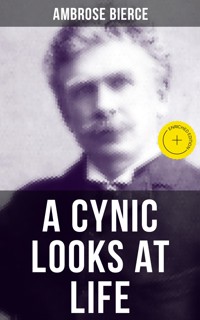
Erhalten Sie Zugang zu diesem und mehr als 300000 Büchern ab EUR 5,99 monatlich.
- Herausgeber: Musaicum Books
- Kategorie: Geisteswissenschaft
- Sprache: Englisch
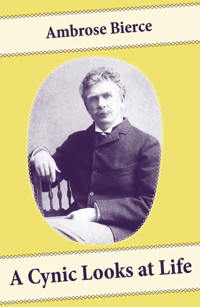
In 'A Cynic Looks at Life' by Ambrose Bierce, the reader is taken on a journey through the cynical lens of the author as he scrutinizes various aspects of life, society, and human nature. Bierce's writing is sharp, satirical, and thought-provoking, making the reader reflect on their own beliefs and values. The book's thematic exploration of cynicism and skepticism is a reflection of the literary context of the late 19th century, a time of great societal change and increasing disillusionment. Bierce's unique style blends humor with philosophical insights, creating a compelling and memorable read. Ambrose Bierce, a veteran of the American Civil War and a renowned satirist, drew inspiration from his own experiences and observations to write 'A Cynic Looks at Life.' His background as a journalist and editor provided him with the platform to voice his opinions and critique the world around him. Bierce's biting wit and uncompromising honesty shine through in this collection of essays, making it a timeless and relevant work of literature. I highly recommend 'A Cynic Looks at Life' to readers who enjoy thought-provoking and witty reflections on society and human nature. Bierce's sharp observations and clever writing style make this book a must-read for anyone interested in exploring the darker side of human existence. In this enriched edition, we have carefully created added value for your reading experience: - A comprehensive Introduction outlines these selected works' unifying features, themes, or stylistic evolutions. - The Author Biography highlights personal milestones and literary influences that shape the entire body of writing. - A Historical Context section situates the works in their broader era—social currents, cultural trends, and key events that underpin their creation. - A concise Synopsis (Selection) offers an accessible overview of the included texts, helping readers navigate plotlines and main ideas without revealing critical twists. - A unified Analysis examines recurring motifs and stylistic hallmarks across the collection, tying the stories together while spotlighting the different work's strengths. - Reflection questions inspire deeper contemplation of the author's overarching message, inviting readers to draw connections among different texts and relate them to modern contexts. - Lastly, our hand‐picked Memorable Quotes distill pivotal lines and turning points, serving as touchstones for the collection's central themes.
Sie lesen das E-Book in den Legimi-Apps auf:
Seitenzahl: 117
Veröffentlichungsjahr: 2017
Das E-Book (TTS) können Sie hören im Abo „Legimi Premium” in Legimi-Apps auf:
Ähnliche








A CYNIC LOOKS AT LIFE
Published by
Books
Table of Contents
Introduction
A Cynic Looks at Life gathers Ambrose Bierce’s concentrated prose reflections on the public fictions and private consolations by which societies sustain themselves. Arranged under eight thematic headings—Civilization, The Gift o’ Gab, Natura Benigna, The Death Penalty, Immortality, Emancipated Woman, A Mad World, and Epigrams of a Cynic—the volume presents a sustained inquiry into belief, behavior, and language. It is a single-author collection, not a compendium of his fiction, but a considered assembly of his skepticism in essayistic and aphoristic form. The result is a portrait of Bierce as moral satirist and stylist, confronting common assumptions with an exacting and unsentimental intelligence.
The scope of this gathering is purposive rather than exhaustive. It does not attempt the author’s entire oeuvre, nor his battlefield tales or other narratives for which he is widely known. Instead it collects a sequence of non-fictional pieces and epigrams that share a temper and a task: to test the sturdiness of received opinions. The collection therefore functions as a compact intellectual autobiography of Bierce’s public thought. It shows how, across varied subjects, he applies the same instruments—definition, distinction, and derision—to give readers a sharper sense of what they mean when they talk about progress, justice, virtue, and hope.
The genres represented are primarily argumentative essays and satirical sketches, culminating in a substantial group of epigrams. There are no novels, plays, or narrative cycles here, and no lyric poems. The essays probe institutions, customs, and credulities; the aphorisms compress those inquiries into sentences that stand on their own. Bierce’s journalistic training is evident in the clarity of structure and the economy of reference, while his reputation as a satirist appears in the controlled severity of his judgments. Together, these forms demonstrate his range within non-fiction prose, from extended exposition and analysis to the lapidary strike of an epigram.
The unifying themes are consistent across sections: a suspicion of cant, an insistence on precise language, and a refusal to confuse comfort with truth. Bierce’s outlook is often called cynical, but in these pages cynicism means disciplined doubt directed at pretension and self-excuse. His method is to strip claims to their definitions, then measure those against experience. He is wary of benevolent abstractions that demand credulity and of sentimental rhetoric mistaken for ethics. What emerges is a moral satire that seeks clarity first, not consolation, and that treats skepticism as a civic and intellectual duty.
Stylistically, Bierce is known for brevity, balance, and the aphorist’s art of reversal. He favors tight sentences, antithesis, and words chosen for exact denotation. The essays maintain a cool temperature even when the subject is heated, and the wit is sharpened by restraint rather than ornament. The aphorisms, while brief, are not ornamental epigrams for their own sake; they are conclusions hammered flat enough to be carried about. The prose prizes definition over digression and honors the reader by presuming attention. This style, at once lucid and cutting, serves his critique of euphemism and inflated moral self-regard.
Civilization opens the collection by confronting the cherished story that history necessarily perfects us. Bierce tests that premise against the spectacle of actual conduct: the arts of war and peace, the reach of law, and the uses to which prosperity is put. Rather than offering a survey, he considers the vocabulary by which people justify their institutions and the convenient amnesia that protects reputations. The premise is simple: if progress is real, it should be legible in character as well as in machinery. From that starting point he assesses whether civility is a habit of conscience or merely a mask we learn to wear.
The Gift o’ Gab examines speech as a tool of authority and misdirection. Bierce focuses on oratory, argument, and public persuasion, especially where fluency masquerades as thought. He does not deny eloquence; he treats it as a force that should be distrusted until tested. The essays here consider how language inflames crowds, launders motives, and confers status on assertions that will not bear proof. He attends to journalism, politics, and the social rewards of saying what pleases. The premise is that talk becomes power when listeners abandon rigor, and that liberty depends on the discipline of definitions.
Natura Benigna addresses the common fantasy that nature is a kindly tutor of virtue. Bierce approaches the theme by separating the physical world from the moral one and asking what, if anything, the former teaches about the latter. He considers the human tendency to read comfort or design into indifference, and the way such readings excuse our own conduct. The starting idea is that nature may be grand, beautiful, or terrible, but it is not our confederate. By clearing away sentimental projections, he makes room for responsibility located in human choice rather than in flattering metaphors about the world’s benign intentions.
The Death Penalty and Immortality take up questions at once practical and metaphysical. On capital punishment, Bierce interrogates the arguments that claim moral necessity for an irreversible sentence; he weighs deterrence, desert, and the dignity of law as reasons that must be examined rather than recited. On immortality, he addresses belief and desire, not by disproving or proving an afterlife, but by testing the uses of the belief in human affairs. The premise in both sections is consistent: ideas with immense consequence should be defended with reasons that survive scrutiny, not with comfort or tradition alone.
Emancipated Woman and A Mad World consider social change and the volatility of public life. In the former, Bierce observes the rhetoric surrounding women’s roles and rights, and asks how language shapes expectations, achievements, and grievances. In the latter, he surveys the spectacle of collective behavior under stress—moments when fashion, fear, and zeal overrule judgment. He treats neither subject as a caricature; he examines the pieties that cluster around them and the contradictions those pieties conceal. Throughout, he measures sentiment by conduct and invitation by outcome, urging readers to preserve discrimination in an age that rewards display.
Epigrams of a Cynic concludes the collection by distilling method into form. The aphorisms do not summarize the essays; they perform the same work in a different key. Each sentence proposes a definition or exposes an evasion, asking the reader to finish the thought by applying it. Their brevity is a discipline, not an affectation: compression forces clarity, and clarity reveals what was smuggled in by vague phrasing elsewhere. Placed after the essays, the epigrams function like touchstones a reader can carry into other debates, reminders that language is the first field on which sense and nonsense contend.
The lasting significance of A Cynic Looks at Life lies in its demand that readers earn their convictions. Bierce’s skepticism is not an end; it is a means to intellectual integrity and civic hygiene. By insisting on definitions, evidence, and proportion, he equips us to resist the confusions of moralizing and the seductions of melodrama. The topics—justice, power, nature, belief, gender, and the temper of crowds—remain urgent, and his method remains serviceable. As a single-author collection of essays and epigrams, this book gives a coherent view of Bierce’s mind at work and an enduring instrument for clearer thought.
Author Biography
Ambrose Bierce (1842–disappeared in the early 20th century) was an American writer, journalist, and satirist whose exacting prose and corrosive wit left a distinctive mark on U.S. letters. A veteran of the Civil War and a relentless observer of public life, he forged a style at once lucid and lacerating. He is remembered for stark tales of war and the uncanny, for his acid social commentary, and for compact aphorisms collected in Epigrams of a Cynic. The essays in this collection—ranging from Civilization to The Gift O' Gab—show his method: demolishing cant with logic, irony, and a disciplined command of rhythm and tone.
Raised in the rural Midwest, Bierce's formal schooling was limited, but he read widely and apprenticed in printing, disciplines that sharpened his ear for exact language. As a teenager he briefly attended the Kentucky Military Institute, training that proved useful when he later did topographical work in the field. Early exposure to newspapers and to the rigors of drill fostered two lifelong commitments: skepticism toward rhetoric divorced from fact, and a preference for clear, economical expression. Those habits, rather than any allegiance to a single movement or mentor, formed the backbone of his craft and underwrote the severity of his judgments.
With the outbreak of the Civil War, Bierce enlisted in the Union Army and served with distinction in numerous campaigns. He saw frontline combat in the Western Theater and sustained a serious head wound at Kennesaw Mountain, an experience that informed his unsparing depictions of fear, fate, and military folly. The war taught him how institutions grind individuals, a lesson echoed in essays like Civilization, which probes the costs of progress, and Natura Benigna, which mocks sentimental worship of a kindly nature. His prose compresses chaos into precise scenes, refusing consolation while honoring the brute facts that soldiers must endure.
After the war he built a career in journalism, most prominently in San Francisco, where he became a columnist noted for fearless criticism and exacting standards. Writing for major papers, he honed an urbane, surgical style that treated public claims as hypotheses to be tested. The Gift O' Gab examines the seductions of eloquence and the dangers of glib persuasion, a theme Bierce encountered daily in politics and the press. Emancipated Woman engages contemporary debates about gender with his characteristic rigor and irony, measuring arguments by evidence rather than fashion. Across such pieces, he balanced courtroom-like logic with memorable verbal sting.
Bierce's mastery of compression also flourished in aphorism. Epigrams of a Cynic gathers barbed, self-contained insights on power, morality, and human credulity, distilling whole arguments into a sentence or two. The essay A Mad World expands that perspective, surveying social life as a tangle of delusions, interests, and accidental outcomes. Together they exemplify his method: dismantle abstraction, define terms, and leave readers with sharpened perception rather than comforting doctrine. Even at his most caustic, the cadence and clarity of his phrasing led admirers and adversaries alike to quote him, helping to fix his voice in the cultural memory.
Much of Bierce's non-fiction tests popular beliefs by subjecting them to austere reasoning. In Immortality he scrutinizes claims about life after death, finding little warrant for consoling certainties and urging intellectual honesty in the face of oblivion. In The Death Penalty he argues from deterrence and social protection rather than sentiment, staking a hard position with cool, prosecutorial logic. The same skeptical posture informs Natura Benigna and related pieces that strip away anthropomorphic fantasies about nature's kindness. His aim was not contrarianism for its own sake, but a cleanliness of mind: words aligned with facts, premises faced without evasive flourish.
In later years Bierce remained an influential columnist and a formidable reviewer, known for campaigns against corruption and for a style that made clarity feel like a moral act. He traveled to Mexico during the revolution in the early 1910s and subsequently disappeared, leaving his precise fate unknown. His legacy rests on disciplined prose, merciless logic, and an imagination attuned to the edges of experience. The essays in this collection—Civilization, The Gift O' Gab, Natura Benigna, The Death Penalty, Immortality, Emancipated Woman, A Mad World, and Epigrams of a Cynic—continue to resonate for their bracing insistence that language tell the truth.
Historical Context
Ambrose Bierce’s A Cynic Looks at Life gathers essays and epigrams produced mainly from the late 1870s through the early twentieth century and issued in collected form around 1912. The volume reflects a life that bridged the American Civil War, the Gilded Age, and the Progressive Era. Bierce (born 1842 in Ohio) fought for the Union, worked as a journalist in San Francisco and briefly in London, and then achieved national prominence writing columns noted for satire and moral ferocity. The collection’s subjects—civilization, rhetoric, nature, punishment, immortality, gender, social disorder, and epigram—mirror the period’s upheavals: rapid industrialization, imperial expansion, reform movements, and contested claims of moral progress.
Bierce’s Civil War service indelibly informed his outlook. He enlisted in 1861 with the 9th Indiana Infantry and saw hard campaigning, suffering a severe head wound at Kennesaw Mountain in 1864. The war’s carnage and the ambiguous fruits of Reconstruction fostered a skepticism toward patriotic abstractions and consoling myths. In literature, this era saw a turn toward realism and naturalism, resisting romantic sentimentality in depicting violence and social constraint. Bierce’s essays inherit this sensibility: they interrogate claims to virtue, collective wisdom, and providential design, often substituting terse observation for piety. The war’s memory looms behind his impatience with euphemism, official optimism, and sentimental reform.
After the war, Bierce joined a vigorous West Coast print culture. San Francisco in the 1860s–90s housed competitive newspapers, illustrated weeklies, and a lively tradition of lampoon. Bierce wrote for the News Letter, the Wasp, and, beginning in 1887, the San Francisco Examiner, then part of William Randolph Hearst’s media empire. His column “The Prattler” and later Washington dispatches showcased investigative zeal and caustic wit. In 1896–97, funded by the Examiner, he campaigned in Washington, D.C., against a bill to extend repayment of the Pacific railroads’ federal debts; the bill failed. That episode typifies his hostility to plutocracy and political mystification, recurrent targets in this collection.