Erhalten Sie Zugang zu diesem und mehr als 300000 Büchern ab EUR 5,99 monatlich.
- Herausgeber: Musaicum Books
- Kategorie: Für Kinder und Jugendliche
- Sprache: Englisch
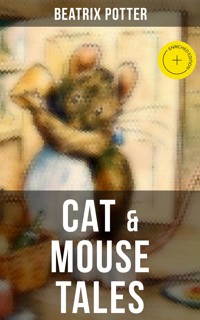
In Beatrix Potter's 'Cat & Mouse Tales', readers are immersed in a whimsical world where anthropomorphic animals tackle various moral dilemmas. With charming illustrations and a simple yet engaging writing style, Potter presents timeless themes of friendship, loyalty, and bravery. The stories are set in a pastoral countryside, echoing the traditional English children's literature of the time. The clever interplay between the cat and mouse characters adds a layer of complexity that will appeal to readers of all ages. Beatrix Potter, known for her beloved 'Peter Rabbit' series, drew inspiration from her love of nature and animals. Her keen observation of wildlife and her passion for storytelling shine through in 'Cat & Mouse Tales'. Potter's dedication to conservation and her unique perspective on human-animal relationships are evident in this collection of stories. Readers who enjoy charming tales with moral lessons will be delighted by Beatrix Potter's 'Cat & Mouse Tales'. This book is a timeless classic that continues to captivate audiences with its enchanting storytelling and delightful characters. In this enriched edition, we have carefully created added value for your reading experience: - A comprehensive Introduction outlines these selected works' unifying features, themes, or stylistic evolutions. - The Author Biography highlights personal milestones and literary influences that shape the entire body of writing. - A Historical Context section situates the works in their broader era—social currents, cultural trends, and key events that underpin their creation. - A concise Synopsis (Selection) offers an accessible overview of the included texts, helping readers navigate plotlines and main ideas without revealing critical twists. - A unified Analysis examines recurring motifs and stylistic hallmarks across the collection, tying the stories together while spotlighting the different work's strengths. - Reflection questions inspire deeper contemplation of the author's overarching message, inviting readers to draw connections among different texts and relate them to modern contexts. - Lastly, our hand‐picked Memorable Quotes distill pivotal lines and turning points, serving as touchstones for the collection's central themes.
Sie lesen das E-Book in den Legimi-Apps auf:
Seitenzahl: 102
Veröffentlichungsjahr: 2017
Das E-Book (TTS) können Sie hören im Abo „Legimi Premium” in Legimi-Apps auf:
Ähnliche








CAT & MOUSE TALES
Published by
Books
Table of Contents
Introduction
This single-author collection, CAT & MOUSE TALES, gathers eight of Beatrix Potter’s illustrated stories in which felines and rodents take center stage. Published between 1903 and 1918, these compact tales exemplify her signature blend of natural observation and domestic comedy. Bringing them together illuminates an arc of recurring characters, settings, and concerns, from the workroom to the parlor, from cottage gardens to city streets. The purpose of this volume is not to present her entire oeuvre but to assemble a focused suite that traces how Potter tests manners, mischief, and neighborliness through the classic tensions and surprises of cat-and-mouse encounters. Read side by side, the narratives reveal variations on rivalry, refuge, and reconciliation within households both human and animal.
These works belong to the genre of illustrated children’s tales: brief narratives accompanied by watercolor plates that carry as much meaning as the prose. They are not novels, plays, diaries, or letters, but finely made picture-book stories designed for small hands and attentive eyes. Potter’s sentences are economical, her pacing exact, her humor dry. The subjects are familiar—sewing, baking, visiting, tidying—yet enlivened by animals who speak and scheme while remaining recognizably themselves. The tales demonstrate how images and text interlock: a change of posture, a tilt of a whisker, or a pattern on a teacup deepens character, mood, and plot without recourse to excess explanation.
First published in 1903, The Tailor of Gloucester sets its scene in a small shop at Christmastime, where a poor tailor faces an urgent commission to make a fine coat for the Mayor. Illness interrupts his work, and even his indispensable companion, the cat Simpkin, cannot wholly steady the household. Mice inhabit the workroom, darting among the scraps and skeins. Potter’s interest in craft—fabric, stitches, and the rituals of making—anchors the tale, while her pictures linger over tools and textures. The premise is simple: time is short, tempers are tested, and kindness is as necessary as skill in bringing a garment to completion.
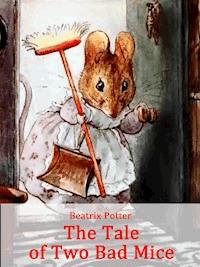
Published in 1904, The Tale of Two Bad Mice follows Hunca Munca and Tom Thumb as curiosity draws them into a doll’s house whose miniature elegance both attracts and frustrates them. The meticulously painted furnishings and imitation food highlight the difference between appearance and use, provoking mischief when expectations fail. The narrative stays close to the mice’s point of view, transforming a nursery toy into a full-sized abode with consequences for its owners. Without moralizing, Potter allows irritation, play, and restitution to intermingle, and she uses the close-up scale of her pictures to make tiny gestures carry the weight of intention.
In The Tale of the Pie and the Patty-Pan (1905), hospitality becomes a delicate game of nerves. Ribby, a cat, invites Duchess, a dog, to tea, and the prospect of pie—what kind it may be, and who will eat which—stirs polite anxieties and private plans. Potter builds comedy from social niceties, neighborhood gossip, and kitchen routines, illustrating china, ovens, and parlors with almost documentary attention. The premise depends on uncertainty and tact rather than overt conflict, and the humor arises from attempts to preserve appearances. The images and sentences alike savor domestic ritual, where appetite and etiquette negotiate a truce.
The Story of Miss Moppet first appeared in 1906 as a fold-out panorama designed for the very young, and its brevity showcases Potter’s command of visual timing. A kitten, Miss Moppet, is tempted to tease a mouse; the mouse, in turn, watches for an opportunity. The setting is spare, the action quick, and every movement matters. By distilling a familiar scene into a handful of poses and a few crisp lines, Potter demonstrates how play, pride, and patience can fit within a miniature frame. The tale’s charm lies in its clarity: nothing extraneous distracts from the simple contest of attention and reflex.
With The Tale of Tom Kitten (1907), domestic expectations and outdoor freedom meet in a garden on a visiting day. Tabitha Twitchit dresses her kittens in their best clothes, hoping for spotless behavior; the garden, however, invites climbing, chasing, and unplanned adventures. Potter contrasts adult order with childish energy, allowing mud, buttons, and brambles to alter the day’s careful plans. Her pictures explore borders—paths, fences, steps—where rules seem firm until curiosity presses against them. The premise introduces a household whose rhythms, frustrations, and affections will recur, and it frames misbehavior not as wickedness but as the lively overflow of high spirits.
The Tale of Samuel Whiskers, first published in 1908 under the title The Roly-Poly Pudding and later issued in standard format with its present name, returns to that same house and traces what happens when a young cat wanders into the less visited spaces of roofs and walls. There he encounters the rats Samuel Whiskers and Anna Maria, whose schemes test the safety of household boundaries. Potter’s drawings map staircases, attics, and hidden passages with exacting care, turning architecture into suspense. The story’s premise is straightforward—straying leads to peril—but its force comes from textures, shadows, and the palpable sense of a labyrinth inside the home.
Published in 1910, The Tale of Mrs. Tittlemouse centers on a tidy wood-mouse determined to keep her rooms clean and her pantry in order. Visitors, however, do not always respect thresholds, and the genial yet disruptive Mr. Jackson, a toad, exemplifies the challenge of hospitality when one values neatness. The narrative moves from chamber to chamber, celebrating woven baskets, stored seeds, and well-swept floors while acknowledging how community unsettles domestic ideals. The premise turns housekeeping into drama: who may enter, what they may do, and how a host can remain gracious without surrendering all control. Order and kindness must find balance.
In The Tale of Johnny Town-Mouse (1918), a country mouse named Timmy Willie finds himself in the city, where he meets the urbane Johnny and experiences new foods, noises, and routines. Later, the contrast reverses, and the city mouse confronts the countryside. Potter frames the exchange as an exploration of pace, taste, and comfort rather than superiority, allowing both settings to reveal their charms and irritations. The pictures juxtapose hedgerows and cobbles, barns and dining rooms, while the prose weighs preference against adaptability. The premise asks how creatures decide where they belong and what constitutes a good life under differing conditions.
Read together, these tales show Potter’s steady interest in manners, appetite, craft, and shelter. Cats and mice serve as foils: stealth and ceremony, order and opportunism, fear and curiosity. Her style is marked by concise narration, precise vocabulary, and watercolors attentive to fur, fabric, crockery, and light. Scale is a constant device; a doll’s house or a mousehole becomes a world, while a staircase can suggest both authority and escape. Dialogue and description are sparing, allowing posture and placement to carry meaning. The resulting art of small things grants everyday objects moral and comic resonance without exaggeration or sentimentality.
The lasting significance of these stories lies in their clarity of observation and their humane humor. By assembling them in one volume, CAT & MOUSE TALES foregrounds how variations on a shared cast and motif can yield fresh situations and tones across fifteen years of work. The collection offers paths for different kinds of reading—aloud with children, sequentially to notice echoes, or singly to appreciate a particular setting. It honors Potter’s integration of image and word, her respect for the textures of ordinary life, and her conviction that small dramas, carefully rendered, deserve a permanent place on the shelf.
Author Biography
Beatrix Potter (1866–1943) was an English author-illustrator whose small-format picture books reshaped early twentieth-century children’s literature. Her finely observed watercolours and concise prose brought animal characters and domestic settings to life with unusual naturalism and restraint. Working in an era of lavish gift books, she established a distinctive blend of field observation, narrative economy, and quiet humor. The titles gathered here—The Tailor of Gloucester; The Tale of Two Bad Mice; The Tale of the Pie and the Patty-Pan; The Story of Miss Moppet; The Tale of Tom Kitten; The Tale of Samuel Whiskers (The Roly-Poly Pudding); The Tale of Mrs. Tittlemouse; and The Tale of Johnny Town-Mouse—demonstrate her range and technical control.
She was largely educated at home, developing an early discipline of drawing from life that shaped both her illustration and storytelling. Sketchbooks from her youth record animals, plants, and fungi rendered with patient attention to structure and gesture. She studied natural specimens and visited museums, and her careful drawings of mushrooms and other organisms reveal an interest in observation that would guide her art. Regular time in the English countryside, especially the Lake District, sharpened her sense of landscape, weather, and rural work. These influences—scientific looking, close-up detail, and a sympathy for everyday labor—became hallmarks of her later books.
Potter’s path to publication began with illustrated letters sent to children she knew, where she paired brief, rhythmic prose with lively vignettes. From this practice she developed self-contained tales and a distinctive small book format designed for small hands. The Tale of Peter Rabbit proved the viability of her approach and opened the way for a sustained series. Early follow-ups drew on real places and careful household observation. Within a few years she had established a readership that trusted her balance of mischief, consequence, and kindness—an approach that frames several works in this collection, from The Tailor of Gloucester to The Tale of Two Bad Mice.
The Tailor of Gloucester exemplifies her respect for skilled craft. It celebrates patience, precision, and the dignity of making, while also revealing her delight in miniature interiors and textiles. The Tale of Two Bad Mice tests the boundary between impulse and restitution within a meticulously drawn doll’s house. The Tale of the Pie and the Patty-Pan turns on social ritual—visits, tea, and polite misunderstanding—allowing Potter to explore plates, ovens, and parlors with near-anthropological care. Across these works, she sets gentle humor against exact detail, creating stories that feel both intimate and sturdily built.
Her feline-and-rodent sequence reveals a keen sense of pacing and architecture. The Story of Miss Moppet compresses a cat-and-mouse encounter into a brisk study of timing and reversal. The Tale of Tom Kitten observes the friction between orderly ceremony and youthful high spirits, while The Tale of Samuel Whiskers (The Roly-Poly Pudding) returns to the same domestic setting with sharper danger and tighter corridors. By revisiting locations and characters, she creates a lightly connected world in which actions echo across books. The interiors—stairs, cupboards, wainscoting—are drawn with structural clarity, grounding capers in recognizable spaces and lending suspense to every turn.
Later titles in this selection show her growing interest in upkeep, manners, and competing notions of comfort. The Tale of Mrs. Tittlemouse follows a meticulous housekeeper whose efforts are tested by intruders and mess, balancing exasperation with civility. The Tale of Johnny Town-Mouse contrasts urban briskness with rural quiet, framing curiosity and hospitality as reciprocal virtues rather than opposites. The drawing remains precise, but the prose grows even more economical, trusting images to carry mood and implication. These books extended her audience while confirming her method: limited means, carefully chosen words, and watercolor plates that invite close, lingering looking.
From the 1910s onward, Potter devoted increasing energy to farming and land stewardship in the Lake District, writing less frequently while continuing to sketch and observe. She managed working properties and supported conservation of local breeds and landscapes, an outlook consistent with her books’ care for place and craft. She died in 1943, leaving a body of tales that have remained continuously in print and widely read. Their influence endures in picture-book pacing, page design, and the respectful portrayal of children’s feelings. The titles in this collection continue to reward attention for their structure, humor, and unshowy technical excellence.