0,49 €
Niedrigster Preis in 30 Tagen: 1,99 €
Niedrigster Preis in 30 Tagen: 1,99 €
Mehr erfahren.
- Herausgeber: Booksell-Verlag
- Kategorie: Lebensstil
- Sprache: Englisch
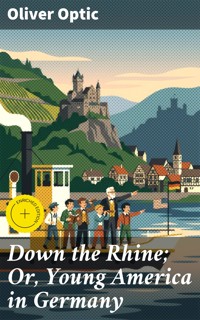
In "Down the Rhine; Or, Young America in Germany," Oliver Optic takes readers on an engaging journey along the historic river Rhine, blending an adventure narrative with educational commentary on the customs and landscapes of Germany. With a vibrant literary style, Optic employs rich descriptions and lively characters that epitomize the youthful spirit of exploration and curiosity prevalent in 19th-century American literature. The book, characteristic of the literary context of its time, reflects the cultural exchanges and burgeoning interest in foreign lands that defined an era of American expansion and self-discovery. Oliver Optic, born William Taylor Adams, was a prominent author during the Golden Age of children's literature in America. His own extensive travels across Europe, coupled with his belief in the importance of character building through adventure, informed his writing. Optic's work often sought to instill moral lessons in his young readers, making them not only entertained but also informed about the wider world, which was particularly relevant as America began to play a larger role on the global stage. I highly recommend "Down the Rhine" for readers who appreciate historical adventures woven with cultural insights. It is an exemplary work that not only captivates the imagination but also enhances understanding of transatlantic relations during a transformative period in both American and European history. In this enriched edition, we have carefully created added value for your reading experience: - A succinct Introduction situates the work's timeless appeal and themes. - The Synopsis outlines the central plot, highlighting key developments without spoiling critical twists. - A detailed Historical Context immerses you in the era's events and influences that shaped the writing. - A thorough Analysis dissects symbols, motifs, and character arcs to unearth underlying meanings. - Reflection questions prompt you to engage personally with the work's messages, connecting them to modern life. - Hand‐picked Memorable Quotes shine a spotlight on moments of literary brilliance. - Interactive footnotes clarify unusual references, historical allusions, and archaic phrases for an effortless, more informed read.
Das E-Book können Sie in Legimi-Apps oder einer beliebigen App lesen, die das folgende Format unterstützen:
Veröffentlichungsjahr: 2019
Ähnliche


















Down the Rhine; Or, Young America in Germany
Table of Contents
Introduction
Travel promises freedom, yet it also tests how firmly identity and judgment hold when everything familiar drops away.
Down the Rhine; Or, Young America in Germany is a nineteenth-century juvenile travel-adventure by Oliver Optic, the pen name of William Taylor Adams, written for young readers during an era when American youth literature often blended instruction with entertainment. Set largely along the Rhine and in Germany, the book uses a journey through celebrated European landscapes as the frame for plot and reflection. Its title signals both movement and encounter: a passage through places long invested with history, legend, and national character, seen through American eyes.
The story follows young American travelers as they move from city to city, meeting new companions, observing customs, and facing the ordinary frictions and surprises that come with being abroad. The narrative energy comes less from a single mystery than from the succession of scenes and decisions that travel produces: misunderstandings, rapid changes of plan, moments of risk, and opportunities for courtesy or impulsiveness. Readers can expect a brisk, event-driven progression, with the journey itself supplying continual variety and the sense of forward motion.
Optic’s voice is characteristically direct and accessible, built for readability and momentum. Description tends to be purposeful, offering enough local color to place the reader while keeping attention on action and conduct. The tone is earnest without being dour, with a clear preference for clarity, discipline, and practical good sense. Dialogue and incident are used to keep lessons embodied in situations rather than set apart as lectures. The result is a travel narrative that aims to be both pleasurable and improving, inviting readers to learn by watching characters navigate unfamiliar ground.
A central tension lies between curiosity and certainty: how to remain open to difference without surrendering one’s principles or misreading what one sees. The book repeatedly turns on the ethics of representation, asking what it means to interpret another country fairly when one is shaped by national pride and limited experience. It also foregrounds self-control, responsibility, and the social demands of travel, where small acts can carry outsized consequences. Alongside these themes runs an implicit meditation on education itself, suggesting that experience can be a rigorous classroom.
The Rhine setting matters not only as scenery but as an idea, a corridor of memory where modern travelers confront layered histories and inherited stories. By placing young Americans in that environment, the novel explores how encounters with European tradition can sharpen questions about modernity, citizenship, and personal ambition. It also reflects the period’s confidence in mobility and improvement, while exposing the anxieties that accompany cross-cultural contact. The travelogue structure keeps the focus on process rather than destination, emphasizing the gradual shaping of judgment.
For contemporary readers, the book remains useful as a window into how American youth fiction once taught global awareness through adventure, and how travel was imagined as both privilege and test. Its concerns anticipate modern questions about tourism, cultural misunderstanding, and the formation of character under public scrutiny. Read today, it can be approached as an engaging period narrative and as a document of literary pedagogy, prompting reflection on what we expect from stories that claim to broaden horizons. It offers a compact reminder that seeing more of the world does not automatically mean understanding it.
Synopsis
Down the Rhine; Or, Young America in Germany by Oliver Optic is a juvenile travel-adventure that follows a party of American youths and their guardians as they journey through Germany, with the Rhine River providing the book’s central route and organizing thread. The narrative frames sightseeing as both recreation and instruction, using movement from place to place to introduce history, customs, and everyday life. The travelers’ curiosity and high spirits repeatedly test the boundaries of propriety and planning, establishing a steady tension between youthful impulsiveness and the discipline needed for safe, respectful travel abroad.
paragraphs
As the group enters German-speaking regions, the story emphasizes first impressions: language differences, unfamiliar etiquette, and the practical demands of lodging, meals, and transportation. Optic uses these encounters to compare American habits with European social expectations, often turning small misunderstandings into lessons about patience and adaptability. The young Americans approach monuments and landscapes with romantic excitement, while adult figures press for careful observation and responsible conduct. This contrast drives much of the early action, as the party learns to balance spontaneity with the constraints of schedules and local rules.
paragraphs
Following the Rhine’s towns and river traffic, the book repeatedly blends scenic description with episodes of minor conflict that arise from the travelers’ decisions. Castles, ruins, and celebrated viewpoints function as prompts for discussion of German history and regional identity, while markets and inns reveal contemporary manners. The youths’ eagerness to explore can lead to momentary separations, awkward encounters, or disputes over what is prudent, giving the journey a plot beyond mere itinerary. Yet the narrative remains anchored in the idea that travel should cultivate knowledge, self-command, and respect for others.
paragraphs
As the tour continues, the group encounters a range of local figures—service workers, fellow travelers, and community members—who shape the Americans’ understanding of German life. Conversations and observations introduce differences in education, civic order, and social hierarchy without reducing the trip to simple comparison. The river itself becomes a stage for shifting moods: calm passages that encourage reflection and busier stretches that demand attention to safety and coordination. Through these sequences, the book reinforces its central question of how young people can grow in judgment while still retaining enthusiasm for discovery and adventure.
Historical Context
Oliver Optic’s Down the Rhine; Or, Young America in Germany appeared in the later nineteenth century, when U.S. publishers issued large quantities of juvenile “travel and adventure” fiction. The book is set in the German lands along the Rhine River, a corridor long associated with commerce, castles, and tourism. Its viewpoint reflects the expanding reach of American readers who increasingly encountered Europe through guidebooks, steamship travel, and serialized narratives. By placing young Americans abroad, the novel draws on a common post–Civil War interest in education through travel and in comparing American civic ideals with European institutions.
paragraphs
The Rhine region had become a major destination for international travelers after the end of the Napoleonic Wars in 1815, when political boundaries stabilized and Romantic writers popularized the landscape. During the nineteenth century, river travel was transformed by steam navigation, while railways increasingly paralleled the river, connecting cities such as Cologne, Koblenz, Mainz, and Mannheim. These changes made itineraries down the river efficient and predictable, supporting the rise of organized tourism and standardized routes. The book’s river setting therefore reflects a modern transportation network that enabled middle-class travel and shaped how visitors experienced “picturesque” Europe.
paragraphs
The political background of the setting is German unification. After the Austro-Prussian War (1866), Prussia led the North German Confederation, and the Franco-Prussian War (1870–1871) culminated in the proclamation of the German Empire in 1871 under Kaiser Wilhelm I. The Rhine carried strong symbolic weight in this era, serving as a perceived western frontier and a focus of nationalist sentiment during Franco-German rivalry. A story moving through Rhineland towns thus occurs in a landscape where new imperial institutions, Prussian administration, and national identity were being consolidated in public life, education, and military culture.
paragraphs
Religious and cultural divisions also marked the Rhine. The Rhineland contained large Catholic populations within a predominantly Protestant-led empire, and it became a key arena for the Kulturkampf, the conflict between Otto von Bismarck’s government and the Catholic Church in the 1870s. Policies such as the May Laws sought greater state control over clerical appointments and education, producing political mobilization among Catholics and strengthening the Centre Party. Even when not treated directly, this tension helps explain why questions of schooling, civic authority, and local loyalties could appear salient to travelers observing German society and its institutions during the decades after unification.
paragraphs maxLength=1830],