Erhalten Sie Zugang zu diesem und mehr als 300000 Büchern ab EUR 5,99 monatlich.
- Herausgeber: Musaicum Books
- Kategorie: Sachliteratur, Reportagen, Biografien
- Sprache: Englisch
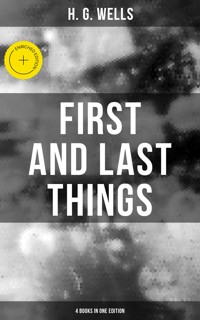
H. G. Wells' 'First and Last Things' is a captivating collection that combines four of his thought-provoking and timeless works in one edition. This anthology delves into a wide range of topics, from philosophical musings on life and science to reflections on the future of humanity. Wells' literary style is marked by his ability to seamlessly blend science fiction elements with profound philosophical inquiry. His exploration of existential questions in a futuristic setting provides readers with a unique and engaging reading experience that challenges conventional beliefs. The interconnected themes of the four books offer a comprehensive look at Wells' visionary thinking and literary craftsmanship. H. G. Wells, a prolific British author known for his seminal works in science fiction, drew inspiration from his observations of society and his own experiences to write 'First and Last Things'. Wells' background in biology and sociology informed his speculative fiction, making him a pioneer in the genre. His keen interest in scientific advancements and their impact on humanity is evident in the depth and complexity of his narratives. I highly recommend 'First and Last Things' to readers interested in thought-provoking literature that explores the intersection of science, philosophy, and humanity. H. G. Wells' timeless insights and visionary storytelling make this collection a must-read for anyone seeking a deeper understanding of the human condition and the future of civilization. In this enriched edition, we have carefully created added value for your reading experience: - A comprehensive Introduction outlines these selected works' unifying features, themes, or stylistic evolutions. - The Author Biography highlights personal milestones and literary influences that shape the entire body of writing. - A Historical Context section situates the works in their broader era—social currents, cultural trends, and key events that underpin their creation. - A concise Synopsis (Selection) offers an accessible overview of the included texts, helping readers navigate plotlines and main ideas without revealing critical twists. - A unified Analysis examines recurring motifs and stylistic hallmarks across the collection, tying the stories together while spotlighting the different work's strengths. - Reflection questions inspire deeper contemplation of the author's overarching message, inviting readers to draw connections among different texts and relate them to modern contexts. - Lastly, our hand‐picked Memorable Quotes distill pivotal lines and turning points, serving as touchstones for the collection's central themes.
Sie lesen das E-Book in den Legimi-Apps auf:
Seitenzahl: 319
Veröffentlichungsjahr: 2017
Das E-Book (TTS) können Sie hören im Abo „Legimi Premium” in Legimi-Apps auf:
Ähnliche












FIRST AND LAST THINGS
(4 Books in One Edition)
Published by
Books
Table of Contents
Introduction
FIRST AND LAST THINGS (4 Books in One Edition) presents the complete text of H. G. Wells’s single, sustained work of personal philosophy, arranged as the author framed it: an opening introduction and four successive books. Written in the early twentieth century, it stands apart from Wells’s novels and scientific romances as a deliberate attempt to set out his considered views on reality, belief, conduct, and personal experience. The purpose of gathering these parts into one continuous edition is to provide a coherent reading of the whole argument, enabling general readers and students to approach the work as an integrated statement.
Unlike the imaginative narratives for which Wells is widely known, this volume is unapologetically nonfiction. It combines reflective essay, philosophical exposition, and autobiographical confession. The author addresses what one can reasonably think about the world, what commitments may be responsibly held, and how those commitments should inform a life. By bringing together his positions in a single work, he invites scrutiny of the grounds of conviction rather than deference to authority. The result is neither a theological manual nor a textbook of philosophy, but a lucid account of a writer’s intellectual conscience at a particular moment in his career.
The collection follows the original internal architecture. The introductory section states the impulse and method of the undertaking, preparing the reader for a measured inquiry rather than an inflexible system. Book the First considers the broadest questions about the nature of reality and how one might talk about it without claiming final knowledge. Book the Second turns to belief, examining the place of religious and moral commitment in a world shaped by inquiry. Book the Third addresses general conduct, asking how principles translate into everyday action. Book the Fourth concludes with personal matters that anchor abstractions in lived experience.
The text types represented here are essays and reflective prose, with passages that approach memoir when the author uses episodes from his life to clarify a point. There are no fictional episodes, letters, or poems; the mood is philosophical and confessional rather than narrative. The prose moves from general propositions to illustrative cases, balancing argument with candour. Readers will encounter analysis, self-criticism, and constructive proposals for thought and behavior. The work’s unity lies not in a story but in a sustained line of reasoning that links a worldview to a practical orientation toward the world.
Across its parts, the volume advances themes that recur throughout Wells’s wider oeuvre: an insistence on intellectual honesty, a respect for scientific habits of mind, and a refusal of dogmatic finality. It asks how provisional knowledge can guide firm action, how private conviction relates to public responsibility, and how one might reconcile individual aspiration with social obligation. The author’s emphasis falls on workable beliefs and testable attitudes rather than on metaphysical closure. The result is a humane, forward-looking temper that seeks to make thinking serve conduct and to align personal integrity with a broader civic purpose.
Stylistically, the writing is direct, emphatic, and paced for clarity. Wells builds his case through careful definitions, graduated transitions, and illustrative comparisons, preferring plain terms to technical vocabulary. The argumentative energy familiar from his social essays is present, yet tempered by a reflective patience that acknowledges uncertainty. The prose strives for accessibility without sacrificing precision, and it avoids ornament that would obscure the steps of reasoning. Readers will recognize a characteristic confidence in mapping large fields of inquiry, coupled with a practical turn toward consequences—an approach that makes complex issues traceable and their implications for life unmistakably clear.
Book the First sets the stage by confronting the limits and possibilities of general ideas about the world. Rather than constructing a rigid system, the author sketches a working orientation rooted in experience and open to revision. He explores how language, perspective, and evidence shape what can be said about reality, and he resists claims that exceed what inquiry can support. The premise is that a usable map of things is better than a complete but illusory chart. This initial portion provides the conceptual footing for everything that follows, establishing method as a counterpart to conviction.
Book the Second addresses the terrain of belief, where questions of religion, meaning, and moral commitment arise. Here the author weighs the claims of inherited doctrines against the demands of sincerity and examination. He asks what it means to affirm something in good faith when knowledge remains incomplete, and how belief can be oriented toward human betterment without pretending to certainty. Institutions and traditions appear as living contexts rather than ultimate authorities. The emphasis falls on commitments that foster inquiry, cooperation, and hope while remaining answerable to experience and reason.
Book the Third turns from principles to practice. It considers general conduct: how one might order a life in light of the foregoing outlook. The author discusses habits of attention, the discipline of self-criticism, and the cultivation of dispositions that sustain truthfulness and generosity. He is concerned with the relation between personal aims and common welfare, and with the ways private choices bear public consequences. The tone remains practical, describing the kinds of actions and restraints that make a life coherent. This segment tests the earlier ideas by the demands of daily living and civic engagement.
Book the Fourth returns to the personal sphere, acknowledging the sources of conviction in temperament, experience, and circumstance. Without offering a chronological narrative, the author reflects on the influences that have shaped his thinking and the responsibilities entailed by authorship. The intent is not to elevate private life above principle, but to show how general views take on weight in concrete situations. By drawing these strands together, this closing portion gives the work a human center, reminding the reader that philosophy gains authority when it is seen at work in a particular life.
The lasting significance of this volume lies in the way it clarifies the animating purposes behind Wells’s broader writing. Many of the concerns that organize his fiction and social commentary—confidence in progress tempered by caution, emphasis on education, and attention to collective futures—find explicit formulation here. Readers who know him as a novelist will discover the premises that inform his imaginative worlds, while those approaching him as an essayist will find a comprehensive account of his intellectual stance. This text thus serves as a key to themes that resonate across his career.
This four-in-one edition offers a continuous reading experience that honors the work’s original coherence while making it convenient for study and reflection. It invites readers to engage actively: to test propositions, to measure beliefs by their fruits, and to consider how a reasoned outlook might shape conduct. By bringing the Introduction and all four books together, the volume presents Wells’s most concentrated statement of his convictions in a single, accessible form. The pages that follow ask for attention rather than agreement, promising not final answers but a disciplined path toward clearer seeing and steadier living.
Author Biography
Introduction
Herbert George Wells (1866–1946) stands among the most influential English writers of the modern era, acclaimed for scientific romances that helped define science fiction and for social novels that probed the fortunes of Britain’s lower middle classes. Works widely associated with his reputation include The Time Machine, The War of the Worlds, The Invisible Man, and The Island of Doctor Moreau, alongside later undertakings such as The Outline of History. A trained biologist turned journalist and novelist, Wells combined scientific speculation with social critique, producing narratives that were both entertaining and argumentative, and shaping public conversations about technology, progress, and human responsibility.
This four‑book collection situates Wells’s achievements within the sweep of his career, emphasizing how his fiction, non‑fiction, and public commentary intersect. From the prophetic energies of the early scientific romances to the realism of Kipps and Tono‑Bungay, and the grand historical synthesis of The Outline of History, the selection underscores a writer who fused lucid prose with ambitious ideas. Across Book the First through Book the Fourth, readers encounter not only emblematic narratives and themes—evolution, imperial anxieties, social mobility, and world order—but also a method: speculative imagination grounded in verifiable science and vigorous public debate.
Education and Literary Influences
Wells grew up in modest circumstances in Bromley, Kent, and entered Midhurst Grammar School after an early apprenticeship. A scholarship in the late 1880s took him to the Normal School of Science in South Kensington, where he studied biology under T. H. Huxley. Although he left without a degree, the training embedded evolutionary thinking, experimental method, and clear expository habits that shaped his later writing. He supported himself as a teacher and lecturer before turning to journalism and fiction. The discipline of science—observation, hypotheses, and systems—became the bedrock of his storytelling, evident from the first wave of speculative narratives onward.
Intellectually, Wells blended scientific naturalism with the narrative inheritance of English realism. Darwin and Huxley supplied a framework for understanding adaptation, struggle, and contingency; Jules Verne demonstrated an appetite for extrapolative adventure; and Charles Dickens modeled social observation and comic verve that echo through Kipps and The History of Mr Polly. Utopian thought—from nineteenth‑century reformers and futurists—encouraged his large‑scale designs in A Modern Utopia and later in The Outline of History. This synthesis enabled a distinctive voice: empirical in spirit yet boldly imaginative, moralizing without sermonizing, and committed to presenting scientific and social questions in accessible, popular forms.
Literary Career
Wells first gained notice through essays and short stories before a sequence of “scientific romances” in the 1890s established his name. The Time Machine introduced a concise, idea‑driven narrative architecture: a plausible device, a carefully reasoned extrapolation, and a social parable distilled into swift episodes. Its engagement with evolution and class dynamics showed his talent for embedding argument in adventure. Reviewers recognized the novel’s ingenuity and unsettling implications, and readers responded to its blend of wonder and critique. This method—compact speculation with pointed social resonance—became a hallmark he refined across subsequent works and that informs selections in this collection.
He followed rapidly with The Island of Doctor Moreau, The Invisible Man, and The War of the Worlds, an extraordinary run that tested the ethics of experiment, the perils of invisibility and alienation, and the vulnerabilities of imperial societies. Each narrative marries scientific premises to moral inquiry: vivisection and responsibility, scientific isolation and social bonds, invasion and technological asymmetry. Their reception cemented Wells as a leading modern storyteller whose speculative frames exposed contemporary anxieties. The books’ durable afterlives—in classrooms, adaptations, and critical debate—reflect the clarity of his fables and their capacity to absorb changing historical concerns.
Around 1900, Wells widened his range with realistic and satirical novels of aspiration and disillusionment. Love and Mr Lewisham examined youthful ideals; Kipps and Tono‑Bungay traced class mobility and commercial modernity; The History of Mr Polly depicted a comic escape from stifling routine; Ann Veronica dramatized a woman’s struggle against constraining social codes. These works demonstrated that the author of extraterrestrial invasions and time travel could also anatomize everyday lives with sympathy and bite. Critics often praised the freshness and topicality, while controversies—especially around Ann Veronica—attested to his willingness to confront prevailing gender and moral conventions.
The speculative mode continued in dialogue with these social novels. The First Men in the Moon imagined alternative physics and social organization; A Modern Utopia set forth a blueprint for a rationalized world state; The Food of the Gods explored the unintended consequences of unleashed growth. On the eve of the First World War, The World Set Free anticipated explosives powered by atomic energy and global upheaval, a striking instance of Wells’s forecasting impulse. The coexistence of extrapolation and reformist argument typifies the breadth highlighted in this collection, where narrative experiment and programmatic thinking continually inform one another.
After the war, Wells undertook synthesis on a grand scale with The Outline of History, an ambitious world history that reached a vast readership and shaped popular historical understanding. He pursued allied projects—The Open Conspiracy and The Work, Wealth and Happiness of Mankind—that argued for planned, scientifically literate societies. In the 1930s, The Shape of Things to Come extended his futurological fiction and led to his celebrated collaboration on the film Things to Come. Experiment in Autobiography offered a candid reckoning with his methods and aims, revealing how pedagogy, polemic, and storytelling converged throughout the phases represented in this four‑book collection.
Beliefs and Advocacy
Wells’s writing was inseparable from advocacy. Associated for a time with the Fabian Society, he pressed for social reform, broader access to education, and governance shaped by scientific expertise. He argued for women’s autonomy and critiqued restrictive sexual and marital norms, themes dramatized in Ann Veronica. Internationalism and the prospect of a world state preoccupied him from A Modern Utopia through The Open Conspiracy, reflecting a conviction that modern technologies required coordinated global solutions. Though often controversial, his public positions were consistent in their faith that rational inquiry, democratic participation, and planned institutions could mitigate conflict and poverty.
As a public intellectual, Wells used journalism, lectures, and interviews to extend his reach beyond the page. He engaged political leaders and audiences across Europe and the United States, urging preparedness for air war, nuclear dangers implied by modern physics, and economic reorganization to address mass unemployment. His capacity to popularize intricate concepts—evolutionary theory, energetics, social statistics—made him a conduit between specialist knowledge and general readers. The prophetic sheen of works like The World Set Free lay not in precise prediction but in dramatizing trajectories already visible, a strategy that kept his arguments alive in public policy debates and in cultural memory.
Final Years & Legacy
In his later decades, Wells continued to publish across genres, including The Work, Wealth and Happiness of Mankind, The Shape of Things to Come, and reflective or admonitory texts such as Experiment in Autobiography and Mind at the End of its Tether. Living through two world wars sharpened his anxieties about disorder and galvanized his calls for informed global governance. He died in London in 1946. His legacy rests on a dual achievement: he enlarged the possibilities of speculative fiction and advanced a layperson’s education in science and history. The narratives and arguments surveyed in this collection continue to animate discussions of technology, ethics, and planetary futures.
Historical Context
H. G. Wells wrote across a turning point from late Victorian to Edwardian Britain, when industrial capitalism, mass politics, and scientific culture reshaped public life. First and Last Things, collected here with its Introduction and four Books, belongs to the years around 1908, after his burst of “scientific romances” and amid a pivot toward social theory and ethical reflection. The collection registers a world of rapid urban growth, imperial anxieties, new democratic energies, and challenges to traditional religion. It offers a personal yet historically situated attempt to construct a secular creed, seeking orientation for individuals and societies confronted by unprecedented technological and institutional change.
Wells’s outlook was formed by education under T. H. Huxley at the Normal School of Science in London in the mid-1880s, where Darwinian evolution and scientific method were taught as intellectual disciplines rather than mere doctrines. Born in 1866 to a family of modest means, he moved from shop-floor apprenticeships and school teaching into scholarship-supported study, absorbing the era’s confidence in systematic inquiry. This background made him an unusually public exponent of “scientific naturalism.” When he later turned to explicit philosophical writing, he brought with him habits of hypothesis, experiment, and critique, framing questions of belief and conduct as problems for organized, evidence-respecting thought rather than for authority or tradition.
By the early 1900s Wells had become an internationally known writer, with works like The Time Machine (1895), The War of the Worlds (1898), Anticipations (1901), and A Modern Utopia (1905). These books established him as both storyteller and social prognosticator. Around 1908 he gathered his ethical and metaphysical reflections into First and Last Things, offering a “confession of faith and rule of life.” The move from speculative fiction to explicit statement reflected a broader Edwardian appetite for systems and manifestos—seen in reform tracts, feminist platforms, and Fabian pamphlets—through which public figures sought to stabilize values under conditions of accelerated change.
The intellectual environment was marked by the rise of agnosticism (a term popularized by Huxley), the authority of evolutionary biology, and the spread of higher criticism of scripture. In Britain, Nonconformist traditions, Anglican modernism, and secular free thought all contended for cultural influence. In Roman Catholicism, the papal encyclical Pascendi (1907) condemned “Modernism,” underscoring how destabilizing new scholarship felt to established churches. Wells’s Introduction and Book the Second respond to this religiously fluid scene by proposing a workable, non-dogmatic pattern of belief—seeking ethical orientation without recourse to doctrinal certainty, and insisting that convictions be held as revisable hypotheses rather than final revelations.
Politics also pressed upon Edwardian consciences. The Liberal landslide of 1906 opened a period of social legislation—old-age pensions (1908), labour protections, and the “People’s Budget” (1909)—culminating in constitutional crisis and the Parliament Act (1911). Wells, who had joined the Fabian Society in 1903, urged organizational renewal and clashed with figures like Sidney and Beatrice Webb and George Bernard Shaw before resigning around 1908. These debates over gradualism, expertise, and democracy inform Book the Third’s concern with conduct and civic responsibility. The work mirrors tensions between technocratic planning and participatory reform that structured British progressivism before the First World War.
Social inquiry made poverty newly visible. Charles Booth’s and Seebohm Rowntree’s empirical studies (from the 1890s to 1901) mapped structural deprivation in London and York, undermining moralistic explanations and legitimating state intervention. National “efficiency” campaigns after the Boer War (1899–1902) tied social health to military and economic performance. Wells’s earlier Mankind in the Making (1903) addressed education, childhood, and social organization within this evidence-based climate. In First and Last Things he extends that impulse into personal ethics, treating conduct as a system of practices responsive to data about human welfare, not as a closed code inherited from the past.
Technologies recalibrated horizons. Electricity, wireless telegraphy, and mass print integrated publics; bicycles, motorcars, and underground railways reconfigured cities; and aviation took off after 1903, with European demonstrations in 1908–1909. Wells registered these upheavals vividly in The War in the Air (1908). The collection’s ethical universalism belongs to this moment of shrinking distances and synchronized risks. When Book the First reaches for cosmopolitan frames and Book the Third addresses the responsibilities of modern life, they do so against the sense that technique can scale both benefit and harm, requiring a morality that anticipates systemic effects beyond local custom.
Empire, war scares, and geopolitics shadow the period. Britain emerged from the Boer War chastened by logistical strain and international criticism. Naval rivalry with Germany accelerated after HMS Dreadnought (1906), and public debate hardened around preparedness and arbitration. Wells’s prewar writings often argued for world-minded solutions, anticipating his later advocacy of a “world state.” First and Last Things channels these pressures into ethical cosmopolitanism rather than policy blueprints. It treats loyalty, duty, and international fellow-feeling as problems of scale and imagination, shaped by a world-system in which isolated national moralities increasingly collided with global interdependence.
Education reforms provided a practical route for ethical change. The 1902 Education Act centralized local provision and expanded secondary schooling, while adult education, mechanics’ institutes, and the university extension movement offered new ladders of mobility. Wells’s own escape from the shop through scholarships made schooling an ethical as well as social priority. The Introduction frames the book as a disciplined attempt to “state one’s case,” consistent with the era’s belief that trained minds could be formed for citizenship. In this context, his emphasis on clarity, method, and self-critique reads as an educational program for personal life as much as a statement of beliefs.
Philosophy in the 1900s was in transition. British idealism still held sway in many universities, but it faced challenges from early analytic philosophy (G. E. Moore, Bertrand Russell), from William James’s pragmatism (1907), and from Henri Bergson’s vitalist currents. While not a technical philosopher, Wells converged with pragmatic habits of thought: workable beliefs, tested by consequences, provisionally held. Book the First situates metaphysics as a set of guiding conceptions rather than closed systems, reflecting a broader Edwardian impatience with scholastic authority and a turn toward concepts that could organize action under uncertainty, without claiming absolute foundations.
Scientific frameworks offered Wells a cosmology. Darwinian evolution dissolved static hierarchies; geology and astronomy extended time and space; thermodynamics recast the universe as energetic process. Wells had dramatized entropy and extinction in The Time Machine and impersonal cosmic threat in The War of the Worlds. In First and Last Things he domesticates those vistas into a metaphysical temper: humility before vast processes, and rejection of anthropocentric guarantees. Book the First’s language of “first and last” draws on this scientific sublime, situating the human ethical project within a universe not designed for our comfort yet intelligible to disciplined inquiry.
Debates about belief were reframed by scholarship and comparison. The “higher criticism” of the Bible, German theology, and historical philology encouraged seeing scriptures as human documents. Comparative religion, exemplified by James Frazer’s The Golden Bough (first published 1890, expanding thereafter), circulated widely in Britain. Ethical societies—such as the South Place Ethical Society—modeled communal morality without theology. Book the Second responds within this milieu, sketching an ethic that honors reverence and purpose while freeing them from creedal infallibility. Its tone resembles contemporary attempts at a “religion of humanity,” while preserving the scientific insistence that piety not override verifiable knowledge.
Questions of conduct in Edwardian Britain were inseparable from gender and family reform. Debates over the “New Woman,” marriage law, birth control, and women’s paid work escalated as suffrage activism intensified after 1905. Wells’s novel Ann Veronica (1909) dramatized these conflicts and provoked controversy for its frankness. Book the Third addresses personal duty, partnership, and truthfulness in ways legible against this backdrop: the claim that honest relations and mutual autonomy could replace conventional prudery. Without prescribing detailed programs, the collection acknowledges how social roles were being renegotiated amid broader claims for political and educational equality.
Public health and social hygiene movements shaped arguments about collective well-being. From late-Victorian sanitation reforms to early twentieth-century campaigns on housing and nutrition, the state’s remit expanded. Contemporaneously, eugenics—allied to the work of Francis Galton—entered mainstream debate, informing policies and popular discourse. Wells participated in discussions of population, education, and “efficiency” in Anticipations (1901) and other essays. Book the Third reflects the era’s confidence that coordinated knowledge could improve human outcomes, while modern readers also recognize the problematic currents intertwined with that confidence. The historical context thus clarifies both the ambition and the limits of Edwardian reformist ethics.
Book the Fourth’s personal turn is rooted in Wells’s social trajectory. Born to a shopkeeper-cricketer father and a mother who worked in service, Wells experienced class precarity, pupil-teaching, and a drapery apprenticeship before winning a scholarship in 1884. These experiences seeded a meritocratic conviction: disciplined learning could reconfigure a life. The autobiographical elements do not seek celebrity confession but illustrate how abstract principles translate into choices about work, friendship, and integrity. They belong to a period when self-formation—via reading societies, evening classes, and professional associations—was celebrated as the ethical complement to institutional reform.
The initial reception of First and Last Things placed it among Wells’s stream of non-fiction interventions, alongside Anticipations and A Modern Utopia. Reviewers noted its accessible voice and its refusal of theological closure, aligning it with a broader Edwardian hunger for lay philosophy. While not a technical treatise, it offered readers a portable framework amidst political agitation and intellectual flux. Its influence was diffuse rather than doctrinal, feeding into debates on education, civic responsibility, and secular ethics that crossed party and denominational lines and that would survive the shattering disillusionments of the First World War.
The collection also prefigures later arcs in Wells’s career. After the war he would write The Outline of History (1920), The Open Conspiracy (1928), and other manifestos for world organization and education. First and Last Things anticipates those efforts by staking a claim for method—clarity, provisional assent, responsibility—over metaphysical finality. It belongs to a chain of works that try to translate scientific and historical understanding into civic and personal norms, a task that would occupy Wells through the interwar years as global crises tested the very possibility of rational coordination at planetary scale. Its Edwardian roots give those later projects a foundation and a foil alike.
Synopsis (Selection)
Introduction
Wells frames the work as a candid statement of personal philosophy, setting out why he feels compelled to define his first principles and last commitments. The tone is exploratory and provisional, emphasizing honest inquiry, the limits of certainty, and a drive to connect scientific thinking with everyday conduct.
Book the First
Beginning from first principles, Wells examines what can be known and how we know it, testing assumptions against a skeptical, scientifically minded outlook. The section establishes a flexible metaphysical footing—neither dogmatic nor purely relativist—aimed at supporting coherent thought and action without claiming final certainty.
Book the Second
Building on that foundation, Wells articulates beliefs that guide meaning and value, distinguishing personal conviction from demonstrable fact. The emphasis falls on workable faiths—commitments that orient conduct and social purpose—expressed in a measured, argumentative tone that balances doubt with resolve.
Book the Third
Here Wells turns to general rules of life, translating abstract commitments into norms for personal behavior, social cooperation, and responsibility. The mood is practical and prescriptive, concerned with integrity, disciplined effort, and the alignment of individual aims with a broader human outlook.
Book the Fourth
The closing part applies the preceding ideas to the author’s own case, reflecting on habits, limitations, and aspirations as a test of the proposed rule of life. The tone is confessional and self-scrutinizing, underscoring recurring themes of intellectual honesty, constructive will, and the continual revision of one’s commitments in light of experience.
FIRST AND LAST THINGS (4 Books in One Edition)
Introduction.
Recently I set myself to put down what I believe. I did this with no idea of making a book, but at the suggestion of a friend and to interest a number of friends with whom I was associated. We were all, we found, extremely uncertain in our outlook upon life, about our religious feelings and in our ideas of right and wrong. And yet we reckoned ourselves people of the educated class and some of us talk and lecture and write with considerable confidence. We thought it would be of very great interest to ourselves and each other if we made some sort of frank mutual confession. We arranged to hold a series of meetings in which first one and then another explained the faith, so far as he understood it, that was in him. We astonished ourselves and our hearers by the irregular and fragmentary nature of the creeds we produced, clotted at one point, inconsecutive at another, inconsistent and unconvincing to a quite unexpected degree. It would not be difficult to caricature one of those meetings; the lecturer floundering about with an air of exquisite illumination, the audience attentive with an expression of thwarted edification upon its various brows. For my own part I grew so interested in planning my lecture and in joining up point and point, that my notes soon outran the possibilities of the hour or so of meeting for which I was preparing them. The meeting got only a few fragments of what I had to say, and made what it could of them. And after that was over I let myself loose from limits of time and length altogether and have expanded these memoranda into a book.
It is as it stands now the frank confession of what one man of the early Twentieth Century has found in life and himself, a confession just as frank as the limitations of his character permit; it is his metaphysics, his religion, his moral standards, his uncertainties and the expedients with which he has met them. On every one of these departments and aspects I write — how shall I put it?— as an amateur. In every section of my subject there are men not only of far greater intellectual power and energy than I, but who have devoted their whole lives to the sustained analysis of this or that among the questions I discuss, and there is a literature so enormous in the aggregate that only a specialist scholar could hope to know it. I have not been unmindful of these professors and this literature; I have taken such opportunities as I have found, to test my propositions by them. But I feel that such apology as one makes for amateurishness in this field has a lesser quality of self-condemnation than if one were dealing with narrower, more defined and fact-laden matters. There is more excuse for one here than for the amateur maker of chemical theories, or the man who evolves a system of surgery in his leisure. These things, chemistry, surgery and so forth, we may take on the reputation of an expert, but our own fundamental beliefs, our rules of conduct, we must all make for ourselves. We may listen and read, but the views of others we cannot take on credit; we must rethink them and “make them our own.” And we cannot do without fundamental beliefs, explicit or implicit. The bulk of men are obliged to be amateur philosophers,— all men indeed who are not specialized students of philosophical subjects,— even if their philosophical enterprise goes no further than prompt recognition of and submission to Authority.
And it is not only the claim of the specialist that I would repudiate. People are too apt to suppose that in order to discuss morals a man must have exceptional moral gifts. I would dispute that naive supposition. I am an ingenuous enquirer with, I think, some capacity for religious feeling, but neither a prophet nor a saint. On the whole I should be inclined to classify myself as a bad man rather than a good; not indeed as any sort of picturesque scoundrel or non-moral expert, but as a person frequently irritable, ungenerous and forgetful, and intermittently and in small but definite ways bad. One thing I claim, I have got my beliefs and theories out of my life and not fitted them to its circumstances. As often as not I have learnt good by the method of difference; by the taste of the alternative. I tell this faith I hold as I hold it and I sketch out the principles by which I am generally trying to direct my life at the present time, because it interests me to do so and I think it may interest a certain number of similarly constituted people. I am not teaching. How far I succeed or fail in that private and personal attempt to behave well, has nothing to do with the matter of this book. That is another story, a reserved and private affair. I offer simply intellectual experiences and ideas.
It will be necessary to take up the most abstract of these questions of belief first, the metaphysical questions. It may be that to many readers the opening sections may seem the driest and least attractive. But I would ask them to begin at the beginning and read straight on, because much that follows this metaphysical book cannot be appreciated at its proper value without a grasp of these preliminaries.
Book the First
Metaphysics
1.1. The Necessity for Metaphysics.
As a preliminary to that experiment in mutual confession from which this book arose, I found it necessary to consider and state certain truths about the nature of knowledge, about the meaning of truth and the value of words, that is to say I found I had to begin by being metaphysical. In writing out these notes now I think it is well that I should state just how important I think this metaphysical prelude is.
There is a popular prejudice against metaphysics as something at once difficult and fruitless, as an idle system of enquiries remote from any human interest. I suppose this odd misconception arose from the vulgar pretensions of the learned, from their appeal to ancient names and their quotations in unfamiliar tongues, and from the easy fall into technicality of men struggling to be explicit where a high degree of explicitness is impossible. But it needs erudition and accumulated and alien literature to make metaphysics obscure, and some of the most fruitful and able metaphysical discussion in the world was conducted by a number of unhampered men in small Greek cities, who knew no language but their own and had scarcely a technical term. The true metaphysician is after all only a person who says, “Now let us take a thought for a moment before we fall into a discussion of the broad questions of life, lest we rush hastily into impossible and needless conflict. What is the exact value of these thoughts we are thinking and these words we are using?” He wants to take thought about thought. Those other ardent spirits on the contrary, want to plunge into action or controversy or belief without taking thought; they feel that there is not time to examine thought. “While you think,” they say, “the house is burning.” They are the kin of those who rush and struggle and make panics in theatre fires.
Now it seems to me that most of the troubles of humanity are really misunderstandings[1q]. Men’s compositions and characters are, I think, more similar than their views, and if they had not needlessly different modes of expression upon many broad issues, they would be practically at one upon a hundred matters where now they widely differ.
Most of the great controversies of the world, most of the wide religious differences that keep men apart, arise from this: from differences in their way of thinking. Men imagine they stand on the same ground and mean the same thing by the same words, whereas they stand on slightly different grounds, use different terms for the same thing and express the same thing in different words. Logomachies, conflicts about words,— into such death-traps of effort those ardent spirits run and perish.
This is now almost a commonplace; it has been said before by numberless people. It has been said before by numberless people, but it seems to me it has been realised by very few — and until it is realised to the fullest extent, we shall continue to live at intellectual cross purposes and waste the forces of our species needlessly and abundantly.
This persuasion is a very important thing in my mind.
I think that the time has come when the human mind must take up metaphysical discussion again — when it must resume those subtle but necessary and unavoidable problems that it dropped unsolved at the close of the period of Greek freedom, when it must get to a common and general understanding upon what its ideas of truth, good, and beauty amount to, and upon the relation of the name to the thing, and of the relation of one mind to another mind in the matter of resemblance and the matter of difference — upon all those issues the young science student is as apt to dismiss as Rot, and the young classical student as Gas, and the austere student of the science of Economics as Theorising, unsuitable for his methods of research.
In our achievement of understandings in the place of these evasions about fundamental things lies the road, I believe, along which the human mind can escape, if ever it is to escape, from the confusion of purposes that distracts it at the present time.
1.2. The Resumption of Metaphysical Enquiry.
It seems to me that the Greek mind up to the disaster of the Macedonian Conquest was elaborately and discursively discussing these questions of the forms and methods of thought and that the discussion was abruptly closed and not naturally concluded, summed up hastily as it were, in the career and lecturings of Aristotle.
Since then the world never effectually reopened these questions until the modern period. It went on from Plato and Aristotle just as the art of the seventeenth and eighteenth century went on from Raphael and Michael Angelo. Effectual criticism was absolutely silent until the Renaissance, and then for a time was but a matter of scattered utterances having only the slightest collective effect. In the past half century there has begun a more systematic critical movement in the general mind, a movement analogous to the Pre–Raphaelite movement in art — a Pre–Aristotelian movement, a scepticism about things supposed to be settled for all time, a resumed inquiry into the fundamental laws of thought, a harking back to positions of the older philosophers and particularly to Heraclitus, so far as the surviving fragments of his teaching enable one to understand him, and a new forward movement from that recovered ground.
1.3. The World of Fact.
Necessarily when one begins an inquiry into the fundamental nature of oneself and one’s mind and its processes, one is forced into autobiography. I begin by asking how the conscious mind with which I am prone to identify myself, began.
It presents itself to me as a history of a perception of the world of facts opening out from an accidental centre at which I happened to begin.
I do not attempt to define this word fact. Fact expresses for me something in its nature primary and unanalyzable[2q]