
0,49 €
Mehr erfahren.
- Herausgeber: DigiCat
- Kategorie: Abenteuer, Thriller, Horror
- Sprache: Englisch
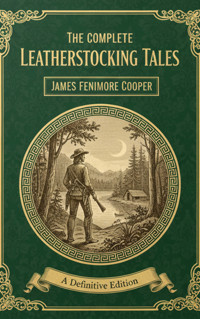
The "Leatherstocking Tales: Complete Western Series (Illustrated)" by James Fenimore Cooper is a seminal work that intricately weaves adventure, nature, and the moral dilemmas of American frontier life through the character of Natty Bumppo, a quintessential American hero. Cooper's distinctive literary style combines vivid descriptions, rich characterizations, and philosophical musings, reflecting the Romantic ideals of the 19th century while also confronting the themes of civilization versus wilderness. Set against the backdrop of the early American frontier, the novel series explores the conflicts between Native American tribes and European settlers, illuminating the complexities of American identity during a transformative period in history. The accompanying illustrations further enhance the immersive experience, bringing to life the landscapes and characters of Cooper's rich narrative tapestry. James Fenimore Cooper, a prominent early American novelist, became known for his exploration of themes concerning the American experience. Born in 1789 in Burlington, New Jersey, Cooper's early life in the wilderness of upstate New York profoundly influenced his writings. His experiences as a sailor and frontier dweller provided him insight into both the beauty and brutality of life on the American frontier, imbuing his tales with authenticity and depth. His commitment to capturing the spirit of early America has earned him a lasting place in the pantheon of American literature. This illustrated edition of the "Leatherstocking Tales" is a must-read for anyone intrigued by the narrative foundations of American literature and the complexities of its historical narratives. It not only offers a thrilling adventure but also challenges readers to reflect on the moral implications of westward expansion and their enduring relevance. Whether you are a student, historian, or literary enthusiast, Cooper's work invites you to delve into the heart of America's mythic past, making it an essential addition to your literary collection. In this enriched edition, we have carefully created added value for your reading experience: - An Introduction draws the threads together, discussing why these diverse authors and texts belong in one collection. - Historical Context explores the cultural and intellectual currents that shaped these works, offering insight into the shared (or contrasting) eras that influenced each writer. - A combined Synopsis (Selection) briefly outlines the key plots or arguments of the included pieces, helping readers grasp the anthology's overall scope without giving away essential twists. - A collective Analysis highlights common themes, stylistic variations, and significant crossovers in tone and technique, tying together writers from different backgrounds. - Reflection questions encourage readers to compare the different voices and perspectives within the collection, fostering a richer understanding of the overarching conversation.
Das E-Book können Sie in Legimi-Apps oder einer beliebigen App lesen, die das folgende Format unterstützen:
Veröffentlichungsjahr: 2022
Ähnliche
















Leatherstocking Tales: Complete Western Series (Illustrated)
Table of Contents
Introduction
Curatorial Vision
This collection brings together James Fenimore Cooper’s five Leatherstocking narratives alongside W. C. Bryant’s Discourse on the Life, Genius, and Writings of James Fenimore Cooper, Mark Twain’s Fenimore Cooper’s Literary Offences, and biographical studies by Thomas R. Lounsbury and Mary E. Phillips. The aim is to present the frontier saga in conversation with contemporaneous celebration, pointed critique, and sustained life-writing. Uniting these works highlights a core inquiry into character, nature, and nation. Read together, they trace the imaginative making of the American wilderness hero and the persistent arguments over craft, ethics, and representation that his adventures continue to provoke.
By assembling The Deerslayer, The Last of the Mohicans, The Pathfinder, The Pioneers, and The Prairie in one arc, the collection encourages attention to progression—of terrain, temperament, and moral testing—rather than isolated episodes. The titles themselves map a journey from “first war path” and “inland sea” to “sources” and “prairie,” announcing movement from forested lakes to open grasslands. Bryant’s discourse frames Cooper’s stature and intentions; Lounsbury and Phillips provide biographical bearings; Twain’s essay counters with stringent scrutiny. Together they chart admiration, correction, and context, inviting a composite understanding unavailable in single-title presentations or customary, partial groupings.
Across the sequence, a consistent philosophical through-line appears: the testing of personal honor amid contested homelands; the uses and abuses of power; the fragile covenant between human ambition and the nonhuman world. The Pioneers contemplates settlement and responsibility; The Pathfinder centers orientation and trust; The Last of the Mohicans, marked as “A Narrative of 1757,” meditates on loyalty under pressure; The Deerslayer inaugurates the novice ethic; The Prairie contemplates age and final horizons. Each work engages boundaries—legal, cultural, and ecological—creating a sustained meditation on belonging and loss that deepens when read as a continuous cycle.
Unlike isolated appearances of individual novels, this assembly juxtaposes life portrait, artistic corpus, and dissenting appraisal. Bryant’s tribute, read beside Lounsbury’s and Phillips’s biographical narratives, sketches sources of temperament and vocation that resonate within the fiction. Twain’s critique, positioned as an internal counterweight, keeps questions of plausibility and style in view. The result is a deliberately dialogic encounter with Cooper: readers receive the saga, a contemporary’s praise, later life-studies, and a notorious challenge in one place. That orchestration encourages balanced judgment rather than unexamined admiration or sweeping dismissal. It foregrounds debate as an essential mode of appreciation.
Thematic & Aesthetic Interplay
Cooper’s titles act as signposts—the path, the sources, the inland sea, the prairie—linking geography to moral orientation. Across the novels, trails, rivers, and open skies recur as emblems of choice and consequence. Silence and sound often register tension: the crack of a rifle contrasts with the hush of woods and water, underscoring precarious codes. When Bryant analyzes Cooper’s genius, his rhetoric echoes this marriage of landscape and character. Lounsbury and Phillips, in turn, connect lived circumstances to such recurring images, while Twain targets the same materials to question proportion, probability, and descriptive restraint.
Recurring dilemmas unify the saga: whether fidelity to a personal ethic can coexist with communal demands; whether justice aligns with formal authority; how cross-cultural alliances can honor difference without betrayal. These problems surface in each narrative’s crises and in quieter acts of counsel, tracking a conscience tested by friendship, obligation, and survival. Bryant honors the moral seriousness of such trials. Twain, by contrast, treats them as aesthetic challenges, insisting that ethical gravity must be matched by technical rigor. The biographies supply additional vantage, relating temperament and training to the tenacity with which these dilemmas are pursued.
Within the fiction, tonal variety shapes an internal dialogue. The Deerslayer opens with an initiatory clarity; The Pathfinder is reflective and companionable; The Pioneers introduces civic bustle and disputation; The Last of the Mohicans moves with martial urgency; The Prairie strips the world to elemental trials and mature resignation. Bryant’s discourse adopts commemorative eloquence, establishing a dignified frame. Lounsbury and Phillips write with steady exposition, favoring measured appraisal. Twain’s essay cuts against the grain with satiric vigor. Read contiguously, these tonal shifts prevent myth from hardening, keeping attention on craft choices and their ethical freight.
Allusion and response circulate among the texts. Bryant’s account of Cooper’s artistic intentions invites readers to hear the novels as arguments about character and landscape; Lounsbury and Phillips reiterate and refine those coordinates, drawing on scenes and reputations to sketch development. Twain engages the same corpus directly, citing recurrent habits to test standards of plausibility and economy. Within the fiction, motifs recur with deliberate variation: the ethics of tracking, the calibration of speech and silence, and the reading of signs in water and grass. Such repetitions bind the series, while the surrounding prose interrogates their force.
Enduring Impact & Critical Reception
Read now, the Leatherstocking sequence remains vital for its sustained inquiry into stewardship, belonging, and conflict. The novels explore how ideals confront material pressures, how attachment to place can both console and constrain, and how cross-cultural contact tests integrity. Bringing these narratives into conversation with Bryant’s celebration, Twain’s provocation, and biographical scrutiny encourages clear-eyed engagement rather than nostalgic reverie. The collection asks how narrative art can clarify public values while acknowledging limitation. It offers a durable space in which admiration and skepticism, environmental feeling and civic aspiration, are weighed against one another with literary evidence.
Bryant’s Discourse on the Life, Genius, and Writings of James Fenimore Cooper helped fix early public images of the author as a national artist, setting a precedent for subsequent appraisal. Mark Twain’s Fenimore Cooper’s Literary Offences became a touchstone of negative critique, sharpening debates about style, structure, and probability that continue to frame discussion. The biographies by Thomas R. Lounsbury and Mary E. Phillips consolidated knowledge of the life and its pressures, offering perspectives that later readers have repeatedly consulted. Together with the narratives, these texts outline a durable conversation about achievement, limitation, and literary responsibility.
The Leatherstocking figure and these landscapes have enjoyed a long cultural afterlife, migrating into performance, visual representation, and public mythmaking. The tensions articulated here—solitary conscience versus communal order, mobility versus settlement, reverence for wilderness alongside its exploitation—have reappeared in later storytelling across media. Because this collection gathers both the tales and the range of responses by Bryant, Twain, Lounsbury, and Phillips, it becomes a compact record of how admiration and dispute travel together. The result is a resource for understanding how literary characters become cultural signs, and how criticism protects inquiry from veneration.
Finally, the collection encourages renewed attention to form: the pacing of pursuit and parley, the orchestration of vistas and thresholds, and the interplay of dialogue with descriptive poise. Reading the five novels beside Bryant’s discourse, Twain’s case against them, and the biographies by Lounsbury and Phillips, one sees how artistic ambition, reception, and life-writing meet. That triangulation does not seek uniform verdicts. It offers durable coordinates for responsible admiration, skeptical testing, and historical awareness, inviting careful rereading of scenes and sentences where Cooper’s strengths and strains are most visible and most instructive.
Historical Context
Socio-Political Landscape
Spanning colonial North America through the early republic, the Leatherstocking Tales trace how warfare, settlement, and law shaped authority on the contested frontier. The settings move from imperial borderlands to newly organized towns and open prairie, revealing shifting sovereignty and civic aspirations. Debates over who owns land, who may hunt, and who speaks for justice animate conflicts as much as bullets do. W. C. Bryant’s Discourse frames James Fenimore Cooper as giving the young nation an imaginative constitution, suggesting that literature could stabilize republican virtue amid expansion. The anthology’s chronology mirrors political transitions from crown outposts to self-governing communities.
THE DEERSLAYER, THE LAST OF THE MOHICANS, and THE PATHFINDER are anchored in the mid-eighteenth-century wars that entangled British colonial forces and Native nations. As forts rise and alliances fracture, scouts, soldiers, and families navigate precarious truces. The French and Indian War provides not only battlefields but legal gray zones where customary law, military orders, and kinship obligations collide. By staging councils, ambushes, and river passages, these novels show how imperial policy filtered into personal vows, ransom practices, and codes of honor. The inland seas and forested corridors become laboratories for improvised governance under stress, before a national constitution existed.
THE PIONEERS relocates conflict to the courthouse, town meeting, and common lands of a nascent settlement. In place of imperial flags, there are judges, sheriffs, and surveyors attempting to normalize property relations and resource use. The novel’s debates over game laws, timber, and squatting expose the friction between customary subsistence and statutory order. A new political class tests its legitimacy by promising security while disciplining excess. Contestations over juries, elections, and church-pew hierarchies dramatize how equality was proclaimed yet stratification persisted. Cooper renders town life as a political experiment, where community cohesion depends on adjudicating competing claims to nature.
THE PRAIRIE pushes westward into spaces unsettled by American law but not ungoverned, as caravans, traders, and military detachments jostle with Native polities and refugee communities. The vast grasslands stage encounters among shifting sovereignties, where federal authority is distant and survival often depends on mutual accommodation. The novel’s overland movement exposes how family inheritance, commercial risk, and martial discipline intersect with environmental hazard. Questions of jurisdiction remain unresolved: Which rules hold on the trail? Who commands a dispersed company? The narrative treats the open plain as a political theater in which migration and memory contest claims to belonging.
Across the series, authority is negotiated within households as much as in councils. Patriarchal prerogatives, filial duty, and companionate ideals condition choices that appear merely tactical. Religious professions create solidarities while marking difference. Militia musters, notaries, and taverns distribute informal power, while literacy and map-reading confer advantages unevenly. The frontier hero mediates among classes and cultures, sometimes rebuking town officials, sometimes deferring to elders. Such movement between camps exposes the unstable status of expertise in a society glorifying independence yet relying on guides. Cooper situates personal honor within public controversy, portraying virtue as a civic resource contested by law.
W. C. Bryant’s Discourse and the biographies by Thomas R. Lounsbury and Mary E. Phillips anchor the political stakes of remembering these tales. They present Cooper as chronicler of manners whose episodes supply civic exempla for a republic anxious about corruption and faction. By narrating the composition, reception, and controversies of the novels, these texts also participate in the politics of memory—selecting which scenes to canonize as national lessons. Their emphasis on character formation, duty, and restraint aligns literary achievement with public service, implying that the frontier narrative could repair fractures opened by expansion, speculation, and periodic violence.
Intellectual & Aesthetic Currents
Intellectually, the collection inhabits the era’s Romantic confidence that landscape shapes character, fused with Enlightenment habits of observation. Forest, river, and prairie function as aesthetic categories—the sublime, the picturesque, the pastoral—while also supplying empirical data about flora, weather, and trailcraft. The narrative voice oscillates between reverie and report, a stylistic compromise suitable to a society discovering national scenery and measuring it. This double allegiance lets episodes operate as moral parables and travel writing at once. The result is an ethical topography: virtue and error are mapped onto ridgelines, shoals, and clearings that test resolve and expose pretension.
Cooper’s craft, as represented here, leans on alternating pursuit and parley, meticulous staging of ambush and escape, and ceremonial oratory in moments of truce. Dialect, jargon, and ritual naming attempt to differentiate communities while claiming authenticity. Detailed inventories of rifles, canoes, and garments promise documentary truth even as coincidence and heightened rhetoric signal romance. Such oscillation between plausibility and marvel became a flashpoint in later debate, because the works insist that moral clarity may require theatrical arrangement. Scenes of trial or council double as aesthetic manifestos, asserting that justice and eloquence can momentarily reconcile worlds otherwise in conflict.
Scientific and technological curiosity shapes the books’ texture. The long rifle’s range, the physics of a skiff in chop, the acoustics of forest alarms, and the cartography of portages are treated with care, converting gear and terrain into narrative instruments. THE PATHFINDER’s inland seamanship reflects knowledge of navigation and discipline, while THE PIONEERS’ attention to seasonal cycles echoes contemporary natural history. The anthology’s illustrated format participates in this evidentiary ethos, fixing landscapes and artifacts as visual proofs that mediate readers’ trust. Images become a parallel rhetoric, compressing description into emblem and circulating a standardized imagination of the frontier.
Critical texts within the volume stage a family argument about aesthetics. W. C. Bryant extols grandeur of conception and moral purpose, measuring success by elevation of feeling and national service. Mark Twain’s FENIMORE COOPER’S LITERARY OFFENCES, with comic asperity, prosecutes violations of probability, economy, and logic, treating the frontier as a technical problem unsolved by inflated diction. Thomas R. Lounsbury and Mary E. Phillips approach as historians, weighing drafts, dates, and public reaction to situate craft within circumstance. Together, these perspectives frame the novels between monument and workshop, asking whether inspiration, rule, or context should govern literary judgment.
The Leatherstocking sequence functions as an experimental matrix for American genre. THE DEERSLAYER presents a code of initiation; THE LAST OF THE MOHICANS adapts the campaign chronicle; THE PATHFINDER blends naval tale with woodland reconnaissance; THE PIONEERS fashions a civic panorama; THE PRAIRIE distills the fugitive caravan and death-haunted pastoral. This progression suggests an ambition larger than episodic adventure: to blueprint a narrative architecture for a continental society. Each book tests a different institutional space—camp, fort, ship, court, trail—so that art and polity inform one another. The anthology’s internal criticism records that design as both achievement and provocation.
Legacy & Reassessment Across Time
In the nineteenth century, the tales quickly became common cultural property, circulating through serial reprints, recitations, and scenic tableaux that distilled their most dramatic passages. Readers sought in them a charter myth that could bridge local loyalties after political crises, and teachers treated key scenes as primers in civic feeling. Biographical narratives by Thomas R. Lounsbury and Mary E. Phillips helped stabilize the author’s image as a principled craftsman, insulating the works from charges of mere sensationalism. Their framing encouraged an understanding of the series as a resource for national reconciliation, even when readers disagreed about its social prescriptions.
Later generations found new uses. As conservation ideas took hold, THE PIONEERS’ quarrels over waste, season, and quota looked prescient, offering a literary genealogy for regulation and stewardship. Scenes of communal harvest and public sanction supplied touchstones for debates about balancing subsistence, sport, and commerce. THE PRAIRIE, read alongside expanding agriculture and fencing, acquired an elegiac air, a meditation on commons turned commodity. Publishers reinforced these themes by issuing illustrated editions that emphasized vistas and fauna, recoding the books as guides to vanishing environments. Environmental readings did not erase politics; they tightened links between habit, law, and habitat.
Twentieth-century criticism oscillated between impatience and recovery. Popularized by classrooms, Mark Twain’s FENIMORE COOPER’S LITERARY OFFENCES offered a portable skepticism about romantic artifice, influencing how many first encountered the novels. Yet scholars, often drawing on the archival labors described by Lounsbury and Phillips, reinterpreted the books’ structures as sophisticated negotiations with violence, rhetoric, and jurisdiction. The supposed inaccuracies became evidence of generic experiment, not incompetence. The debate sharpened editorial practice: glossaries, maps, and historical notes increasingly accompanied editions, inviting readers to test plausibility while recognizing symbolic design. The result was a more dialectical appreciation of their technique.
Changing public conversations about Native representation altered the books’ meaning. Some readers identified the series’ recurrent binaries and sentimentalized losses as part of a canon that normalized dispossession. Others traced more ambivalent patterns: interdependence, translation, and provisional alliances that refuse simple triumphalism. The novels’ attention to treaty language, ransom customs, and hospitality codes provided materials for analyses of sovereignty and cross-cultural law. While the collection itself cannot settle these disputes, its internal conversation—praise from W. C. Bryant, indictment from Mark Twain, documentation from Lounsbury and Phillips—enables readers to stage informed arguments about portrayal, agency, and historical responsibility.
Adaptations for stage and screen amplified certain motifs—siege, chase, vow—while compressing legal and ecological nuance. THE LAST OF THE MOHICANS, in particular, traveled widely, fixing an iconography of frontier heroism and peril that sometimes overshadowed the polyphonic civic textures of THE PIONEERS or the itinerant melancholy of THE PRAIRIE. Translation into multiple languages extended this simplification and reach, making the cycle a global shorthand for North American origins. The illustrated nature of this anthology participates in that visual legacy, reminding readers that reception has long depended on images that both clarify and distort textual complexity.
Today, the anthology invites triangulation. W. C. Bryant’s Discourse models civic gratitude; Mark Twain’s FENIMORE COOPER’S LITERARY OFFENCES demands technical accountability; Thomas R. Lounsbury and Mary E. Phillips supply contextual patience. Read together with the five novels, these texts help audiences distinguish durable invention from dated convention. Current scholarship often emphasizes jurisdiction, extractive economies, and multilingual contact, reframing the sequence as a ledger of entanglements rather than a single myth. Classroom and public history settings now foreground annotation and illustration as tools for ethical access. The series endures by catalyzing argument about how nations remember, reform, and narrate.
Synopsis (Selection)
DISCOURSE ON THE LIFE, GENIUS, AND WRITINGS OF JAMES FENIMORE COOPER by W. C. Bryant
Bryant delivers a commemorative portrait of Cooper’s career, praising his originality in depicting the American landscape and frontier character. Framing Cooper as a national voice, the oration emphasizes moral sentiment, scenic vividness, and narrative vigor. Its celebratory tone sets a benchmark that later critical pieces in the collection question or refine.
Leatherstocking Tales: Series Overview
The five-novel cycle follows frontiersman Natty Bumppo—known by names such as Deerslayer, Hawkeye, Pathfinder, and Leatherstocking—across the eighteenth-century wilderness from forested lakes to the open prairie. Together the books trace the friction between nature and settlement, the ethics of warfare and hunting, and alliances and misunderstandings among cultures. Romantic adventure and elegiac reflection run throughout, inviting the critical conversations echoed by the included tribute, satire, and biographies.
THE DEERSLAYER: The First War Path
Set at the outset of Natty Bumppo’s life on the frontier, this tale centers on a lakeside stronghold where rival parties test his emerging code of honor. Rescue attempts, parleys, and skirmishes introduce his principles of restraint and truthfulness amid a contested landscape. The tone is initiatory and reflective, pairing action with moral formation.
THE LAST OF THE MOHICANS: A Narrative of 1757
During the 1757 campaigns of the French and Indian War, Hawkeye and his Mohican companions guide two sisters through ambushes, sieges, and shifting loyalties. Swift set pieces and tense pursuits drive a story about cultural collision, courage, and loss. The novel blends high adventure with a deepening sense of historical turbulence.
THE PATHFINDER: The Inland Sea
Relocating to the Great Lakes frontier, Natty scouts waterways and island forts while navigating a more domestic storyline involving friendship, duty, and tentative courtship. Tactical maneuvers on lakes and rivers mix with quieter character study. The mood is humane and contemplative, broadening the series’ inquiry into belonging and restraint.
THE PIONEERS: The Sources of the Susquehanna
In a growing settlement on the Susquehanna, an older Leatherstocking contends with courts, customs, and resource use as wilderness gives way to town life. Social comedy, legal disputes, and hunting scenes probe questions of authority, stewardship, and tradition. The novel contrasts communal order with individual conscience, anticipating ecological concerns.
THE PRAIRIE: A Tale
Driving westward beyond the forests, the aging frontiersman joins a migrant party on the open plains amid intertribal tensions and vast, austere scenery. Journeying and counsels replace woodland tactics, as the story meditates on the costs of expansion and the passing of an ethos. Its spacious, elegiac tone completes the arc from youth to seasoned farewell.
FENIMORE COOPER’S LITERARY OFFENCES by Mark Twain
Twain’s satirical essay critiques Cooper’s plotting, diction, and handling of plausibility by enumerating narrative ‘offences’ and supposed rules of craft. The humor is sharp and exacting, turning beloved adventure scenes into examples of technical misstep. As a counterpoint to praise elsewhere, it challenges readers to balance enjoyment with standards of style and credibility.
JAMES FENIMORE COOPER by Thomas R. Lounsbury
Lounsbury offers a measured critical biography that situates Cooper’s works within their historical and literary contexts. Weighing strengths and limitations, he traces reception and influence while clarifying the novelist’s aims and methods. The tone is judicious and scholarly, mediating between celebratory and skeptical views in the collection.
JAMES FENIMORE COOPER by Mary E. Phillips
Phillips presents a biographical portrait attentive to personality, milieu, and the lived experiences that inform recurring subjects in the fiction. Emphasizing narrative and character, she complements formal criticism with a more personal perspective on the author. The result underscores how life and legend intersect in the Leatherstocking figure and beyond.
Leatherstocking Tales: Complete Western Series (Illustrated)
Introduction:
DISCOURSE ON THE LIFE, GENIUS, AND WRITINGS OF JAMES FENIMORE COOPERby W. C. Bryant
It is now somewhat more than a year, since the friends of James Fenimore Cooper, in this city; were planning to give a public dinner to his honor. It was intended as an expression both of the regard they bore him personally, and of the pride they took in the glory his writings had reflected on the American name. We thought of what we should say in his hearing; in what terms, worthy of him and of us, we should speak of the esteem in which we held him, and of the interest we felt in a fame which had already penetrated to the remotest nook of the earth inhabited by civilized man.
To-day we assemble for a sadder purpose: to pay to the dead some part of the honors then intended for the living. We bring our offering, but he is not here who should receive it; in his stead are vacancy and silence; there is no eye to brighten at our words, and no voice to answer. “It is an empty office that we perform,” said Virgil, in his melodious verses, when commemorating the virtues of the young Marcellus, and bidding flowers be strewn, with full hands, over his early grave. We might apply the expression to the present occasion, but it would be true in part only. We can no longer do anything for him who is departed, but we may do what will not be without fruit to those who remain. It is good to occupy our thoughts with the example of great talents in conjunction with great virtues. His genius has passed away with him; but we may learn, from the history of his life, to employ the faculties we possess with useful activity and noble aims; we may copy his magnanimous frankness, his disdain of everything that wears the faintest semblance of deceit, his refusal to comply with current abuses, and the courage with which, on all occasions, he asserted what he deemed truth, and combated what he thought error.
The circumstances of Cooper’s early life were remarkably suited to confirm the natural hardihood and manliness of his character, and to call forth and exercise that extraordinary power of observation, which accumulated the materials afterwards wielded and shaped by his genius. His father, while an inhabitant of Burlington, in New Jersey, on the pleasant banks of the Delaware, was the owner of large possessions on the borders of the Otsego Lake in our own state, and here, in the newly-cleared fields, he built, in 1786, the first house in Cooperstown. To this home, Cooper, who was born in Burlington, in the year 1789, was conveyed in his infancy, and here, as he informs us in his preface to the Pioneers, his first impressions of the external world were obtained. Here he passed his childhood, with the vast forest around him, stretching up the mountains that overlook the lake, and far beyond, in a region where the Indian yet roamed, and the white hunter, half Indian in his dress and mode of life, sought his game,—a region in which the bear and the wolf were yet hunted, and the panther, more formidable than either, lurked in the thickets, and tales of wanderings in the wilderness, and encounters with these fierce animals, beguiled the length of the winter nights. Of this place, Cooper, although early removed from it to pursue his studies, was an occasional resident throughout his life, and here his last years were wholly passed.
At the age of thirteen he was sent to Yale College, where, notwithstanding his extreme youth,—for, with the exception of the poet Hillhouse, he was the youngest of his class, and Hillhouse was afterwards withdrawn,—his progress in his studies is said to have been honorable to his talents. He left the college, after a residence of three years, and became a midshipman in the United States navy. Six years he followed the sea, and there yet wanders, among those who are fond of literary anecdote, a story of the young sailor who, in the streets of one of the English ports, attracted the curiosity of the crowd by explaining to his companions a Latin motto in some public place. That during this period he made himself master of the knowledge and the imagery which he afterwards employed to so much advantage in his romances of the sea, the finest ever written, is a common and obvious remark; but it has not been so far as I know, observed that from the discipline of a seaman’s life he may have derived much of his readiness and fertility of invention, much of his skill in surrounding the personages of his novels with imaginary perils, and rescuing them by probable expedients. Of all pursuits, the life of a sailor is that which familiarizes men to danger in its most fearful shapes, most cultivates presence of mind, and most effectually calls forth the resources of a prompt and fearless dexterity by which imminent evil is avoided.
In 1811, Cooper, having resigned his post as midshipman, began the year by marrying Miss Delaney, sister of the present bishop; of the diocese of Western New York, and entered upon a domestic life happily passed to its close. He went to live at Mamaroneck, in the county of Westchester, and while here he wrote and published the first of his novels, entitled Precaution. Concerning the occasion of writing this work, it is related, that once, as he was reading an English novel to Mrs. Cooper, who has, within a short time past, been laid in the grave beside her illustrious husband, and of whom we may now say, that her goodness was no less eminent than his genius, he suddenly laid down the book, and said, “I believe I could write a better myself.” Almost immediately he composed a chapter of a projected work of fiction, and read it to the same friendly judge, who encouraged him to finish it, and when it was completed, suggested its publication. Of this he had at the time no intention, but he was at length induced to submit the manuscript to the examination of the late Charles Wilkes, of this city, in whose literary opinions he had great confidence. Mr. Wilkes advised that it should be published, and to these circumstances we owe it that Cooper became an author.
I confess I have merely dipped into this work. The experiment was made with the first edition, deformed by a strange punctuation—a profusion of commas, and other pauses, which puzzled and repelled me. Its author, many years afterwards, revised and republished it, correcting this fault, and some faults of style also, so that to a casual inspection it appeared almost another work. It was a professed delineation of English manners, though the author had then seen nothing of English society. It had, however, the honor of being adopted by the country whose manners it described, and, being early republished in Great Britain, passed from the first for an English novel. I am not unwilling to believe what is said of it, that it contained a promise of the powers which its author afterwards put forth.
Thirty years ago, in the year 1821, and in the thirty-second of his life, Cooper published the first of the works by which he will be known to posterity, the Spy. It took the reading world by a kind of surprise; its merit was acknowledged by a rapid sale; the public read with eagerness and the critics wondered. Many withheld their commendations on account of defects in the plot or blemishes in the composition, arising from want of practice, and some waited till they could hear the judgment of European readers. Yet there were not wanting critics in this country, of whose good opinion any author in any part of the world might be proud, who spoke of it in terms it deserved. “Are you not delighted,” wrote a literary friend to me, who has since risen to high distinction as a writer, both in verse and in prose, “are you not delighted with the Spy, as a work of infinite spirit and genius?” In that word genius lay the explanation of the hold which the work had taken on the minds of men. What it had of excellence was peculiar and unborrowed; its pictures of life, whether in repose or activity, were drawn, with broad lights and shadows, immediately from living originals in nature or in his own imagination. To him, whatever he described was true; it was made a reality to him by the strength with which he conceived it. His power in the delineation of character was shown in the principal personage of his story, Harvey Birch, on whom, though he has chosen to employ him in the ignoble office of a spy, and endowed him with the qualities necessary to his profession,—extreme circumspection, fertility in stratagem, and the art of concealing his real character—qualities which, in conjunction with selfishness and greediness, make the scoundrel, he has bestowed the virtues of generosity, magnanimity, an intense love of country, a fidelity not to be corrupted, and a disinterestedness beyond temptation. Out of this combination of qualities he has wrought a character which is a favorite in all nations, and with all classes of mankind.
It is said that if you cast a pebble into the ocean, at the mouth of our harbor, the vibration made in the water passes gradually on till it strikes the icy barriers of the deep at the south pole. The spread of Cooper’s reputation is not confined within narrower limits. The Spy is read in all the written dialects of Europe, and in some of those of Asia. The French, immediately after its first appearance, gave it to the multitudes who read their far-diffused language, and placed it among the first works of its class. It was rendered into Castilian, and passed into the hands of those who dwell under the beams of the Southern Cross. At length it passed the eastern frontier of Europe, and the latest record I have seen of its progress towards absolute universality, is contained in a statement of the International Magazine, derived, I presume, from its author, that in 1847 it was published in a Persian translation at Ispahan. Before this time, I doubt not, they are reading it in some of the languages of Hindostan, and, if the Chinese ever translated anything, it would be in the hands of the many millions who inhabit the far Cathay.
I have spoken of the hesitation which American critics felt in admitting the merits of the Spy, on account of crudities in the plot or the composition, some of which, no doubt, really existed. An exception must be made in favor of the Port Folio, which, in a notice written by Mrs. Sarah Hall, mother of the editor of that periodical, and author of Conversations on the Bible, gave the work a cordial welcome; and Cooper, as I am informed, never forgot this act of timely and ready kindness.
It was perhaps favorable to the immediate success of the Spy, that Cooper had few American authors to divide with him the public attention. That crowd of clever men and women who now write for the magazines, who send out volumes of essays, sketches, and poems, and who supply the press with novels, biographies, and historical works, were then, for the most part, either stammering their lessons in the schools, or yet unborn. Yet it is worthy of note, that just about the time that the Spy made its appearance, the dawn of what we now call our literature was just breaking. The concluding number of Dana’s Idle Man, a work neglected at first, but now numbered among the best things of the kind in our language, was issued in the same month. The Sketch Book was then just completed; the world was admiring it, and its author was meditating Bracebridge Hall. Miss Sedgwick, about the same time, made her first essay in that charming series of novels of domestic life in New England, which have gained her so high a reputation. Percival, now unhappily silent, had just put to press a volume of poems. I have a copy of an edition of Hallock’s Fanny, published in the same year; the poem of Yamoyden, by Eastburn and Sands, appeared almost simultaneously with it. Livingston was putting the finishing hand to his Report on the Penal Code of Louisiana, a work written with such grave, persuasive eloquence, that it belongs as much to our literature as to our jurisprudence. Other contemporaneous American works there were, now less read. Paul Allen’s poem of Noah was just laid on the counters of the booksellers. Arden published, at the same time, in this city, a translation of Ovid’s Tristia, in heroic verse, in which the complaints of the effeminate Roman poet were rendered with great fidelity to the original, and sometimes not without beauty. If I may speak of myself, it was in that year that I timidly intrusted to the winds and waves of public opinion a small cargo of my own—a poem entitled The Ages, and half a dozen shorter ones, in a thin duodecimo volume, printed at Cambridge.
We had, at the same time, works of elegant literature, fresh from the press of Great Britain, which are still read and admired. Barry Cornwall, then a young suitor for fame, published in the same year his Marcia Colonna; Byron, in the full strength and fertility of his genius, gave the readers of English his tragedy of Marino Faliero, and was in the midst of his spirited controversy with Bowles concerning the poetry of Pope. The Spy had to sustain a comparison with Scott’s Antiquary, published simultaneously with it, and with Lockhart’s Valerius, which seems to me one of the most remarkable works of fiction ever composed.
In 1823, and in his thirty-fourth year, Cooper brought out his novel of the Pioneers, the scene of which was laid on the borders of his: own beautiful lake. In a recent survey of Mr; Cooper’s works, by one of his admirers, it is intimated that the reputation of this work may have been, in some degree factitious. I cannot think so; I cannot see how such a work could fail of becoming, sooner or later, a favorite. It was several years after its first appearance that I read the Pioneers, and I read it with a delighted astonishment. Here, said I to myself, is the poet of rural life in this country—our Hesiod, our Theocritus, except that he writes without the restraint of numbers, and is a greater poet than they. In the Pioneers, as in a moving picture, are made to pass before us the hardy occupations and spirited, amusements of a prosperous settlement, in, a fertile region, encompassed for leagues around with the primeval wilderness of woods. The seasons in their different aspects, bringing with them, their different employments; forests falling before the axe; the cheerful population, with the first mild; day of spring, engaged in the sugar orchards; the chase of the deer through the deep woods, and into the lake; turkey-shooting, during the Christmas holidays, in which the Indian marksman vied for the prize of skill with the white man; swift sleigh rides under the bright winter sun, and, perilous encounters with wild animals in the forests; these, and other scenes of rural life, drawn, as Cooper knew how to draw them, in the bright and healthful coloring of which he was master are interwoven with a regular narrative of human fortunes, not unskilfully constructed; and how could such a work be otherwise than popular?
In the Pioneers, Leatherstocking; is first introduced—a philosopher of the woods, ignorant of books, but instructed in all that nature, without the aid of, science, could reveal to the man of quick senses and inquiring intellect, whose life has been passed under the open sky, and in companionship with a race whose animal perceptions are the acutest and most cultivated of which there is any example. But Leatherstocking has higher qualities; in him there is a genial blending of the gentlest virtues of the civilized man with the better nature of the aboriginal tribes; all that in them is noble, generous, and ideal, is adopted into his own kindly character, and all that is evil is rejected. But why should I attempt to analyse a character so familiar? Leatherstocking is acknowledged, on all hands, to be one of the noblest, as well as most striking and original creations of fiction. In some of his subsequent novels, Cooper—for he had not yet Attained to the full maturity of his powers—heightened and ennobled his first conception of the character, but in the Pioneers it dazzled the world with the splendor of novelty;
His next work was the Pilot, in which he showed how, from the vicissitudes of a life at sea, its perils and escapes, from the beauty and terrors of the great deep, from the working of a vessel on a long voyage, and from the frank, brave, and generous but peculiar character of the seaman, may be drawn materials of romance by which the minds of men may be as deeply moved as by anything in the power of romance to present. In this walk, Cooper has had many disciples but no rival. All who have since written romances of the sea have been but travellers in a country of which he was the great discoverer; and none of them all seemed to have loved a ship as Cooper loved it, or have been able so strongly to interest all classes of readers in its fortunes. Among other personages drawn with great strength in the Pilot, is the general favorite, Tom Coffin, the thorough seaman with all the virtues and one or two of the infirmities of his profession, superstitious, as seamen are apt to be, yet whose superstitions strike us as but an irregular growth of his devout recognition of the Power who holds the ocean in the hollow of his hand; true-hearted, gentle, full of resources, collected in danger, and at last calmly perishing at the post of duty, with the vessel he has long guided, by what I may call a great and magnanimous death. His rougher and coarser companion, Boltrope, is drawn with scarcely less skill, and with a no less vigorous hand.
The Pioneers is not Cooper’s best tale of the American forest, nor, the Pilot, perhaps, in all respects, his best tale of the sea; yet, if he had ceased to write here, the measure of his fame would possibly have been scarcely less ample than it now is. Neither of them is far below the best of his productions, and in them appear the two most remarkable creations of his imagination—two of the most remarkable characters in all fiction.
It was about this time that my acquaintance with Cooper began, an acquaintance of more than a quarter of a century, in which his deportment towards me was that of unvaried kindness. He then resided a considerable part of the year in this city, and here he had founded a weekly club, to which many of the most distinguished men of the place belonged. Of the members who have since passed away, were Chancellor Kent, the jurist; Wiley the intelligent and liberal bookseller; Henry D. Sedgwick, always active in schemes of benevolence; Jarvis, the painter, a man of infinite humor, whose jests awoke inextinguishable laughter; De Kay, the naturalist; Sands, the poet; Jacob Harvey whose genial memory is cherished by many friends. Of those who are yet living was Morse, the inventor of the electric telegraph; Durand, then, one of the first of engravers, and now no less illustrious as a painter; Henry James Anderson, whose acquirements might awaken the envy of the ripest scholars of the old world; Halleck, the poet and wit; Verplanck, who has given the world the best edition of Shakspeare for general readers; Dr. King, now at the head of Columbia College, and his two immediate predecessors in that office. I might enlarge the list with many other names of no less distinction. The army and navy contributed their proportion of members, whose names are on record in our national history. Cooper when in town was always present, and I remember being struck with the inexhaustible vivacity of his conversation and the minuteness of his knowledge, in everything which depended upon acuteness of observation and exactness of recollection. I remember, too, being somewhat startled, coming as I did from the seclusion of a country life, with a certain emphatic frankness in his manner, which, however, I came at last to like and to admire. The club met in the hotel called Washington Hall, the site of which, is now occupied by part of the circuit of Stewart’s marble building.
Lionel Lincoln, which cannot be ranked among the successful productions of Cooper, was published in 1825; and in the year following appeared the Last of the Mohicans which more than recovered the ground lost by its predecessor. In this work, the construction of the narrative has signal defects, but it is one of the triumphs of the author’s genius that he makes us unconscious of them while we read. It is only when we have had time to awake from the intense interest in which he has held us by the vivid reality of his narrative, and have begun to search for faults in cold blood, that we are able to find them, In the Last of the Mohicans, we have a bolder portraiture of. Leatherstocking than in the Pioneers.
This work was published in 1826, and in the same year Cooper sailed with his family for Europe. He left New York as one of the vessels of war, described in his romances of the sea, goes out of port, amidst the thunder of a parting salute from the big guns on the batteries. A dinner was given him just before his departure, attended by most of the distinguished men of the city, at which Peter A. Jay presided, and Dr. King addressed him in terms which some then thought too glowing, but which would now seem sufficiently temperate, expressing the good wishes of his friends, and dwelling on the satisfaction they promised themselves in possessing so illustrious a representative of American literature in the old world. Cooper was scarcely in France when he remembered his friends of the weekly club, and sent frequent missives to be read at its meetings; but the club missed its founder went into a decline, and not long afterwards quietly expired.
The first of Cooper’s novels published after leaving America: was the Prairie, which appeared early in 1827, a work with the admirers of which I wholly agree. I read it with a certain awe, an undefined sense of sublimity, such as one experiences on entering, for the first time, upon those immense grassy deserts from which the work takes its name. The squatter and his family—that brawny old man and his large-limbed sons, living in a sort of primitive and patriarchal barbarism, sluggish on ordinary occasions, but terrible when roused, like the hurricane that sweeps the grand but monotonous wilderness in which they dwell—seem a natural growth of ancient fields of the West. Leatherstocking, a hunter in the Pioneers, a warrior in the Last of the Mohicans, and now, in his extreme old age, a trapper on the prairie, declined in strength, but undecayed in intellect, and looking to the near close of his life, and a grave under the long grass, as calmly as the laborer at sunset looks to his evening slumber, is no less in harmony with the silent desert in which he wanders. Equally so are the Indians, still his companions, copies of the American savage somewhat idealized, but not the less a part of the wild nature in which they have their haunts.
Before the year closed, Cooper had given the world another nautical tale, the Red Rover, which, with many, is a greater favorite than the Pilot, and with reason, perhaps, if we consider principally the incidents, which are conducted and described with a greater mastery over the springs of pity and terror.
It happened to Cooper while he was abroad, as it not unfrequently happens to our countrymen, to hear the United States disadvantageously compared with Europe. He had himself been a close observer of things both here and in the old world, and was conscious of being able to refute the detractors of his country in regard to many points. He published in 1828, after he had been two years in Europe, a series of letters, entitled Notions of the Americans, by a Travelling Bachelor, in which he gave a favorable account of the working of our institutions, and vindicated his country from various flippant and ill-natured misrepresentations of foreigners. It is rather too measured in style, but is written from a mind full of the subject, and from a memory wonderfully stored with particulars. Although twenty-four years have elapsed since its publication, but little of the vindication has become obsolete.
Cooper loved his country and was proud of her history and her institutions, but it puzzles many that he should have appeared, at different times, as her eulogist, and her censor. My friends, she is worthy both of praise and of blame, and Cooper was not the man to shrink from bestowing either, at what seemed to him the proper time. He defended her from detractors abroad; he sought to save her from flatterers at home. I will not say that he was in as good humor with his country when he wrote Home at Found, as when he wrote his Notions of the Americans, but this I will say that whether he commended or censured, he did it in the sincerity of his heart, as a true American, and in the belief that it would do good. His Notions of the Americans were more likely to lessen than to increase his popularity in Europe, inasmuch as they were put forth without the slightest regard to European prejudices.
In 1829, he brought out the novel entitled the Wept of Wishton-Wish, one of the few of his works which we now rarely hear mentioned. He was engaged in the composition of a third nautical tale, which he afterwards published under the name of the Water-Witch, when the memorable revolution of the Three Days of July broke out. He saw a government, ruling by fear and in defiance of public opinion, overthrown in a few hours, with little bloodshed; he saw the French nation, far from being intoxicated with their new liberty, peacefully addressing themselves to the discussion of the institutions under which they were to live. A work which Cooper afterwards published, his Residence in Europe, gives the outline of a plan of government for France furnished by him at that time, to La Fayette, with whom he was in habits of close and daily intimacy. It was his idea to give permanence to the new order of things by associating two strong parties in its support, the friends of legitimacy and the republicans. He suggested that Henry V. should be called to the hereditary throne of France, a youth yet to be educated as the head of a free people, that the peerage should be abolished, and a legislature of two chambers established, with a constituency of at least a million and a half of electors; the senate to be chosen by the general vote, as the representative of the entire nation, and the members of the other house to be chosen by districts, as the representatives of the local interests. To the middle ground of politics so ostentatiously occupied by Louis Philippe at the beginning of his reign, he predicted a brief duration, believing that it would speedily be merged in despotism, or supplanted by the popular rule. His prophecy has been fulfilled more amply than he could have imagined—fulfilled in both its alternatives.
In one of the controversies of that time, Cooper bore a distinguished part. The Revue Britannique, a periodical published in Paris, boldly affirmed the government of the United States to be one of the most expensive in the world, and its people among the most heavily taxed of mankind. This assertion was supported with a certain show of proof, and the writer affected to have established the conclusion that a republic must necessarily be more expensive than a monarchy. The partisans of the court were delighted with the reasoning of the article, and claimed a triumph over our ancient friend La Fayette, who, during forty years, had not ceased to hold up the government of the United States as the cheapest in the world. At the suggestion of La Fayette, Cooper replied to this attack upon his country in a letter which was translated into French, and, together with, another from General Bertrand, for many years a resident in America, was laid before the people of France.
These, two letters provoked a shower of rejoinders, in which, according to Cooper, misstatements were mingled with scurrility. He commenced a series of letters on the question in dispute, which were published in the National, a daily sheet, and gave the first evidence of that extraordinary acuteness in controversy which was no less characteristic of his mind than the vigor of his imagination. The enemies of La Fayette pressed into their service Mr. Leavitt Harris, of New Jersey, afterwards our chargé d’affaires at the court of France, but Cooper replied to Mr. Harris in the National of May 2d, 1832, closing a discussion in which he had effectually silenced those who objected to our institutions on the score of economy. Of these letters, which would form an important chapter in political science, no entire copy, I have been told, is to be found in this country.
One of the consequences of earnest controversy is almost invariably personal ill-will. Cooper was told by one who held an official station under the French government, that the part he had taken in this dispute concerning taxation would neither be forgotten nor forgiven. The dislike he had incurred in that quarter was strengthened by his novel of the Bravo, published in the year 1831, while he was in the midst of his quarrel with the aristocratic party. In that work, of which he has himself justly said that it was thoroughly American in all that belonged to it, his object was to show how institutions, professedly created to prevent violence and wrong, become, when perverted from their natural destination, the instruments of injustice; and how, in every system which makes power the exclusive property of the strong, the weak are sure to be oppressed. The work is written with all the vigor and spirit of his best novels; the magnificent city of Venice, in which the scene of the story is laid, stands continually before the imagination; and from time to time the gorgeous ceremonies of the Venetian republic pass under our eyes, such as the marriage of the Doge with the Adriatic, and the, contest of the gondolas for the prize of speed. The Bravo himself and several of the other characters are strongly conceived and distinguished, but the most remarkable of them all is the spirited and generous-hearted daughter of the jailer.
It has been said by some critics, who judge of Cooper by his failures, that he had no skill in drawing female characters. By the same process, it might, I suppose, be shown that Raphael was but an ordinary painter. It must be admitted that when Cooper drew a lady of high breeding, he was apt to pay too much attention to the formal part of her character, and to make her a mere bundle of cold proprieties. But when he places his heroines in some situation in life which leaves him nothing to do but to make them natural and true, I know of nothing finer, nothing more attractive or more individual than the portraitures he has given us.
Figaro, the wittiest of the French periodicals, and at that time on the liberal side, commended the Bravo; the journals on the side of the government censured it. Figaro afterwards passed into the hands of the aristocratic party, and Cooper became the object of its attacks. He was not, however, a man to be driven from any purpose which he had formed, either by flattery or abuse, and both were tried with equal ill success. In 1832 he published his Heidenmauer, and in 1833 his Headsman of Berne, both with a political design similar to that of the Bravo, though neither of them takes the same high rank among his works.
In 1833, after a residence of seven years in different parts of Europe, but mostly in France, Cooper returned to his native country. The welcome which met him here was somewhat chilled by the effect of the attacks made upon him in France, and remembering with what zeal, and at what sacrifice of the universal acceptance which his works would otherwise have met, he had maintained the cause of his country against the wits and orators of the court party in France, we cannot wonder that he should have felt this coldness as undeserved. He published, shortly after his arrival in this country, A Letter to his Countrymen in which he complained of the censures cast upon him in the American newspapers, gave a history of the part he had taken in exposing the misstatements of the Révue Britannique, and warned his countrymen against the too common error of resorting, with a blind deference, to foreign authorities, often swayed by national or political prejudices, for our opinions of American authors. Going beyond this topic, he examined and reprehended the habit of applying to the interpretation of our own constitution maxims derived from the practice of other governments, particularly that of Great Britain. The importance of construing that instrument by its own principles, he illustrated by considering several points in dispute between parties of the day, on which he gave very decided opinions.
The principal effect of this pamphlet, as it seemed to me, was to awaken in certain quarters a kind of resentment that a successful writer of fiction should presume to give lessons in politics. I meddle not here with the conclusions to which he arrived, though must be allowed to say that they were stated and argued with great ability. In 1835 Cooper published The Monnikins, a satirical work, partly with a political aim; and in the same year appeared his American Democrat, a view of the civil and social relations of the United States, discussing more gravely various topics touched upon in the former work, and pointing out in what respects he deemed the American people in their practice to have fallen short of the excellence of their institutions.
He found time, however, for a more genial task—that of giving to the world his observations on foreign countries. In 1836 appeared his Sketches of Switzerland, a series of letters in four volumes, the second part published about two months after the first, a delightful work, written in a more fluent and flexible style than his Notions of the Americans. The first part of Gleanings in Europe, giving an account of his residence in France, followed in the same year; and the second part of the same work, containing his observations on England, was published in April, 1837. In these works, forming a series of eight volumes, he relates and describes with much of the same distinctness as in his novels; and his remarks on the manners and institutions of the different countries, often sagacious, and always peculiarly his own, derive, from their frequent reference to contemporary events, an historical interest.
In 1838 appeared Homeward Bound and Home as Found, two satirical novels, in which Cooper held up to ridicule a certain class of conductors of the newspaper press in America. These works had not the good fortune to become popular. Cooper did not, and, because he was too deeply in earnest, perhaps would not, infuse into his satirical works that gaiety without which satire becomes wearisome. I believe, however, that if they had been written by anybody else they would have met with more favor; but the world knew that Cooper was able to give them something better, and would not be satisfied with anything short of his best, Some childishly imagined that because, in the two works I have just mentioned, a newspaper editor is introduced, in whose character almost every possible vice of his profession is made to find a place, Cooper intended an indiscriminate attack upon the whole body of writers for the newspaper press, forgetting that such a portraiture was a satire only on those to whom it bore a likeness We have become less sensitive and more reasonable of late, and the monthly periodicals make sport for their readers of the follies and ignorance of the newspaper editors, without awakening the slightest resentment; but Cooper led the way in this sort of discipline, and I remember some instances of towering indignation at his audacity expressed in the journals of that time.
The next year Cooper made his appearance before the public in a new department of writing; his Naval History of the United States was brought out in two octavo volumes at Philadelphia, by Carey and Lea. In writing his stories of the sea, his attention had been much turned to this subject, and his mind filled with striking incidents from expeditions and battles in which our naval commanders had been engaged. This made his task the lighter; but he gathered his materials with great industry, and with a conscientious attention to exactness, for he was not a man to take a fact for granted, or allow imagination to usurp the place of inquiry He digested our naval annals into a narrative, written with spirit it is true, but with that air of sincere dealing which the reader willingly takes as a pledge of its authenticity.
An abridgment of the work was afterwards prepared and published by the author. The Edinburgh Review, in an article professing to examine the statements both of Cooper’s work and of The History of the English Navy, written by Mr. James, a surgeon by profession, made a violent attack upon the American historian. Unfortunately, it took James’s narrative as its sole guide, and followed it implicitly. Cooper replied in the Democratic Review for January, 1840, and by a masterly analysis of his statements, convicting James of self-contradiction in almost every particular in which he differed from himself, refuted both James and the reviewer. It was a refutation which admitted of no rejoinder.
Scarce anything in Cooper’s life was so remarkable, or so strikingly illustrated his character, as his contest with the newspaper press. He engaged in it after provocations, many and long endured, and prosecuted it through years with great energy, perseverance, and practical dexterity, till he was left master of the field. In what I am about to say of it, I hope I shall not give offence to any one, as I shall speak without the slightest malevolence towards those with whom he waged this controversy. Over some of them, as over their renowned adversary, the grave has now closed. Yet where shall the truth be spoken, if not beside the grave?