Erhalten Sie Zugang zu diesem und mehr als 300000 Büchern ab EUR 5,99 monatlich.
- Herausgeber: Musaicum Books
- Kategorie: Gesellschafts- und Liebesromane
- Sprache: Englisch
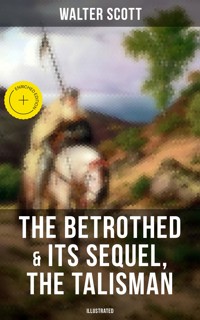
In 'The Betrothed & Its Sequel, The Talisman (Illustrated)', Walter Scott weaves a captivating tale set in medieval times, focusing on themes of love, loyalty, and honor. His intricate prose and vivid descriptions immerse the reader in the historical backdrop, providing a rich literary experience. The two stories follow the struggles and adventures of the main characters, offering a unique blend of romance and action that keeps the reader engaged throughout. Scott's attention to detail and character development showcase his mastery of storytelling, making this book a classic in the literary world. Walter Scott, a prominent figure in Romantic literature, drew inspiration from his Scottish heritage and interest in history to create this masterpiece. His extensive knowledge of medieval times and his ability to bring historical figures to life through his writing contribute to the authenticity of the narrative. Scott's passion for storytelling and his dedication to his craft shine through in 'The Betrothed & Its Sequel, The Talisman (Illustrated)'. I highly recommend 'The Betrothed & Its Sequel, The Talisman (Illustrated)' to readers who enjoy historical fiction with a touch of romance and adventure. Walter Scott's timeless work continues to enchant audiences with its compelling storytelling and vivid imagery, making it a must-read for anyone interested in classic literature. In this enriched edition, we have carefully created added value for your reading experience: - A comprehensive Introduction outlines these selected works' unifying features, themes, or stylistic evolutions. - The Author Biography highlights personal milestones and literary influences that shape the entire body of writing. - A Historical Context section situates the works in their broader era—social currents, cultural trends, and key events that underpin their creation. - A concise Synopsis (Selection) offers an accessible overview of the included texts, helping readers navigate plotlines and main ideas without revealing critical twists. - A unified Analysis examines recurring motifs and stylistic hallmarks across the collection, tying the stories together while spotlighting the different work's strengths. - Reflection questions inspire deeper contemplation of the author's overarching message, inviting readers to draw connections among different texts and relate them to modern contexts. - Lastly, our hand‐picked Memorable Quotes distill pivotal lines and turning points, serving as touchstones for the collection's central themes.
Sie lesen das E-Book in den Legimi-Apps auf:
Seitenzahl: 1278
Veröffentlichungsjahr: 2017
Das E-Book (TTS) können Sie hören im Abo „Legimi Premium” in Legimi-Apps auf:
Ähnliche












The Betrothed & Its Sequel, The Talisman (Illustrated)
Table of Contents
Introduction
This volume gathers, complete and unabridged, the pair of historical novels that constitute Sir Walter Scott’s Tales of the Crusaders: The Betrothed and The Talisman. First published in 1825 as companion works within a single series, these narratives are presented here together to restore their intended dialogue of theme and setting. The collection is devoted to a single author and a single project within his broader career, allowing readers to consider how Scott imagines medieval society from two complementary vantage points. The inclusion of illustrations is designed to support the reading experience by visualizing the period detail that Scott so carefully evokes.
Tales of the Crusaders belongs to the Waverley Novels, the sequence through which Scott helped define the modern historical novel. In these books he unites learned attention to the past with the momentum of romance and adventure. The paired tales look outward from Britain to the twelfth-century world, yet they maintain Scott’s characteristic interest in the interplay of public events and private obligations. Composed during the later phase of his career, they display a writer still committed to the experiment that made his name: placing invented characters amid verifiable historical situations to explore how large forces touch individual lives.
The texts gathered here are both novels, and they represent Scott’s mature blend of historical fiction and chivalric romance. Their modes include courtly intrigue, martial episode, diplomatic maneuver, and domestic trial. While narrative prose is the central form, Scott’s method draws on antiquarian habits—cataloging customs, laws, and material culture—filtered through storytelling that privileges character and scene. Readers thus encounter an elastic prose capable of statecraft and campfire, chapel and council, without the intrusion of essays or verse that would break the novels’ continuity. The result is a coherent pair of long-form narratives unified by period, purpose, and design.
The Betrothed opens on the medieval frontier of the Welsh Marches, where a beleaguered household must defend its pledged union against the pressures of border warfare, feudal rivalry, and ecclesiastical influence. The initial premise concerns the attempt to uphold a lawful betrothal in a climate where law itself is contested, and where the summons to crusade complicates obligations at home. Scott makes the Marches a stage for testing loyalty and prudence: a place in which oaths, custody of lands, and the fragile peace between neighboring peoples all press upon the fate of a promised marriage.
The Talisman turns to the Third Crusade in the Levant, setting a convalescent knight of the crusading host amid the camps of kings and emirs. Its premise pivots on a chance encounter with a healer of extraordinary skill, and on the illness of a monarch whose recovery bears on the fortunes of the campaign. Richard I of England and Saladin of Egypt and Syria appear as historical presences within a plot concerned with honor, negotiation, and the ethics of conflict. The desert, the pavilion, and the council tent replace the border castle, but the questions are recognizably Scott’s.
Although this collection’s title names The Talisman as the sequel to The Betrothed, the relation is that of companion pieces within one series rather than a direct continuation of characters and incidents. The unity lies in subject and structure: each novel examines chivalry under strain, the reach of authority, and the costs of zeal. One tale studies the management of a frontier community; the other, the diplomacy of a multi-national army. Together they consider how ideals of faith and honor must answer to practical governance, and how personal vows are shaped by the rolling machinery of history.
Readers will recognize Scott’s stylistic hallmarks across both works. He builds scenes like stage tableaux, with entrances, reversals, and pointed dialogue that move swiftly from jest to gravity. Descriptive set-pieces—of armor, architecture, ceremony, and landscape—anchor the imagination without halting the story. He modulates register, allowing clerics, soldiers, rulers, and servants to speak in distinct voices, and he employs irony to expose self-interest under piety or bravado. Historical personages appear not as mere emblems but as actors within a crowded civic drama, sharing the field with invented figures whose choices bear consequence.
Scott’s historical art depends on a disciplined curiosity about sources and circumstances. He draws on chronicles and reports to establish chronology, geography, and the frameworks of law, custom, and belief, then populates that framework with plausible motives. Attention to the routines of camp, the protocols of truce, the hierarchy of feudal tenure, and the rhythms of religious observance gives the novels their persuasive surface. Yet the machinery of research remains subordinate to narrative purpose: the past is not a museum but a living environment in which characters must decide, often under pressure, with incomplete knowledge and conflicting duties.
The lasting significance of these novels resides in the way they shape the European imagination of the Middle Ages. Scott made the historical novel into a form capable of large patterns and intimate feeling, a vehicle for thinking about national character, cultural encounter, and the uses of power. In The Talisman, his portrayal of virtuous conduct across confessional lines contributed to a durable vision of magnanimity amid warfare. In The Betrothed, his analysis of frontier governance and household stewardship clarifies how civil order is made or broken at the margins of authority.
Across the pair, Scott explores ethical tensions that remain recognizable. Oath and expediency, zeal and tolerance, bravery and prudence, justice and mercy—these binaries are not abstract theses but pressures exerted by time, place, and circumstance. He resists caricature by allowing worthy conduct and error to appear in more than one camp. Religious commitment is taken seriously without absolving violence, and martial prowess is admired without mistaking it for wisdom. The result is a vision of chivalry tempered by realism, in which honor is achieved through restraint as often as through daring.
The illustrated character of this edition serves more than ornament. Visual elements can clarify the cut of mail and surcoat, the plan of a fortress, the order of a procession, or the furnishing of a princely tent—details that Scott’s audience relished and that modern readers may find newly legible with images to hand. The artwork is intended to guide, not to dictate, the imagination: to accompany the prose without substituting for it, and to underscore how attentive Scott is to the material textures through which institutions and ideals become visible.
Presented together, The Betrothed and The Talisman invite both continuous reading and comparative reflection. They offer, in different keys, Scott’s answer to the perennial question of how individuals inhabit history: not as passive witnesses, nor as solitary heroes, but as agents whose choices matter within the constraints of custom, allegiance, and necessity. This collection provides the complete texts of the two novels that make up Tales of the Crusaders, framed by images that illuminate their world, so that readers may experience anew the breadth, energy, and humane intelligence of Walter Scott’s historical art.
Author Biography
Sir Walter Scott (1771–1832) was a Scottish poet, novelist, and antiquarian whose work helped define the historical novel in the Romantic era. Writing from the early nineteenth century’s vibrant Edinburgh, he fused meticulous interest in the past with narrative momentum and a humane eye for social change. His novels—often issued anonymously at first and later grouped as the Waverley Novels—reached a wide international audience. Within that larger project stands Tales of the Crusaders, comprising The Betrothed and The Talisman, which transport readers to medieval frontiers and crusading camps. Across genres, Scott sought to animate history, testing ideals of honor, law, loyalty, and cultural encounter.
Educated in Edinburgh, Scott attended the High School and the University, training in law before being admitted to practice. Legal study and public service sharpened his attention to institutions, precedent, and the social web that undergirds historical change. At the same time, he read deeply in Scottish border lore and European romantic literature, cultivating an antiquarian method that prized documentary sources, oral tradition, and place. Early editorial and translation work, alongside ballad collecting, informed his narrative voice and his habit of embedding fiction in a carefully textured past. These habits would later shape his medieval romances, including the pair gathered as Tales of the Crusaders.
Scott first achieved wide fame as a writer of long narrative poems before turning decisively to fiction in the 1810s. With Waverley and the sequence that followed, he demonstrated how the novel could dramatize the meeting of past and present, presenting ordinary individuals against the sweep of political and cultural transformation. Readers valued his panoramic scenes, vernacular dialogue, and impartial curiosity about rival traditions. He experimented with settings from medieval to early modern periods, using antiquarian detail to ground romance in credible social worlds. By the mid-1820s, he extended this approach to the Middle Ages abroad, preparing the ground for Tales of the Crusaders.
Tales of the Crusaders (mid-1820s) collects two distinct romances. The Betrothed is set on the turbulent medieval borderlands of Wales and the Marches, exploring feudal obligation, shifting allegiance, and the pressures of law and custom on personal choice. The Talisman moves to the Third Crusade, staging encounters among rival courts and commanders while imagining codes of chivalry that test enmity and respect across religious lines. Together they show Scott’s fascination with frontier societies, diplomacy, and the logistics of war, yet keep attention on character, courtesy, and mistaken judgment. The pair balances spectacle with inquiry into how ideals are negotiated amid faction and necessity.
Scott’s method combined research with dramatic empathy. He consulted chronicles, charters, and travel narratives, but insisted that the novelist’s task was to animate the probable rather than catalogue the past. A conservative by temperament, he prized continuity, law, and social compromise, yet his fiction grants dignity to competing communities and values. In The Betrothed and The Talisman, that balance emerges in attention to protocol, mediation, and the ethics of oaths, hospitality, and command. He favored fallible protagonists who learn prudence, treating history as a forum where private conscience and public duty contend, and where reconciliation, though fragile, remains thinkable.
Public renown did not spare Scott from hardship. After the failure of his publishing and printing partners in the mid-1820s, he assumed heavy debts and undertook an arduous program of writing to discharge them, continuing his historical cycles while editing and revising earlier work. The strain coincided with declining health, but he maintained professional duties and literary ambition as long as strength allowed. He died in 1832 at Abbotsford, the house he built near the River Tweed, a site that embodied his historical imagination in stone, artifact, and landscape. Friends and readers memorialized him as industrious, courteous, and steadfast under pressure.
Scott’s legacy rests on making the past intelligible without reducing its difference. He shaped expectations for historical fiction worldwide, encouraging later writers to treat costume, dialect, and policy as elements of character and choice rather than mere decoration. His novels fed nineteenth-century illustration, theater, and tourism, and they continue to invite adaptation and debate. Tales of the Crusaders exemplifies his reach beyond Britain, engaging with medieval Europe and the Near East to explore courtesy amid conflict. Scholars and general readers still turn to him for narrative breadth, humane irony, and a disciplined sense that history’s dramas are lived by imperfect, recognizably modern people.
Historical Context
Sir Walter Scott wrote in the early nineteenth century, amid Romanticism and emergent mass print culture. By 1825, when Tales of the Crusaders appeared, he had shaped the modern historical novel through Waverley and its successors, using the past to reflect on law, loyalty, and national memory. The Betrothed & Its Sequel, The Talisman set their actions in the twelfth century, yet arise from post‑Napoleonic Britain’s curiosity about chivalry and empire. The Betrothed surveys the Welsh Marches, a frontier marked by Norman colonization and native resistance. The Talisman turns to the Third Crusade, staging rulers, soldiers, and clerics negotiating war, faith, and diplomacy.
In composing such fictions, Scott blended antiquarian research with dramatic narrative. He published the Waverley novels anonymously until the later 1820s, inviting readers to test his scenes against documented custom and chronicle. For the Crusader tales he drew on medieval sources available in translation, including Latin annalists of Henry II and Richard I and accounts of Saladin derived from Arabic biographies. He habitually appended notes identifying statutes, chronicles, and travel reports that informed his reconstructions. The 1820s book market—circulating libraries, multi‑volume editions, and a readership schooled on history compendia—encouraged detailed period background, which he used to anchor imagined characters to verifiable political settings.
The twelfth century in Western Europe was an age of consolidation and contest. The Angevin monarchy, under Henry II, governed an extensive realm stretching from Scotland’s border to the Pyrenees through England, Normandy, Anjou, and Aquitaine. Feudal bonds, castle lordship, and itinerant kingship structured power, while legal and fiscal institutions expanded. Borders were not fixed; the Norman advance into Wales and Ireland created marcher societies where military colonization met resilient local polities. This political environment shapes The Betrothed, which situates conflict and allegiance within a zone where royal authority depended on semi‑autonomous lords, fortified places, and negotiated coexistence with neighboring Welsh principalities.
Medieval Wales experienced vigorous cultural and political life during this period. Native princely houses—particularly in Gwynedd and Deheubarth—contested authority among themselves and with Norman settlers. Castle building transformed the landscape of the Marches, but Welsh warfare, law, and poetry remained influential, and alliances shifted frequently. The English Crown settled foreigners, including Flemish communities in southwestern Wales in the early twelfth century, adding to a mosaic of identities. Such conditions—frontier agriculture, raiding, tribute, and oath‑bound lordship—provide context for The Betrothed’s attention to tenure, garrison life, and diplomacy across linguistic and legal boundaries, illuminating how border families navigated loyalty, protection, and ambition.
Henry II’s reign (1154–1189) introduced reforms that deepened royal justice and administration: the Assize of Clarendon (1166), itinerant justices, and procedures that laid foundations for the English common law. Yet his authority was constrained by baronial power and church privileges. The Becket controversy (1160s) dramatized tensions between crown and clergy. In the Marches, royal strategy relied on marcher lords whose fortified jurisdictions acted as buffers against Welsh rulers. The Betrothed resonates with this milieu of competing jurisdictions, feudal obligations, and sanctions imposed by both church and king, suggesting the fragility and utility of law when garrison commanders confront emergency and custom.
The crusading movement formed the broader international frame for Scott’s sequel, The Talisman. After Saladin’s victory at Hattin (1187) and the subsequent fall of Jerusalem, Pope Gregory VIII and his successor Clement III called for renewed expedition. The Third Crusade (1189–1192) brought Richard I of England, Philip II of France, and other princes to the eastern Mediterranean. Its most protracted operation, the siege of Acre (1189–1191), drew contingents from across Europe and Italian maritime support. The Talisman sets its action within this campaign world, exploring the coalition politics, logistical strains, and ceremonial diplomacy that defined crusader interactions with each other and with their Muslim adversaries.
Richard I and Salah al‑Din (Saladin) occupy central places in medieval and later historiography. Chroniclers recorded fierce combat alongside exchanges of envoys, gifts, and courtesies between the two leaders. Although they never met face to face, negotiations and truces—culminating in the agreement often called the Treaty of Jaffa (1192)—allowed Christian pilgrimage to Jerusalem while the city remained under Ayyubid control. The Talisman dramatizes this climate of rivalry moderated by pragmatism. Its interest in chivalric reputation mirrors medieval narratives that praised prowess and magnanimity, even across confessional lines, while also registering the hard calculations of succession, garrisoning, and maritime dominance that constrained both camps.
Military‑religious orders, especially the Hospital of Saint John and the Knights Templar, were major actors in the crusading world. Originating from charitable and defensive missions in the early twelfth century, they evolved into transregional institutions with fortified houses, international revenues, and disciplined fighting contingents. Their distinct rules and prerogatives could create friction with secular princes and with each other, especially over strategy and precedence during sieges and marches. The Talisman reflects this complex ecology, presenting orders whose spiritual vows intersect with political ambition, reminding readers that crusader leadership was fragmented among barons, prelates, royal officers, and corporate military communities.
Twelfth‑century warfare intersected with advances in medicine and cross‑cultural learning. Latin Europe absorbed Greco‑Arabic medical texts—associated with figures like al‑Razi and Ibn Sina (Avicenna)—through translation centers such as Toledo and the School of Salerno. Surgeons and physicians served in camps on both sides. Sources report that Saladin’s court provided medicines and even snow for cooling feverish patients, and that medical envoys sometimes crossed lines during truces. The Talisman uses a healer’s presence to explore how practical knowledge could temper enmity without dissolving it, situating its episodes within an era when learned medicine, empiricism, and piety coexisted on the battlefield.
The material culture of twelfth‑century conflict informs both novels. Fortified stone keeps and curtain walls dominated frontier defense in the Welsh Marches, while in the Levant sieges relied on towers, battering rams, and traction or counterweight trebuchets. Mail hauberks, conical helmets, and kite shields equipped heavy cavalry; couched‑lance charges and dismounted formations alternated depending on terrain. Crossbows, efficient yet controversial—condemned at the Second Lateran Council (1139) for use against Christians—were common in sieges. Maritime power, crucial at Acre, determined supply and blocking maneuvers. Scott’s descriptive set‑pieces draw on such technologies to ground chivalric spectacle in recognizably period tactics and logistics.
Religious culture provided both sanction and critique for violence. Reform energies flowed through Cistercian and Augustinian networks, expanding monastic foundations in Britain and on the Continent. In Wales, major houses such as Whitland and Strata Florida (founded in 1164) became centers of learning and patronage. Crusade preaching mobilized penitential ideals: in 1188, Archbishop Baldwin of Canterbury, accompanied by Gerald of Wales, toured through Wales to recruit for the Third Crusade, an itinerary recorded by Gerald in Latin. The Betrothed and The Talisman unfold against this spiritual backdrop, where vows, relics, indulgences, and confession intersect with policy, pride, and necessity.
Feudal and ecclesiastical law shaped private life as much as public war. Betrothal, marriage, and wardship carried legal and economic force: heiresses could bring strategic lands; guardians arranged matches to consolidate alliances; consent and kinship rules were increasingly formalized by church courts. On turbulent frontiers, the custody of castles and the marital future of noble wards could determine the balance of local power. The Betrothed engages these structures by dramatizing the tensions between personal inclination, kin obligation, and the calculus of lordship, illustrating how vows taken in youth, or under duress, ramified through property rights, service, and fealty.
Scott’s contemporary Britain influenced how he told these medieval stories. The 1820s combined industrial acceleration—steam power, mechanized textiles, and the pioneering Stockton and Darlington Railway (opened 1825)—with political aftershocks from the French Revolution and Napoleon. A broadening reading public, sustained by circulating libraries and cheaper reprints, favored historical fiction that balanced research with romance. The decade also saw financial turbulence, notably the 1825 credit crisis that unsettled publishers and authors. Within this environment, Scott’s depictions of authority, faction, and negotiation reflect a conservative interest in social cohesion and lawful reform, even as he explored the allure and dangers of charismatic leadership.
European engagement with the Islamic world shaped The Talisman’s intellectual background. Since the eighteenth century, scholars had edited and translated Arabic chronicles, including biographies of Saladin, making cross‑confessional perspectives more accessible. Travel narratives from Syria, Palestine, and Egypt proliferated after the Napoleonic expedition to Egypt (1798) and under British naval supremacy. Such materials fed both Romantic exoticism and empirically minded geography and ethnography. Scott writes within this dual inheritance, employing Eastern settings familiar to his readers through maps, engravings, and popular histories, while presenting Muslim and Christian leaders as political actors whose motives include honor, policy, and pragmatic restraint.
Tales of the Crusaders appeared in 1825 as part of Scott’s continuing Waverley series. Contemporary reviewers and later readers often distinguished between the two novels, with The Talisman praised for its vigorous depiction of crusader politics and its treatment of Saladin, while The Betrothed appealed to those interested in British frontier society. The Talisman proved adaptable: nineteenth‑century dramatizations brought its scenes to the stage, and a mid‑twentieth‑century film, King Richard and the Crusaders (1954), reworked its material for cinema. Such afterlives reflect the books’ reliance on recognizable historical figures and events that could be detached from the novels’ intricate plots.
Illustrated editions intensified the reception of Scott’s medieval worlds. Nineteenth‑century publishers issued gift‑book formats and later the so‑called Magnum Opus editions with engravings, vignettes, and historical notes. Advances in steel engraving and wood‑engraved illustration enabled detailed images of armor, castles, and orientalized landscapes, shaping how readers pictured the Welsh Marches and the crusader camp. These visuals drew on antiquarian prints, travelers’ sketches, and museum collections, aligning Scott’s narratives with a broader Victorian medievalism that combined research with spectacle. In such editions, the interplay of text and image reinforced the impression of authenticity that his meticulous scene‑setting sought to create.
Taken together, The Betrothed and The Talisman function as a historical commentary on force and legitimacy across two fronts of the same century: a British border society and an international holy war. Scott uses the friction among princes, magnates, clerics, and corporate orders to question how law restrains violence and how ideals of honor survive negotiation. Later readers have reassessed these novels alongside shifting historiography—on the Crusades as intercultural contact as well as conflict, and on medieval Wales as a complex polity shaped by accommodation and resistance. The collection thus remains a lens on memory, empire, and the uses of the past.
Synopsis (Selection)
Tales of the Crusaders
This two-part cycle pairs a borderland romance of the Welsh Marches (The Betrothed) with an Eastern adventure amid the Third Crusade (The Talisman). Across both, Scott contrasts feudal duty, religious zeal, and personal honor with the pragmatics of power and cultural encounter, staging courtly pageantry against siegecraft and diplomacy. The collection showcases his panoramic historical method—vivid settings, antiquarian detail, and interlaced plots—while tracing a movement from local feuds to international chivalry and guarded mutual respect.
THE BETROTHED
Centered on a young heiress whose pledged marriage becomes a linchpin for alliances on the turbulent Welsh frontier, the story pits marcher lords against insurgent neighbors and rival claimants. Guardianship, oath, and reputation are tested through sieges and shifting loyalties, where domestic promises collide with the demands of command. The tone is martial and procedural, attentive to feudal law and border customs as much as to romance.
THE TALISMAN
Set in the Crusaders’ camp in the Levant, the tale follows a wounded king, a mysterious Saracen physician, and knights entangled in courtly rivalry and espionage. Diplomatic maneuvers, bouts of single combat, and acts of unexpected generosity probe the ideal of chivalry across enemy lines, with healing as a counterpoint to war. The mood balances high adventure and ceremonial spectacle with a cautiously cosmopolitan vision of honor and faith.
The Betrothed & Its Sequel, The Talisman (Illustrated)
Tales of the Crusaders
THE BETROTHED
Chapter I
Now in these days were hotte wars upon the Marches of Wales[1q].
LEWIS’S History.
The Chronicles, from which this narrative is extracted, assure us, that during the long period when the Welsh princes maintained their independence, the year 1187 was peculiarly marked as favourable to peace betwixt them and their warlike neighbours, the Lords Marchers, who inhabited those formidable castles on the frontiers of the ancient British, on the ruins of which the traveller gazes with wonder. This was the time when Baldwin, Archbishop of Canterbury, accompanied by the learned Giraldus de Barri, afterwards Bishop of Saint David’s, preached the Crusade from castle to castle, from town to town; awakened the inmost valleys of his native Cambria with the call to arms for recovery of the Holy Sepulchre; and, while he deprecated the feuds and wars of Christian men against each other, held out to the martial spirit of the age a general object of ambition, and a scene of adventure, where the favour of Heaven, as well as earthy renown, was to reward the successful champions.
Yet the British chieftains, among the thousands whom this spirit-stirring summons called from their native land to a distant and perilous expedition, had perhaps the best excuse for declining the summons. The superior skill of the Anglo-Norman knights, who were engaged in constant inroads on the Welsh frontier, and who were frequently detaching from it large portions, which they fortified with castles, thus making good what they had won, was avenged, indeed, but not compensated, by the furious inroads of the British, who, like the billows of a retiring tide, rolled on successively, with noise, fury, and devastation; but, on each retreat, yielded ground insensibly to their invaders.
A union among the native princes might have opposed a strong and permanent barrier to the encroachments of the strangers; but they were, unhappily, as much at discord among themselves as they were with the Normans, and were constantly engaged in private war with each other, of which the common enemy had the sole advantage.
The invitation to the Crusade promised something at least of novelty to a nation peculiarly ardent in their temper; and it was accepted by many, regardless of the consequences which must ensue, to the country which they left defenceless. Even the most celebrated enemies of the Saxon and Norman race laid aside their enmity against the invaders of their country, to enrol themselves under the banners of the Crusade.
Amongst these was reckoned Gwenwyn, (or more properly Gwenwynwen, though we retain the briefer appellative,) a British prince who continued exercising a precarious sovereignty over such parts of Powys-Land as had not been subjugated by the Mortimers, Guarines, Latimers, FitzAlans, and other Norman nobles, who, under various pretexts, and sometimes contemning all other save the open avowal of superior force, had severed and appropriated large portions of that once extensive and independent principality, which, when Wales was unhappily divided into three parts on the death of Roderick Mawr, fell to the lot of his youngest son, Mervyn. The undaunted resolution and stubborn ferocity of Gwenwyn, descendant of that prince, had long made him beloved among the “Tall men” or Champions of Wales; and he was enabled, more by the number of those who served under him, attracted by his reputation, than by the natural strength of his dilapidated principality, to retaliate the encroachments of the English by the most wasteful inroads.
Yet even Gwenwyn on the present occasion seemed to forget his deeply sworn hatred against his dangerous neighbours. The Torch of Pengwern (for so Gwenwyn was called, from his frequently laying the province of Shrewsbury in conflagration) seemed at present to burn as calmly as a taper in the bower of a lady; and the Wolf of Plinlimmon, another name with which the bards had graced Gwenwyn, now slumbered as peacefully as the shepherd’s dog on the domestic hearth.
But it was not alone the eloquence of Baldwin or of Girald which had lulled into peace a spirit so restless and fierce. It is true, their exhortations had done more towards it than Gwenwyn’s followers had thought possible. The Archbishop had induced the British Chief to break bread, and to mingle in silvan sports, with his nearest, and hitherto one of his most determined enemies, the old Norman warrior Sir Raymond Berenger, who, sometimes beaten, sometimes victorious, but never subdued, had, in spite of Gwenwyn’s hottest incursions, maintained his Castle of Garde Doloureuse, upon the marches of Wales; a place strong by nature, and well fortified by art, which the Welsh prince had found it impossible to conquer, either by open force or by stratagem, and which, remaining with a strong garrison in his rear, often checked his incursions, by rendering his retreat precarious. On this account, Gwenwyn of Powys-Land had an hundred times vowed the death of Raymond Berenger, and the demolition of his castle; but the policy of the sagacious old warrior, and his long experience in all warlike practice, were such as, with the aid of his more powerful countrymen, enabled him to defy the attempts of his fiery neighbour. If there was a man, therefore, throughout England, whom Gwenwyn hated more than another, it was Raymond Berenger; and yet the good Archbishop Baldwin could prevail on the Welsh prince to meet him as a friend and ally in the cause of the Cross. He even invited Raymond to the autumn festivities of his Welsh palace, where the old knight, in all honourable courtesy, feasted and hunted for more than a week in the dominions of his hereditary foe.
To requite this hospitality, Raymond invited the Prince of Powys, with a chosen but limited train, during the ensuing Christmas, to the Garde Doloureuse, which some antiquaries have endeavoured to identify with the Castle of Colune, on the river of the same name. But the length of time, and some geographical difficulties, throw doubts upon this ingenious conjecture.
As the Welshman crossed the drawbridge, he was observed by his faithful bard to shudder with involuntary emotion; nor did Cadwallon, experienced as he was in life, and well acquainted with the character of his master, make any doubt that he was at that moment strongly urged by the apparent opportunity, to seize upon the strong fortress which had been so long the object of his cupidity, even at the expense of violating his good faith.
Dreading lest the struggle of his master’s conscience and his ambition should terminate unfavourably for his fame, the bard arrested his attention by whispering in their native language, that “the teeth which bite hardest are those which are out of sight[2q];” and Gwenwyn looking around him, became aware that, though, only unarmed squires and pages appeared in the courtyard, yet the towers and battlements connecting them were garnished with archers and men-at-arms.
They proceeded to the banquet, at which Gwenwyn, for the first time, beheld Eveline Berenger, the sole child of the Norman castellane, the inheritor of his domains and of his supposed wealth, aged only sixteen, and the most beautiful damsel upon the Welsh marches. Many a spear had already been shivered in maintenance of her charms; and the gallant Hugo de Lacy, Constable of Chester, one of the most redoubted warriors of the time, had laid at Eveline’s feet the prize which his chivalry had gained in a great tournament held near that ancient town. Gwenwyn considered these triumphs as so many additional recommendations to Eveline; her beauty was incontestable, and she was heiress of the fortress which he so much longed to possess, and which he began now to think might be acquired by means more smooth than those with which he was in the use of working out his will.
Again, the hatred which subsisted between the British and their Saxon and Norman invaders; his long and ill-extinguished feud with this very Raymond Berenger; a general recollection that alliances between the Welsh and English had rarely been happy; and a consciousness that the measure which he meditated would be unpopular among his followers, and appear a dereliction of the systematic principles on which he had hitherto acted, restrained him from speaking his wishes to Raymond or his daughter. The idea of the rejection of his suit did not for a moment occur to him; he was convinced he had but to speak his wishes, and that the daughter of a Norman, castellane, whose rank or power were not of the highest order among the nobles of the frontiers, must be delighted and honoured by a proposal for allying his family with that of the sovereign of a hundred mountains.
There was indeed another objection, which in later times would have been of considerable weight—Gwenwyn was already married. But Brengwain was a childless bride; sovereigns (and among sovereigns the Welsh prince ranked himself) marry for lineage, and the Pope was not likely to be scrupulous, where the question was to oblige a prince who had assumed the Cross with such ready zeal, even although, in fact, his thoughts had been much more on the Garde Doloureuse than on Jerusalem. In the meanwhile, if Raymond Berenger (as was suspected) was not liberal enough in his opinions to permit Eveline to hold the temporary rank of concubine, which the manners of Wales warranted Gwenwyn to offer as an interim, arrangement, he had only to wait for a few months, and sue for a divorce through the Bishop of Saint David’s, or some other intercessor at the Court of Rome.
Agitating these thoughts in his mind, Gwenwyn prolonged his residence at the Castle of Berenger, from Christmas till Twelfthday; and endured the presence of the Norman cavaliers who resorted to Raymond’s festal halls, although, regarding themselves, in virtue of their rank of knighthood, equal to the most potent sovereigns, they made small account of the long descent of the Welsh prince, who, in their eyes, was but the chief of a semibarbarous province; while he, on his part, considered them little better than a sort of privileged robbers, and with the utmost difficulty restrained himself from manifesting his open hatred, when he beheld them careering in the exercises of chivalry, the habitual use of which rendered them such formidable enemies to his country. At length, the term of feasting was ended, and knight and squire departed from the castle, which once more assumed the aspect of a solitary and guarded frontier fort.
But the Prince of Powys-Land, while pursuing his sports on his own mountains and valleys, found that even the abundance of the game, as well as his release from the society of the Norman chivalry, who affected to treat him as an equal, profited him nothing so long as the light and beautiful form of Eveline, on her white palfrey, was banished from the train of sportsmen. In short, he hesitated no longer, but took into his confidence his chaplain, an able and sagacious man, whose pride was flattered by his patron’s communication, and who, besides, saw in the proposed scheme some contingent advantages for himself and his order. By his counsel, the proceedings for Gwenwyn’s divorce were prosecuted under favourable auspices, and the unfortunate Brengwain was removed to a nunnery, which perhaps she found a more cheerful habitation than the lonely retreat in which she had led a neglected life, ever since Gwenwyn had despaired of her bed being blessed with issue. Father Einion also dealt with the chiefs and elders of the land, and represented to them the advantage which in future wars they were certain to obtain by the possession of the Garde Doloureuse, which had for more than a century covered and protected a considerable tract of country, rendered their advance difficult, and their retreat perilous, and, in a word, prevented their carrying their incursions as far as the gates of Shrewsbury. As for the union with the Saxon damsel, the fetters which it was to form might not (the good father hinted) be found more permanent than those which had bound Gwenwyn to her predecessor, Brengwain.
These arguments, mingled with others adapted to the views and wishes of different individuals, were so prevailing, that the chaplain in the course of a few weeks was able to report to his princely patron, that this proposed match would meet with no opposition from the elders and nobles of his dominions. A golden bracelet, six ounces in weight, was the instant reward of the priest’s dexterity in negotiation, and he was appointed by Gwenwyn to commit to paper those proposals, which he doubted not were to throw the Castle of Garde Doloureuse, notwithstanding its melancholy name, into an ecstasy of joy. With some difficulty the chaplain prevailed on his patron to say nothing in this letter upon his temporary plan of concubinage, which he wisely judged might be considered as an affront both by Eveline and her father. The matter of the divorce he represented as almost entirely settled, and wound up his letter with a moral application, in which were many allusions to Vashti, Esther, and Ahasuerus.
Having despatched this letter by a swift and trusty messenger, the British prince opened in all solemnity the feast of Easter, which had come round during the course of these external and internal negotiations.
Upon the approaching Holytide, to propitiate the minds of his subjects and vassals, they were invited in large numbers to partake of a princely festivity at Castell-Coch, or the Red-Castle, as it was then called, since better known by the name of Powys-Castle, and in latter times the princely seat of the Duke of Beaufort. The architectural magnificence of this noble residence is of a much later period than that of Gwenwyn, whose palace, at the time we speak of, was a low, long-roofed edifice of red stone, whence the castle derived its name; while a ditch and palisade were, in addition to the commanding situation, its most important defences.
Chapter II
In Madoc’s tent the clarion sounds, With rapid clangor hurried far; Each hill and dale the note rebounds, But when return the sons of war? Thou, born of stern Necessity, Dull Peace! the valley yields to thee, And owns thy melancholy sway.
WELSH POEM.
The feasts of the ancient British princes usually exhibited all the rude splendour and liberal indulgence of mountain hospitality, and Gwenwyn was, on the present occasion, anxious to purchase popularity by even an unusual display of profusion; for he was sensible that the alliance which he meditated might indeed be tolerated, but could not be approved, by his subjects and followers.
The following incident, trifling in itself, confirmed his apprehensions. Passing one evening, when it was become nearly dark, by the open window of a guardroom, usually occupied by some few of his most celebrated soldiers, who relieved each other in watching his palace, he heard Morgan, a man distinguished for strength, courage, and ferocity, say to the companion with whom he was sitting by the watchfire, “Gwenwyn is turned to a priest, or a woman! When was it before these last months, that a follower of his was obliged to gnaw the meat from the bone so closely, as I am now peeling the morsel which I hold in my hand?” [Footnote: It is said in Highland tradition, that one of the Macdonalds of the Isles, who had suffered his broadsword to remain sheathed for some months after his marriage with a beautiful woman, was stirred to a sudden and furious expedition against the mainland by hearing conversation to the above purpose among his bodyguard.]
“Wait but awhile,” replied his comrade, “till the Norman match be accomplished; and so small will be the prey we shall then drive from the Saxon churls, that we may be glad to swallow, like hungry dogs, the very bones themselves.”
Gwenwyn heard no more of their conversation; but this was enough to alarm his pride as a soldier, and his jealousy as a prince. He was sensible, that the people over whom he ruled were at once fickle in their disposition, impatient of long repose, and full of hatred against their neighbours; and he almost dreaded the consequences of the inactivity to which a long truce might reduce them. The risk was now incurred, however; and to display even more than his wonted splendour and liberality, seemed the best way of reconciling the wavering affections of his subjects.
A Norman would have despised the barbarous magnificence of an entertainment, consisting of kine and sheep roasted whole, of goat’s flesh and deer’s flesh seethed in the skins of the animals themselves; for the Normans piqued themselves on the quality rather than the quantity of their food, and, eating rather delicately than largely, ridiculed the coarser taste of the Britons, although the last were in their banquets much more moderate than were the Saxons; nor would the oceans of Crw and hydromel, which overwhelmed the guests like a deluge, have made up, in their opinion, for the absence of the more elegant and costly beverage which they had learnt to love in the south of Europe. Milk, prepared in various ways, was another material of the British entertainment, which would not have received their approbation, although a nutriment which, on ordinary occasions, often supplied the Avant of all others among the ancient inhabitants, whose country was rich in flocks and herds, but poor in agricultural produce.
The banquet was spread in a long low hall, built of rough wood lined with shingles, having a fire at each end, the smoke of which, unable to find its way through the imperfect chimneys in the roof, rolled in cloudy billows above the heads of the revellers, who sat on low seats, purposely to avoid its stifling fumes.
[Footnote: The Welsh houses, like those of the cognate tribes in Ireland and in the Highlands of Scotland, were very imperfectly supplied with chimneys. Hence, in the History of the Gwydir Family, the striking expression of a Welsh chieftain who, the house being assaulted and set on fire by his enemies, exhorted his friends to stand to their defence, saying he had seen as much smoke in the hall upon a Christmas even.]
The mien and appearance of the company assembled was wild, and, even in their social hours, almost terrific. Their prince himself had the gigantic port and fiery eye fitted to sway an unruly people, whose delight was in the field of battle; and the long mustaches which he and most of his champions wore, added to the formidable dignity of his presence. Like most of those present, Gwenwyn was clad in a simple tunic of white linen cloth, a remnant of the dress which the Romans had introduced into provincial Britain; and he was distinguished by the Eudorchawg, or chain of twisted gold links, with which the Celtic tribes always decorated their chiefs. The collar, indeed, representing in form the species of links made by children out of rushes, was common to chieftains of inferior rank, many of whom bore it in virtue of their birth, or had won it by military exploits; but a ring of gold, bent around the head, intermingled with Gwenwyn’s hair—for he claimed the rank of one of three diademed princes of Wales, and his armlets and anklets, of the same metal, were peculiar to the Prince of Powys, as an independent sovereign. Two squires of his body, who dedicated their whole attention to his service, stood at the Prince’s back; and at his feet sat a page, whose duty it was to keep them warm by chafing and by wrapping them in his mantle. The same right of sovereignty, which assigned to Gwenwyn his golden crownlet, gave him a title to the attendance of the foot-bearer, or youth, who lay on the rushes, and whose duty it was to cherish the Prince’s feet in his lap or bosom.
[Footnote: See Madoc for this literal foot page’s office and duties. Mr. Southey’s notes inform us: “The foot-bearer shall hold the feet of the King in his lap, from the time he reclines at the board till he goes to rest, and he shall chafe them with a towel; and during all that time shall watch that no harm befalls the King. He shall eat of the shame dish from which the King takes his food; he shall light the first candle before the King.” Such are the instructions given for this part of royal ceremonial in the laws of Howell Dha. It may be added, that probably upon this Celtic custom was founded one of those absurd and incredible representations which were propagated at the time of the French revolution, to stir up the peasants against their feudal superiors. It was pretended that some feudal seigneurs asserted their right to kill and disembowel a peasant, in order to put their own feet within the expiring body, and so recover them from the chill.]
Notwithstanding the military disposition of the guests, and the danger arising from the feuds into which they were divided, few of the feasters wore any defensive armour, except the light goatskin buckler, which hung behind each man’s seat. On the other hand, they were well provided with offensive weapons; for the broad, sharp, short, two-edged sword was another legacy of the Romans. Most added a wood-knife or poniard; and there were store of javelins, darts, bows, and arrows, pikes, halberds, Danish axes, and Welsh hooks and bills; so, in case of ill-blood arising during the banquet, there was no lack of weapons to work mischief.
But although the form of the feast was somewhat disorderly, and that the revellers were unrestrained by the stricter rules of good-breeding which the laws of chivalry imposed, the Easter banquet of Gwenwyn possessed, in the attendance of twelve eminent bards, one source of the most exalted pleasure, in a much higher degree than the proud Normans could themselves boast. The latter, it is true, had their minstrels, a race of men trained to the profession of poetry, song, and music; but although those arts were highly honoured, and the individual professors, when they attained to eminence, were often richly rewarded, and treated with distinction, the order of minstrels, as such, was held in low esteem, being composed chiefly of worthless and dissolute strollers, by whom the art was assumed, in order to escape from the necessity of labour, and to have the means of pursuing a wandering and dissipated course of life. Such, in all times, has been the censure upon the calling of those who dedicate themselves to the public amusement; among whom those distinguished by individual excellence are sometimes raised high in the social circle, while far the more numerous professors, who only reach mediocrity, are sunk into the lower scale. But such was not the case with the order of bards in Wales, who, succeeding to the dignity of the Druids, under whom they had originally formed a subordinate fraternity, had many immunities, were held in the highest reverence and esteem, and exercised much influence with their countrymen. Their power over the public mind even rivalled that of the priests themselves, to whom indeed they bore some resemblance; for they never wore arms, were initiated into their order by secret and mystic solemnities, and homage was rendered to their Awen, or flow of poetic inspiration, as if it had been indeed marked with a divine character. Thus possessed of power and consequence, the bards were not unwilling to exercise their privileges, and sometimes, in doing so, their manners frequently savoured of caprice.
This was perhaps the case with Cadwallon, the chief bard of Gwenwyn, and who, as such, was expected to have poured forth the tide of song in the banqueting-hall of his prince. But neither the anxious and breathless expectation of the assembled chiefs and champions—neither the dead silence which stilled the roaring hall, when his harp was reverently placed before him by his attendant—nor even the commands or entreaties of the Prince himself—could extract from Cadwallon more than a short and interrupted prelude upon the instrument, the notes of which arranged themselves into an air inexpressibly mournful, and died away in silence. The Prince frowned darkly on the bard, who was himself far too deeply lost in gloomy thought, to offer any apology, or even to observe his displeasure. Again he touched a few wild notes, and, raising his looks upward, seemed to be on the very point of bursting forth into a tide of song similar to those with which this master of his art was wont to enchant his hearers. But the effort was in vain—he declared that his right hand was withered, and pushed the instrument from him.
A murmur went round the company, and Gwenwyn read in their aspects that they received the unusual silence of Cadwallon on this high occasion as a bad omen. He called hastily on a young and ambitious bard, named Caradoc of Menwygent, whose rising fame was likely soon to vie with the established reputation of Cadwallon, and summoned him to sing something which might command the applause of his sovereign and the gratitude of the company. The young man was ambitious, and understood the arts of a courtier. He commenced a poem, in which, although under a feigned name, he drew such a poetic picture of Eveline Berenger, that Gwenwyn was enraptured; and while all who had seen the beautiful original at once recognized the resemblance, the eyes of the Prince confessed at once his passion for the subject, and his admiration of the poet. The figures of Celtic poetry, in themselves highly imaginative, were scarce sufficient for the enthusiasm of the ambitious bard, rising in his tone as he perceived the feelings which he was exciting. The praises of the Prince mingled with those of the Norman beauty; and “as a lion,” said the poet, “can only be led by the hand of a chaste and beautiful maiden, so a chief can only acknowledge the empire of the most virtuous, the most lovely of her sex. Who asks of the noonday sun, in what quarter of the world he was born? and who shall ask of such charms as hers, to what country they owe their birth?”
Enthusiasts in pleasure as in war, and possessed of imaginations which answered readily to the summons of their poets, the Welsh chiefs and leaders united in acclamations of applause; and the song of the bard went farther to render popular the intended alliance of the Prince, than had all the graver arguments of his priestly precursor in the same topic.
Gwenwyn himself, in a transport of delight, tore off the golden bracelets which he wore, to bestow them upon a bard whose song had produced an effect so desirable; and said, as he looked at the silent and sullen Cadwallon, “The silent harp was never strung with golden wires.”
“Prince,” answered the bard, whose pride was at least equal to that of Gwenwyn himself, “you pervert the proverb of Taliessin—it is the flattering harp which never lacked golden strings.”
Gwenwyn, turning sternly towards him, was about to make an angry answer, when the sudden appearance of Jorworth, the messenger whom he had despatched to Raymond Berenger, arrested his purpose. This rude envoy entered the hall barelegged, excepting the sandals of goatskin which he wore, and having on his shoulder a cloak of the same, and a short javelin in his hand. The dust on his garments, and the flush on his brow, showed with what hasty zeal his errand had been executed. Gwenwyn demanded of him eagerly, “What news from Garde Doloureuse, Jorworth ap Jevan?”
“I bear them in my bosom,” said the son of Jevan; and, with much reverence, he delivered to the Prince a packet, bound with silk, and sealed with the impression of a swan, the ancient cognizance of the House of Berenger. Himself ignorant of writing or reading, Gwenwyn, in anxious haste, delivered the letter to Cadwallon, who usually acted as secretary when the chaplain was not in presence, as chanced then to be the case. Cadwallon, looking at the letter, said briefly, “I read no Latin. Ill betide the Norman, who writes to a Prince of Powys in other language than that of Britain! and well was the hour, when that noble tongue alone was spoken from Tintadgel to Cairleoil!”
Gwenwyn only replied to him with an angry glance.
“Where is Father Einion?” said the impatient Prince.
“He assists in the church,” replied one of his attendants, “for it is the feast of Saint—”
“Were it the feast of Saint David,” said Gwenwyn, “and were the pyx between his hands, he must come hither to me instantly!”
One of the chief henchmen sprung off, to command his attendance, and, in the meantime, Gwenwyn eyed the letter containing the secret of his fate, but which it required an interpreter to read, with such eagerness and anxiety, that Caradoc, elated by his former success, threw in a few notes to divert, if possible, the tenor of his patron’s thoughts during the interval. A light and lively air, touched by a hand which seemed to hesitate, like the submissive voice of an inferior, fearing to interrupt his master’s meditations, introduced a stanza or two applicable to the subject.
“And what though thou, O scroll,” he said, apostrophizing the letter, which lay on the table before his master, “dost speak with the tongue of the stranger? Hath not the cuckoo a harsh note, and yet she tells us of green buds and springing flowers? What if thy language be that of the stoled priest, is it not the same which binds hearts and hands together at the altar? And what though thou delayest to render up thy treasures, are not all pleasures most sweet, when enhanced by expectation? What were the chase, if the deer dropped at our feet the instant he started from the cover—or what value were there in the love of the maiden, were it yielded without coy delay?”
The song of the bard was here broken short by the entrance of the priest, who, hasty in obeying the summons of his impatient master, had not tarried to lay aside even the stole, which he had worn in the holy service; and many of the elders thought it was no good omen, that, so habited, a priest should appear in a festive assembly, and amid profane minstrelsy.
The priest opened the letter of the Norman Baron, and, struck with surprise at the contents, lifted his eyes in silence.
“Read it!” exclaimed the fierce Gwenwyn.
“So please you,” replied the more prudent chaplain, “a smaller company were a fitter audience.”
“Read it aloud!” repeated the Prince, in a still higher tone; “there sit none here who respect not the honour of their prince, or who deserve not his confidence. Read it, I say, aloud! and by Saint David, if Raymond the Norman hath dared—”
He stopped short, and, reclining on his seat, composed himself to an attitude of attention; but it was easy for his followers to fill up the breach in his exclamation which prudence had recommended.
The voice of the chaplain was low and ill-assured as he read the following epistle:—
“Raymond Berenger, the noble Norman Knight, Seneschal
of the Garde Doloureuse, to Gwenwyn, Prince of Powys,
(may peace be between them!) sendeth health.
“Your letter, craving the hand of our daughter Eveline Berenger, was safely delivered to us by your servant, Jorworth ap Jevan, and we thank you heartily for the good meaning therein expressed to us and to ours. But, considering within ourselves the difference of blood and lineage, with the impediments and causes of offence which have often arisen in like cases, we hold it fitter to match our daughter among our own people; and this by no case in disparagement of you, but solely for the weal of you, of ourselves, and of our mutual dependants, who will be the more safe from the risk of quarrel betwixt us, that we essay not to draw the bonds of our intimacy more close than beseemeth. The sheep and the goats feed together in peace on the same pastures, but they mingle not in blood, or race, the one with the other. Moreover, our daughter Eveline hath been sought in marriage by a noble and potent Lord of the Marches, Hugo de Lacy, the Constable of Chester, to which most honourable suit we have returned a favourable answer. It is therefore impossible that we should in this matter grant to you the boon you seek; nevertheless, you shall at all times find us, in other matters, willing to pleasure you; and hereunto we call God, and Our Lady, and Saint Mary Magdalene of Quatford, to witness; to whose keeping we heartily recommend you.
“Written by our command, at our Castle of Garde Doloureuse, within the Marches of Wales, by a reverend priest, Father Aldrovand, a black monk of the house of Wenlock; and to which we have appended our seal, upon the eve of the blessed martyr Saint Alphegius, to whom be honour and glory!”
The voice of Father Einion faltered, and the scroll which he held in his hand trembled in his grasp, as he arrived at the conclusion of this epistle; for well he knew that insults more slight than Gwenwyn would hold the least word it contained, were sure to put every drop of his British blood into the most vehement commotion. Nor did it fail to do so. The Prince had gradually drawn himself up from the posture of repose in which he had prepared to listen to the epistle; and when it concluded, he sprung on his feet like a startled lion, spurning from him as he rose the foot-bearer, who rolled at some distance on the floor. “Priest,” he said, “hast thou read that accursed scroll fairly? for if thou hast added, or diminished, one word, or one letter, I will have thine eyes so handled, that thou shalt never read letter more!”
The monk replied, trembling, (for he was well aware that the sacerdotal character was not uniformly respected among the irascible Welshmen,) “By the oath of my order, mighty prince, I have read word for word, and letter for letter.”
There was a momentary pause, while the fury of Gwenwyn, at this unexpected affront, offered to him in the presence of all his Uckelwyr, (i.e. noble chiefs, literally men of high stature,) seemed too big for utterance, when the silence was broken by a few notes from the hitherto mute harp of Cadwallon. The Prince looked round at first with displeasure at the interruption, for he was himself about to speak; but when he beheld the bard bending over his harp with an air of inspiration, and blending together, with unexampled skill, the wildest and most exalted tones of his art, he himself became an auditor instead of a speaker, and Cadwallon, not the Prince, seemed to become the central point of the assembly, on whom all eyes were bent, and to whom each ear was turned with breathless eagerness, as if his strains were the responses of an oracle.
“We wed not with the stranger,”—thus burst the song from the lips of the poet. “Vortigern wedded with the stranger; thence came the first wo upon Britain, and a sword upon her nobles, and a thunderbolt upon her palace. We wed not with the enslaved Saxon— the free and princely stag seeks not for his bride the heifer whose neck the yoke hath worn. We wed not with the rapacious Norman—the noble hound scorns to seek a mate from the herd of ravening wolves. When was it heard that the Cymry, the descendants of Brute, the true children of the soil of fair Britain, were plundered, oppressed, bereft of their birthright, and insulted even in their last retreats?—when, but since they stretched their hand in friendship to the stranger, and clasped to their bosoms the daughter of the Saxon? Which of the two is feared?—the empty watercourse of summer, or the channel of the headlong winter torrent?—A maiden smiles at the summer-shrunk brook while she crosses it, but a barbed horse and his rider will fear to stem the wintry flood. Men of Mathravel and Powys, be the dreaded flood of winter—Gwenwyn, son of Cyverliock!—may thy plume be the topmost of its waves!”
All thoughts of peace, thoughts which, in themselves, were foreign to the hearts of the warlike British, passed before the song of Cadwallon like dust before the whirlwind, and the unanimous shout of the assembly declared for instant war. The Prince himself spoke not, but, looking proudly around him, flung abroad his arm, as one who cheers his followers to the attack.