0,99 €
Niedrigster Preis in 30 Tagen: 1,99 €
Niedrigster Preis in 30 Tagen: 1,99 €
Mehr erfahren.
- Herausgeber: Booksell-Verlag
- Kategorie: Religion und Spiritualität
- Sprache: Englisch
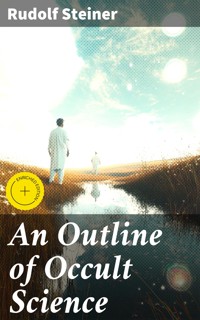
In "An Outline of Occult Science," Rudolf Steiner presents a comprehensive exploration of spiritual science, weaving a narrative that seamlessly intertwines metaphysical concepts with practical insights into human existence. The book is characterized by Steiner's distinctive literary style, marked by clarity and a profound philosophical undertone. Grounded in a context of early 20th-century esotericism, Steiner's work challenges conventional perceptions of reality, delving into themes of reincarnation, karma, and the evolution of consciousness. The reader is guided through a systematic exposition of the spiritual dimensions of life, underpinned by a rigorous intellectual framework that invites contemplation and introspection. Rudolf Steiner, an Austrian philosopher and social reformer, is the founder of Anthroposophy, a movement that seeks to integrate spiritual insight with scientific inquiry. His extensive background in philosophy, as well as his interest in art and education, profoundly influenced his writing. Steiner's commitment to fostering a holistic understanding of humanity's place in the cosmos is evident, as he sought to bridge the gap between the spiritual and the material worlds, inspiring generations of thinkers and practitioners in various fields. This remarkable work is highly recommended for scholars, seekers of knowledge, and anyone interested in the intersection of spirituality and science. By engaging with Steiner's insights, readers can enrich their understanding of both the inner and outer worlds, discovering a pathway toward personal and collective evolution. In this enriched edition, we have carefully created added value for your reading experience: - A succinct Introduction situates the work's timeless appeal and themes. - The Synopsis outlines the central plot, highlighting key developments without spoiling critical twists. - A detailed Historical Context immerses you in the era's events and influences that shaped the writing. - A thorough Analysis dissects symbols, motifs, and character arcs to unearth underlying meanings. - Reflection questions prompt you to engage personally with the work's messages, connecting them to modern life. - Hand‐picked Memorable Quotes shine a spotlight on moments of literary brilliance. - Interactive footnotes clarify unusual references, historical allusions, and archaic phrases for an effortless, more informed read.
Das E-Book können Sie in Legimi-Apps oder einer beliebigen App lesen, die das folgende Format unterstützen:
Veröffentlichungsjahr: 2020
Ähnliche







An Outline of Occult Science
Table of Contents
Introduction
Proposing that inner experience can be cultivated with the rigor of science, this book advances a comprehensive vision in which spiritual knowledge illuminates the human being and the wider cosmos with disciplined clarity.
Written by Rudolf Steiner (1861–1925), An Outline of Occult Science is a foundational work of anthroposophy, a spiritual philosophy he developed in the early twentieth century. First published in German in the 1909–1910 period and revised thereafter, it belongs to the genre of esoteric or spiritual science rather than to narrative literature. The work arose in a European milieu fascinated by both scientific progress and the renewal of spiritual understanding. Its aim is not to abandon modern thought but to widen it, offering a structured approach to supersensible knowledge while maintaining a serious, methodical tone.
Readers encounter a systematic treatise rather than a story: concepts are unfolded step by step, arguments are carefully built, and the author’s voice is earnest, pedagogical, and exploratory. The book presents a panorama of ideas about human development and the larger order of existence, always insisting on disciplined cognition rather than credulous belief. The mood is sober yet visionary, inviting readers into a demanding intellectual and inner exercise. It seeks to balance accessible exposition with depth, offering pathways of reflection that are intended to be tested, not simply accepted, by one’s own thoughtful practice.
At its heart lies the question of how knowledge is possible when the objects of inquiry are not strictly physical. The book explores the relation between sense-bound understanding and capacities that, Steiner argues, can be cultivated for spiritual cognition. Themes of responsibility, freedom, and ethical self-development run alongside discussions of consciousness and evolution, framed not as dogma but as outcomes of disciplined investigation. The work asks readers to consider whether the modern scientific ideal of method can be extended to inner life, and what such an extension might mean for culture, education, and personal meaning.
Without veering into prescription, the text sketches the conditions under which spiritual research might proceed: attentiveness, moral steadiness, patient training of thought, and careful discrimination between imagination and insight. It emphasizes that rigorous inner work demands both critical self-scrutiny and a willingness to test claims against experience. Rather than urging withdrawal from the world, it situates spiritual practice within the responsibilities of ordinary life. The result is a portrait of knowledge that does not oppose empirical science but seeks to complement it, proposing a disciplined pathway for approaching questions that exceed the measurable.
The publication appeared amid a broader early twentieth-century conversation about the limits of materialism and the future of religious and philosophical inquiry. In this context, An Outline of Occult Science offered an unusually systematic voice, attempting to articulate a coherent architecture for spiritual research. Steiner continued to refine his texts over time, and this book has remained central within anthroposophic study and a point of interest to scholars of Western esotericism. Its historical setting matters: it addresses a world grappling with rapid scientific advances, cultural upheaval, and the search for frameworks that could hold both precision and depth.
For contemporary readers, the book’s relevance lies in its audacious wager that clarity and reverence need not be opposites, and that disciplined inner inquiry can be conducted without sacrificing intellectual seriousness. It invites a patient, contemplative reading, in which unfamiliar terms are approached as working concepts rather than ready-made conclusions. The promise is not quick certainty but a sustained encounter with questions about what it means to know, to act freely, and to take responsibility for one’s development. Approached in this spirit, An Outline of Occult Science offers a challenging, integrative experience that seeks to widen the horizon of modern thought.
Synopsis
An Outline of Occult Science presents Rudolf Steiner’s systematic account of anthroposophy, describing a disciplined approach to spiritual research alongside natural science. The book opens by defining “occult science” as a methodical investigation of supersensible realities, insisting on clarity, consistency, and inner training rather than speculation. Steiner frames his project as a continuation of scientific thinking into domains not accessible to the physical senses, drawing on regulated inner observation. He outlines the work’s scope: the constitution of the human being, the states of sleep and death, the path of higher cognition, and a comprehensive narrative of cosmic evolution, culminating in perspectives on humanity’s future development.
Steiner next describes the human constitution as a set of interrelated members: the physical body, etheric or life body, astral or soul body, and the I-organization (ego). He further distinguishes three higher developments—the spirit self (Manas), life spirit (Buddhi), and spirit man (Atman)—as future metamorphoses of the soul and bodily principles. The text explains how waking life depends on the integration of these members, while imbalance or separation reveals different conditions of consciousness. The I-organization is presented as the central agent of selfhood and moral growth. This framework underpins later chapters on evolution, postmortem experience, and the disciplines that cultivate supersensible perception.
A chapter on sleep and death outlines transitions of consciousness when the astral body and I-organization withdraw from the physical and etheric. Sleep is described as a nightly loosening that restores forces depleted by waking life, while dreams reflect partial and symbolic perception of supersensible realities. Death initiates a sequence of experiences: a life panorama, a phase of purification or adjustment to the spiritual world, and an entry into realms of soul and spirit. Steiner correlates these conditions with the long-range processes of karma and reincarnation. The account emphasizes continuity of individual identity across lives and the formative role of moral and cognitive development.
The path to higher knowledge is presented as a careful training of attention and moral character. Steiner differentiates three stages of cognition: imagination (supersensible picturing), inspiration (direct perception of spiritual meanings), and intuition (union with the realities perceived). Exercises focus on concentration, meditation, and ethical strengthening to cultivate reliable observation beyond sense data. The narrative stresses balance, humility, and verification to avoid illusion, asserting that spiritual findings must cohere with sound thinking. This path is not limited to specialists; rather, it is described as a disciplined cultivation accessible in principle to all, provided appropriate safeguards and a commitment to inner responsibility.
The cosmological sections begin with the evolution of humanity and the cosmos through successive planetary conditions: Ancient Saturn, Ancient Sun, and Ancient Moon preceding Earth. On Ancient Saturn, the groundwork for the physical body is laid as a warmth organization; on Ancient Sun, the etheric life principle is added; on Ancient Moon, the astral principle arises. Each stage is guided by hierarchies of spiritual beings and accompanied by changing states of substance and consciousness. The account maintains that present human faculties are the result of long metamorphoses. These descriptions draw on the “Akashic Chronicle,” a term used for a supersensible record of cosmic and human history.
Turning to Earth evolution, Steiner describes the separation of Sun and Earth, followed later by the Moon’s detachment, each event reshaping terrestrial conditions and human development. Humanity’s individuality (the I-organization) is said to awaken within this context, interacting with sphere-influences and spiritual beings. The narrative sketches ancient epochs—Lemurian and Atlantean—followed by post-Atlantean cultural periods (Indian, Persian, Egypto-Chaldean, Greco-Roman, and the present). These stages mark shifts in consciousness, social forms, and capacities. The presence of luciferic and ahrimanic influences is noted as a factor complicating evolution, yet also fostering freedom and discernment within the developing human soul.
The book highlights a central turning point in Earth evolution: the Mystery of Golgotha. Steiner presents this event as a spiritual deed affecting the human I-organization and the balance of cosmic influences. It is described as making possible a renewed relationship between the human being and the spiritual world, countering distortions introduced by luciferic and ahrimanic powers. This perspective situates religious history within the larger cosmic narrative. The account emphasizes that spiritual science seeks to understand such events through inner research rather than dogma, integrating them into a comprehensive picture of the evolution of consciousness and the progressive formation of the higher members of the human being.
Steiner extends the evolutionary panorama into the future, describing further stages of Earth’s transformation and subsequent planetary conditions—sometimes termed Jupiter, Venus, and Vulcan. Human faculties are forecast to mature as spirit self, life spirit, and spirit man increasingly shape existence. The text outlines future cultural epochs and deepening moral responsibilities, emphasizing karmic law as an organizing principle of individual and collective development. Social, ethical, and cognitive capacities are depicted as mutually informing. The overall trajectory is one of spiritualization rather than material intensification, with consciousness becoming more awake and creative while integrating and transmuting the results of earlier evolutionary phases.
The work concludes by restating the purpose of occult science: to extend rigorous knowing into the supersensible, thereby offering a coherent picture of human nature and cosmic history. Steiner positions this approach as complementary to empirical research, not a substitute, aiming to unite exact thinking with inner observation. The book’s central message is that human beings participate in a lawful spiritual evolution, shaped by freedom, responsibility, and knowledge. By outlining methods, cosmology, and moral implications, the text provides a framework for understanding reincarnation, karma, and historical change. It invites readers to consider a disciplined path toward broader cognition and purposeful participation in evolution.
Historical Context
Rudolf Steiner composed An Outline of Occult Science (Die Geheimwissenschaft im Umriss) amid the intellectual ferment of Central Europe at the turn of the twentieth century. First issued in German in 1910, the work crystallized lectures he delivered in 1909 across German-speaking cities, especially Berlin, Munich, and Stuttgart. The German Empire under Wilhelm II and the Austro-Hungarian Monarchy were experiencing rapid industrialization, urban growth, and a blossoming of scientific research alongside cultural anxiety. Steiner had moved from Vienna and Weimar—where he edited Goethe’s scientific writings (1890–1897)—to Berlin by 1897, integrating scholarly rigor with public lecturing. The book addresses readers steeped in positivist science, religious controversies, and a resurgent esoteric milieu.
The modern Theosophical movement most decisively shaped the book’s genesis and aims. Founded in New York in 1875 by Helena P. Blavatsky and Henry S. Olcott, and relocated to Adyar (Madras) in 1879, the Theosophical Society popularized comparative esotericism through Blavatsky’s The Secret Doctrine (1888). In 1902 Steiner became General Secretary of the newly formed German Section, organizing an energetic lecture culture in Berlin and Munich with Marie von Sivers. The 1907 Theosophical Congress in Munich—curated by Steiner—signaled a distinctive Western-esoteric emphasis. Meanwhile, leadership changes under Annie Besant (elected 1907) and the controversial promotion of Jiddu Krishnamurti after his “discovery” by Charles W. Leadbeater in Adyar in 1909 culminated in the Order of the Star in the East (1911–1912). Steiner rejected messianic claims around a single “World-Teacher,” insisting on a path of exact, methodical clairvoyance rooted in a Christian-Rosicrucian stream. The split of 1912–1913 led Steiner and his colleagues to establish an independent anthroposophical movement, soon centered in Berlin and, architecturally, at Dornach (Switzerland). An Outline of Occult Science, appearing at this hinge, systematized a cosmology—Old Saturn, Old Sun, Old Moon, Earth, and future cycles—distinct from Blavatsky’s schema, and offered disciplined inner exercises and epistemic safeguards. It thus served both as a programmatic manifesto differentiating Anthroposophy from Adyar Theosophy and as a response to European intellectuals seeking a comprehensive, non-dogmatic spiritual science.
The rise of scientific materialism and evolutionary debate formed a second crucial backdrop. Charles Darwin’s On the Origin of Species (1859) and The Descent of Man (1871) catalyzed continental discussions sharpened by Ernst Haeckel’s monism—Generelle Morphologie (1866) and the bestseller Die Welträthsel (1899). Haeckel co-founded the Deutscher Monistenbund in 1906 in Jena, advocating a unitary, naturalistic worldview influential in Berlin’s public sphere. Steiner engaged this milieu directly in Haeckel und seine Gegner (1900) and through Goethean biology. In the book, he recasts evolution as a lawful spiritual process, proposing metamorphoses of consciousness through planetary-eon stages, thereby answering monist reductionism with an integrated history of nature and spirit.
The occult revival and emerging psychical research also shaped expectations about evidence for the supersensible. The Society for Psychical Research (London, 1882), led by figures such as Henry Sidgwick and Frederic W. H. Myers, investigated telepathy, mediumship, and apparitions; William James helped found the American SPR in 1885. French clinical studies under Jean-Martin Charcot at the Salpêtrière and the Nancy School examined hypnosis and altered states in the 1880s–1890s. Against sensational mediumism, Steiner framed “exact clairvoyance” as trained observation, aligning inner research with methodological rigor. The book’s initiatory exercises and epistemological cautions speak to this environment, asserting disciplined spiritual perception rather than spontaneous trance phenomena.
A crisis of religious authority and modernist theology marked the era. In Roman Catholicism, Pope Pius X condemned modernism in the encyclical Pascendi Dominici Gregis and the syllabus Lamentabili (both 1907), curbing historical-critical approaches. In German Protestantism, Adolf von Harnack’s Das Wesen des Christentums (1900) at the University of Berlin exemplified liberal theology’s ethical emphasis. Steiner’s work situates the “Christ Event” as the axial turning point in Earth evolution, linking esoteric Christianity with a universal history of consciousness. The book’s Christological center responds to these controversies by reframing doctrine as experiential knowledge, neither bound to dogma nor reduced to purely ethical or historical categories.
Steiner’s years at the Goethe- und Schiller-Archiv in Weimar (1890–1897), editing Goethe’s scientific writings, provided a methodological springboard. Goethe’s morphology and the search for Urphänomene modeled a participatory, qualitative science of form. Steiner’s Berlin publications—especially The Philosophy of Freedom (Die Philosophie der Freiheit, 1894)—argued for cognitive activity as a lawful, accessible path to insight. An Outline of Occult Science extends this Goethean-epistemological attitude to cosmic history, treating supersensible evolution as a phenomenon accessible through trained observation. The emphasis on lawful metamorphosis, organ formation, and stages of consciousness mirrors Goethe’s botanical and anatomical thinking transposed to a grand historical scale.
The wider social climate of German-speaking Europe between 1890 and 1914 intensified the book’s appeal. Berlin’s population surged to roughly 2 million by 1910; electrification, new industries, and mass print culture altered daily life. The Social Democratic Party (SPD) became the largest party in the Reichstag in 1912, signaling deep class tensions. Simultaneously, Lebensreform currents—vegetarian societies (e.g., Deutscher Vegetarierbund, 1892), naturopathy, and reform housing—sought holistic renewal. Occult Science addresses readers negotiating industrial modernity by proposing karmic and reincarnational frameworks for ethical responsibility and community. Its comprehensive cosmology offered orientation amid rapid urbanization and political polarization, while anticipating later anthroposophical applications in medicine, agriculture, and education.
The book functions as an implicit social and political critique by challenging the period’s reductive materialism and institutional dogmatism. By positing freedom, responsibility, and spiritual development across lifetimes, it resists deterministic views of class and heredity that underwrote technocratic and nationalist projects. Its portrayal of the human being as a tripartite entity—body, soul, and spirit—questions educational and economic systems that treat persons as labor units. By re-centering the Christ impulse as a universal, not confessional, force, it critiques sectarian polarization. In proposing a disciplined, accessible spiritual science, it calls for renewing culture from conscience and cognition, offering a counter-model to the era’s instrumental reason and social fragmentation.
An Outline of Occult Science
Preface to the Fourth Edition.
One who undertakes to represent certain results of scientific spiritual research of the kind recorded in this book, must above all things be prepared to find that this kind of investigation is at the present time almost universally regarded as impossible. For things are related in the following pages about which those who are today esteemed exact thinkers[3], assert that they will probably remain altogether indeterminable by human intelligence. One who knows and can respect the reasons which prompt many a serious person to assert this impossibility, would fain make the attempt again and again to show what misunderstandings are really at the bottom of the belief that it is not given to human knowledge to penetrate into the superphysical worlds.
For two things present themselves for consideration. First, no human being will, on deeper reflection, be able in the long run to shut his eyes to the fact that his most important questions as to the meaning and significance of life must remain unanswered, if there be no access to higher worlds. Theoretically we may delude ourselves concerning this fact and so get away from it; the depths of our soul-life, however, will not tolerate such self-delusion. The person who will not listen to what comes from [pg xii] these depths of the soul will naturally reject any account of supersensible worlds. There are however people—and their number is not small—who find it impossible to remain deaf to the demands coming from the depths of the soul. They must always be knocking at the gates which, in the opinion of others, bar the way to what is “incomprehensible.”
Secondly, the statements of “exact thinkers” are on no account to be despised. Where they have to be taken seriously, one who occupies himself with them will thoroughly feel and appreciate this seriousness. The writer of this book would not like to be taken for one who lightly disregards the enormous thought-labour which has been expended in determining the limits of the human intellect. This thought-labour cannot be put aside with a few phrases about “academic wisdom” and the like. In many cases it has its source in true striving after knowledge and in genuine discernment. Indeed, even more than this must be admitted; reasons have been brought forward to show that that knowledge which is to-day regarded as scientific cannot penetrate into supersensible worlds, and these reasons are in a certain sense irrefutable.
Now it may appear strange to many people that the writer of this book admits this freely, and yet undertakes to make statements about supersensible worlds. It seems indeed almost impossible that a person should admit in a certain sense the reasons [pg xiii] why knowledge of superphysical worlds is unattainable, and should yet speak about those worlds.
Yet it is possible to take this attitude, and at the same time to understand that it impresses others as being inconsistent. It is not given to every one to enter into the experiences we pass through when we approach supersensible realms with the human intellect. Then it turns out that intellectual proofs may certainly be irrefutable, and that notwithstanding this, they need not be decisive with regard to reality. Instead of all sorts of theoretical explanations, let us now try to make this comprehensible by a comparison. That comparisons are not in themselves proofs is readily admitted, but this does not prevent their often making intelligible what has to be expressed.
Human understanding, as it works in everyday life and in ordinary science, is actually so constituted that it cannot penetrate into superphysical worlds. This may be proven beyond the possibility of denial. But this proof can have no more value for a certain kind of soul-life than the proof one would use in showing that man's natural eye cannot, with its visual faculty, penetrate to the smallest cells of a living being, or to the constitution of far-off celestial bodies.
Just as the assertion is true and demonstrable that the ordinary power of seeing does not penetrate as far as the cells, so also is the other assertion which maintains that ordinary knowledge cannot penetrate into supersensible worlds. And yet the [pg xiv] proof that the ordinary power of vision has to stop short of the cells in no way excludes the investigation of cells. Why should the proof that the ordinary power of cognition has to stop short of supersensible worlds, decide anything against the possibility of investigating those worlds?
One can well sense the feeling which this comparison may evoke in many people. One can even understand that he who doubts and holds the above comparison against this labor of thought, does not even faintly sense the whole seriousness of that mental effort. And yet the present writer is not only fully convinced of that seriousness, but is of opinion that that work of thought may be numbered among the noblest achievements of humanity. To show that the human power of vision cannot perceive the cellular structure without the help of instruments, would surely be a useless undertaking; but in exact thinking, to become conscious of the nature of that thought is a necessary work of the mind. It is only natural that one who devotes himself to such work, should not notice that reality may refute him. The preface to this book can be no place for entering into many “refutations” of former editions, put forth by those who are entirely devoid of appreciation of that for which it strives, or who direct their unfounded attacks against the personality of the author; but it must, none the less, be emphasized that belittling of serious scientific thought in this book can only be imputed to the author by one who [pg xv] wishes to shut himself off from the spirit of what is expressed in it.
Man's power of cognition may be augmented and made more powerful, just as the eye's power of vision may be augmented. Only the means for strengthening the capacity of cognition are entirely of a spiritual nature; they are inner processes, belonging purely to the soul. They consist of what is described in this book as meditation and concentration (contemplation). Ordinary soul-life is bound up with the bodily instrument; the strengthened soul-life liberates itself from it. There are schools of thought at the present time to which this assertion must appear quite senseless, to which it must seem based only upon self-delusion. Those who think in this way will find it easy, from their point of view, to prove that “all soul-life” is bound up with the nervous system. One who holds the standpoint from which this book has been written, can thoroughly understand such proofs. He understands people who say that only superficiality can assert that there may be some kind of soul-life independent of the body, and who are quite convinced that in such experiences of the soul there exists a connection with the life of the nervous system, which the “dilettantism of occult science[1]” merely fails to detect.
Here certain quite comprehensible habits of thought are in such sharp contradiction to what has been described in this book, that there is as yet no prospect of coming to an understanding with many [pg xvi] people. It is here that we come to the point where the desire must arise that it should no longer be a characteristic of our present day culture to at once decry as fanciful or visionary a method of research which differs from its own. But on the other hand it is also a fact at the present time that a number of people can appreciate the supersensible method of research, as it is presented in this book, people who understand that the meaning of life is not revealed in general phrases about the soul, self, and so on, but can only result from really entering into the facts of superphysical research.
Not from lack of modesty, but with a sense of joyful satisfaction, does the author of this book feel profoundly the necessity for this fourth edition after a comparatively short time. The author is not prompted to this statement by lack of modesty, for he is entirely too conscious of how little even this new edition approaches that “outline of a supersensuous world concept” which it is meant to be. The whole book has once more been revised for the new edition, much supplementary matter has been inserted at important points, and elucidations have been attempted. But in numerous passages the author has realized how poor the means of presentation accessible to him prove to be in comparison with what superphysical research discovers. Thus it was scarcely possible to do more than point out the way in which to reach conceptions of the events described in this book as the Saturn, Sun, and Moon evolutions. An important aspect of this subject has been briefly [pg xvii] remodelled in this edition. But experiences in relation to such things diverge so widely from all experiences in the realm of the senses, that their presentation necessitates a continual striving after expressions which may be, at least in some measure, adequate. One who is willing to enter into the attempted presentation which has here been made, will perhaps notice that in the case of many things which cannot possibly be expressed by mere words, the endeavour has been made to convey them by the manner of the description. This manner is, for instance, different in the account of the Saturn evolution from that used for the Sun evolution, and so on.
Much complementary and additional matter has been inserted in this edition in the part dealing with “Perception of the Higher Worlds.” The endeavour has been made to represent in a graphic way the kind of inner soul-processes by which the power of cognition liberates itself from the limits which confine it in the world of sense and thereby becomes qualified for experiencing the supersensible world. The attempt has been made to show that these experiences, even though gained by entirely inner ways and methods, still do not have a merely subjective significance for the particular individual who gains them. The description attempts to show that within the soul stripped of its individuality and personal peculiarities, an experience takes place which every human being may have in the same way, if he will only work at his development from out his subjective experiences. It is only when “knowledge of supersensible [pg xviii] worlds” is thought of as bearing this character that it may be differentiated from old experiences of merely subjective mysticism. Of this mysticism it may be said that it is after all more or less a subjective concern of the mystic. The scientific spiritual training of the soul, however, as it is described here, strives for objective experiences, the truth of which, although recognized in an entirely inner way, may yet, for that very reason, be found to be universally valid. This again is a point on which it is very difficult to come to an understanding concerning many of the habits of thought of our time.
In conclusion, the author would like to observe that it would be well if even the sympathetic reader of the book would take its statements exactly as they stand. At the present time there is a very prevalent tendency to give this or that spiritual movement an historical name, and to many it is only such a name that seems to make it valuable. But, it may be asked, what would the statements in this book gain by being designated “Rosicrucian,” or anything else of the kind? What is of importance is that in this book a glimpse into supersensible worlds is attempted with the means which in our present period of evolution are possible and suitable for the human soul; and that from this point of view the problems of human destiny and human existence are considered beyond the limits of birth and death. It is not a question of an endeavor which shall bear this or that old name, but of a striving after truth.
On the other hand, expressions have also been [pg xix] used, with hostile intention, for the conception of the universe presented in this book. Leaving out of account that those which were intended to strike and discredit the author most heavily are absurd and objectively untrue, these expressions are stamped as unworthy by the fact that they disparage a fully independent search for truth; because the aggressors do not judge it on its own merits, but try to impose on others, as a judgment of these investigations, erroneous ideas about their dependence upon this or that tradition,—ideas which they have invented, or adopted from others without reason. However necessary these words are in face of the many attacks on the author, it is yet repugnant to him in this place to enter further into the matter.
Rudolf SteinerJune, 1913.
Author's Remarks To First Edition
In placing a book such as this in the hands of the public, the writer must calmly anticipate every kind of criticism regarding his work which is likely to arise in the present day. A reader, for instance, whose opinions are based upon the results of scientific research, after noting certain statements made here touching these things, may pronounce the following judgment: “It is astounding that such statements should be possible in our time. The most elementary conceptions of natural science are distorted in such a manner as to denote positively inconceivable ignorance of even the rudiments of science. The author uses such terms, for instance, as ‘heat’ in a way that would lead one to infer that he had let the entire wave of modern thought on the subject of physics sweep past him unperceived. Any one familiar with the mere elements of this science would show him that not even the merest dilettante could have made these statements, and they can only be dismissed as the outcome of rank ignorance.”
This and many a similar verdict might be pronounced, and we can picture our reader, after the perusal of a page or two, laying the book aside,—smiling or indignant, according to his temperament,—and [pg xxi] reflecting on the singular growths which a perverse tendency of thought may put forth in our time. So thinking, he will lay this volume aside, with his collection of similar freaks of the brain. What, however, would the author say should such opinions come to his knowledge? Would he not, from his point of view, also set the critic down as incapable of judgment or, at least, as one who has not chosen to bring his good will to bear in forming an intelligent opinion? To this the answer is most emphatically—No! In no sense whatever does the author feel this, for he can easily conceive of his critic as being not only a highly intelligent man, but also a trained scientist, and one whose opinions are the result of conscientious thought. The author of this book is able to enter into the feelings of such a person and to understand the reasons which have led him to form these conclusions.
Now, in order to comprehend what the author really means, it is necessary to do here what generally seems to him to be out of place, but for which there is urgent cause in the case of this book, namely, to introduce certain personal data. Of course, nothing will be said in this connection but what bears upon the author's decision to write this book. What is said in it could not be justified if it bore merely a personal character. A book of this kind is bound to proffer views to which any person may attain, and these views must be presented in such a way [pg xxii] as to suggest no shade of the personal element, that is, as far as such a thing is possible.
It is therefore not in this sense that the personal note is sounded. It is only intended to explain how it was possible for the author to understand the above characterized opinions concerning his presentations, and yet was able to write this book.
It is true there is one method which would have made the introduction of the personal element unnecessary—this would have been to specify in detail all those particulars which would show that the statements here made are in agreement with the progress of modern science. This course would, however, have necessitated the writing of many volumes, and as such a task is at present out of the question, the writer feels it necessary to state the personal reasons which he believes justify him in thinking such an agreement thoroughly possible and satisfactory. Were he not in a position to make the following explanations, he would most certainly never have gone so far as to publish such statements as those referring to heat processes.
Some thirty years ago the author had the opportunity of studying physics in its various branches. At that time the central point of interest in the sphere of heat phenomena was the promulgation of the so-called “Mechanical Theory of Heat,” and it happened that this theory so particularly engrossed his attention that the historical development of the various interpretations associated with the names of Julius Robert Mayer, Helmholtz, Joule, Clausius, [pg xxiii] and others, formed the subject of his continuous study. During that period of concentrated work he laid those foundations which have enabled him to follow all the actual advances since made with regard to the theory of physical heat, without experiencing any difficulty in penetrating into what science is achieving in this department. Had he been obliged to confess himself unable to do this, the writer would have had good reason for leaving unsaid and unwritten much that has been brought forward in this book.
He has made it a matter of conscience, when writing or speaking on occult science, to deal only with matters on which he could also report, in what seemed an adequate manner, the views held by modern science. With this, however, he does not wish in the least to give the impression that this is always a necessary prerequisite. Any one may feel a call to communicate or to publish whatever his judgment, his sense of truth, and his feelings may prompt him to, even if he is ignorant of the attitude taken by contemporary science in the matter. The writer wishes to indicate merely that he holds to the pronouncements he has made. For instance, he would never have written those few sentences on the human glandular system, nor those regarding man's nervous system, contained in this volume, were he not in a position to discuss both subjects in the terms used by the modern scientist, when speaking of the glandular and nervous systems from the standpoint of science.
[pg xxiv]In spite of the fact that it may be said that he who speaks concerning “heat,” as is done here, knows nothing of the elements of modern physics, yet the author feels himself quite justified, because he believes that he knows present day research along those lines, and because if it were unknown to him, he would have left the subject alone. He knows that such utterances may be ascribed to lack of modesty, but it is necessary to declare his true motives, lest they should be confounded with others of a very different nature, a result infinitely worse than a verdict of mere vanity.
He who reads this book as a philosopher, may well ask himself, “Has this author been asleep to present day research in the field of the theory of cognition? Had he never heard of the existence of a man called Kant[2]?” this philosopher might ask, “and did he not know that according to this man it was simply inadmissible, from a philosophic point of view, to put forward such statements?” and so on, while in conclusion he might remark that stuff of so uncritical, childish, and unprofessional a nature should not be tolerated among philosophers, and that any further investigation would be waste of time. However, here again, for reasons already advanced and at the risk of being again misinterpreted, the writer would fain introduce certain personal experiences.
His studies of Kant date from his sixteenth year, and he really believes he is now capable of criticizing quite objectively, from the Kantian point of view, everything that has been put forward in this [pg xxv] book. On this account, too, he might have left this book unwritten were he not fully aware of what moves a philosopher to pass the verdict of “childishness” whenever the critical standard of the day is applied. Yet one may actually know that in the Kantian sense the limits of possible knowledge are here exceeded: one may know in what way Herbart (who never arrived at an “arrangement of ideas”) would discover his “naive realism.” One may even know the degree to which the modern pragmatism of James and Schiller and others would find the bounds of “true presentments” transgressed—those presentments which we are able to make our own, to vindicate, enforce, and to verify.
We may know all these things and yet, for this very reason, feel justified in holding the views here presented. The writer has dealt with the tendencies of philosophic thought in his works: “The Theory of Cognition of Goethe's World-Concept”; “Truth and Science”; “Philosophy of Freedom”; “Goethe's World Concept” and “Views of the World and Life in the Nineteenth Century.”
Many other criticisms might be suggested. Any one who had read some of the writer's earlier works: “Views of the World and Life in the Nineteenth Century,” for instance, or a smaller work on Haeckel and his Opponents, might think it incredible that one and the same man could have written those books as well as the present work and also his already published “Theosophy.”“How,” he might ask, “can a man throw himself into the breach [pg xxvi] for Haeckel, and then, turn around and discredit every sound theory concerning monism that is the outcome of Haeckel's researches?” He might understand the author of this book attacking Haeckel “with fire and sword”; but it passes the limits of comprehension that, besides defending him, he should actually have dedicated “Views of the World and Life in the Nineteenth Century” to him. Haeckel, it might be thought, would have emphatically declined the dedication had he known that the author was shortly to produce such stuff as An Outline of Occult Science, with all its unwieldy dualism.
The writer of this book is of the opinion that one may very well understand Haeckel without being bound to consider everything else as nonsense which does not flow directly from Haeckel's own presentments and premises. The author is further of the opinion that Haeckel cannot be understood by attacking him with “fire and sword,” but by trying to grasp what he has done for science. Least of all does he hold those opponents of Haeckel to be in the right, against whom he has in his book, Haeckel and his Opponents, sought to defend the great naturalist; for surely, the fact of his having gone beyond Haeckel's premises by placing the spiritual conception of the world side by side with the merely natural one conceived by Haeckel, need be no reason for assuming that he was of one mind with the latter's opponents. Any one taking the trouble to look at the matter in the right light must see that the [pg xxvii] writer's recent books are in perfect accord with those of an earlier date.
But the author can also conceive of a critic who in general and offhand looks upon the presentations of this book as the out-pourings of a fantasy run wild or as dreamy thought-pictures. Yet all that can be said in this respect is contained in the book itself, and it is explicitly shown that sane and earnest thought not only can but must be the touch-stone of all the facts presented. Only one who submits what is here advanced to logical and adequate examination, such as is applied to the facts of natural science, will be in a position to decide for himself how much reason has to say in the matter.
After saying this much about those who may at first be inclined to take exception to this work, we may perhaps be permitted to address a few words to those on whose sympathetic attention we can rely. These will find all broad essentials contained in the first chapter, “Concerning the Nature of Occult Science.” A word, however, must here be added. Although this book deals with investigations carried beyond the confines of intellect limited to the world of the senses, yet nothing has been asserted except what can be grasped by any person possessed of unprejudiced reasoning powers backed by a healthy sense of truth, and who is at the same time willing to turn these gifts to the best account; and the writer emphatically wishes it to be understood that he hopes to appeal to readers who will not be content with merely accepting on “blind faith” the [pg xxviii] matters presented, but who will take the trouble to test them by the light of their own understanding and by the experiences of their own lives. Above all, he desires cautious readers, who will allow themselves to be convinced only by what can be logically justified. The writer is well aware that his work would be worth nothing were its value to rest on blind belief; it is valuable only in the degree to which it can be justified by unbiased reason. It is an easy thing for “blind faith” to confound folly and superstition with truth, and doubtless many, who have been content to accept the supersensible on mere faith, will be inclined to think that this book makes too great demands upon their powers of thought. It is not a question of merely making certain communications, but rather of presenting them in a manner consistent with a conscientious view of the corresponding plane of life; for this is the plane upon which the loftiest matters are often handled with unscrupulous charlatanism, and where knowledge and superstition come into such close contact as to be liable to be confused one with the other.
Any one acquainted with supersensual research will, on reading this book, be able to see that the author has sought to define the boundary line sharply between what can be communicated now from the sphere of supersensible cognition, and that which will be given out, at a later time, or at least, in a different form.
Rudolf SteinerDecember, 1909.
Chapter I. The Character of Occult Science
At the present time the words “occult science” are apt to arouse the most varied feelings. Upon some people they work like a magic charm, like the announcement of something to which they feel attracted by the innermost powers of their soul; to others there is in the words something repellent, calling forth contempt, derision, or a compassionate smile. By many, occult science is looked upon as a lofty goal of human effort, the crown of all other knowledge and cognition; others, who are devoting themselves with the greatest earnestness and noble love of truth to that which appears to them true science, deem occult science mere idle dreaming and fantasy, in the same category with what is called superstition. To some, occult science is like a light without which life would be valueless; to others, it represents a spiritual danger, calculated to lead astray immature minds and weak souls, while between these two extremes is to be found every possible intermediate shade of opinion.
Strange feelings are awakened in one who has attained a certain impartiality of judgment in regard [pg 002] to occult science, its adherents and its opponents, when one sees how people, undoubtedly possessed of a genuine feeling for freedom in many matters, become intolerant when they meet with this particular line of thought. And an unprejudiced observer will scarcely fail in this case to admit that what attracts many adherents of occult science—or occultism—is nothing but the fatal craving for what is unknown and mysterious, or even vague. And he will also be ready to own that there is much cogency in the reasons put forward against what is fantastic and visionary by serious opponents of the cause in question. In fact, one who studies occult science will do well not to lose sight of the fact that the impulse toward the mysterious leads many people on a vain chase after worthless and dangerous will-o'-the-wisps.
Even though the occult scientist keeps a watchful eye on all errors and vagaries on the part of adherents of his views, and on all justifiable antagonism, yet there are reasons which hold him back from the immediate defence of his own efforts and aspirations. These reasons will become apparent to any one entering more deeply into occult science. It would therefore be superfluous to discuss them here. If they were cited before the threshold of this science had been crossed, they would not suffice to convince one who, held back by irresistible repugnance, refuses to cross that threshold. But to one who effects an entry, the reasons will soon manifest themselves, with unmistakable clearness from within.
[pg 003]This much, however, implies that the reasons in question point to a certain attitude as the only right one for an occult scientist. He avoids, as much as he possibly can, any kind of outer defence or conflict, and lets the cause speak for itself. He simply puts forward occult science; and in what it has to say about various matters, he shows how his knowledge is related to other departments of life and science, what antagonism it may encounter, and in what way reality stands witness to the truth of his cognitions. He knows that an attempted vindication would,—not merely on account of current defective thinking but by virtue of a certain inner necessity,—lead into the domain of artful persuasion; and he desires nothing else than to let occult science work its own way quite independently.
The first point in occult science is by no means the advancing of assertions or opinions which are to be proven, but the communication, in a purely narrative form, of experiences which are to be met with in a world other than the one that is to be seen with physical eyes and touched with physical hands. And further, it is an important point that through this science the methods are described by which man may verify for himself the truth of such communications. For one who makes a serious study of genuine occult science will soon find that thereby much becomes changed in the conceptions and ideas which are formed—and rightly formed—in other spheres of life. A wholly new conception necessarily arises also about what has hitherto been called a “proof.”[pg 004] We come to see that in certain domains such a word loses its usual meaning, and that there are other grounds for insight and understanding than “proofs” of this kind.
All occult science is born from two thoughts, which may take root in any human being. To the occult scientist these thoughts express facts which may be experienced if the right methods for the purpose are used. But to many people these same thoughts represent highly disputable assertions, which may arouse fierce contention, even if they are not regarded as something which may be “proven” impossible.
These two thoughts are, first, that behind the visible world there is another, the world invisible, which is hidden from the senses and also from thought that is fettered by these senses; and secondly, that it is possible for man to penetrate into that unseen world by developing certain faculties dormant within him.
Some will say that there is no such hidden world. The world perceived by man through his senses is the only one. Its enigmas can be solved out of itself. Even if man is still very far from being able to answer all the questions of existence, the time will certainly come when sense-experience and the science based upon it will be able to give the answers to all such questions.
Others say that it cannot be asserted that there is no unseen world behind the visible one, but that human powers of perception are not able to penetrate into that world. Those powers have bounds [pg 005] which they cannot pass. Faith, with its urgent cravings, may take refuge in such a world; but true science, based on ascertained facts, can have nothing to do with it.
A third class looks upon it as a kind of presumption for man to attempt to penetrate, by his own efforts of cognition, into a domain with regard to which he should give up all claim to knowledge and be content with faith. The adherents of this view feel it to be wrong for weak human beings to wish to force their way into a world which should belong to religious life.
It is also alleged that a common knowledge of the facts of the sense-world is possible for mankind, but that in regard to supersensible things it can be merely a question of the individual's personal opinion, and that in these matters there can be no possibility of a certainty universally recognized. And many other assertions are made on the subject.
The occult scientist has convinced himself that a consideration of the visible world propounds enigmas to man which can never be solved out of the facts of that world itself. Their solution in this way will never be possible, however far advanced a knowledge of those facts may be. For visible facts plainly point, through their own inner nature, to the existence of a hidden world. One who does not see this closes his eyes to the problems which obviously spring up everywhere out of the facts of the sense-world. He refuses to recognize certain questions and problems, and therefore thinks that all questions [pg 006] can be answered through facts within reach of sense perception. The questions which he is willing to ask are all capable of being answered by the facts which he is convinced will be discovered in the course of time. Every genuine occultist admits this. But why should one, when he asks no questions, expect answers on certain subjects? The occult scientist says that to him such questioning is natural, and must be regarded as a wholly justifiable expression of the human soul. Science is surely not to be confined within limits which prohibit impartial inquiry.
The opinion that there are bounds to human knowledge which it is impossible to pass, compelling man to stop short of the invisible world, is thus met by the occult scientist: he says that there can exist no doubt concerning the impossibility of penetrating into the unseen world by means of the kind of cognition here meant. One who considers it the only kind can come to no other opinion than that man is not permitted to penetrate into a possibly existing higher world. But the occult scientist goes on to say that it is possible to develop a different sort of cognition, and that this leads into the unseen world. If this kind of cognition is held to be impossible, we arrive at a point of view from which any mention of an invisible world appears as sheer nonsense. But to an unbiased judgment there can be no basis for such an opinion as this, except that its adherent is a stranger to that other kind of cognition. But how can a person form an opinion about a subject of which he declares himself ignorant? Occult science [pg 007] must in this case maintain the principle that people should speak only of what they know, and should not make assertions about anything of which they are ignorant. It can only recognize every man's right to communicate his own experiences, not every man's right to declare the impossibility of what he does not, or will not, know. The occult scientist disputes no one's right to ignore the invisible world; but there can be no real reason why a person should declare himself an authority, not only on what he may know, but also on things considered unknowable.
To those who say that it is presumption to penetrate into unseen regions, the occult scientist would merely point out that this can be done, and that it is sinning against the faculties with which man has been endowed if he allows them to waste instead of developing and using them.
But he who thinks that views about the unseen world are necessarily wholly dependent on personal opinion and feeling is denying the common essence of all human beings. Even though it is true that every one must find light on these things within himself, it is also a fact that all those, who go far enough, arrive at the same, not at different conclusions regarding them. Differences exist only as long as people will not approach the highest truths by the well-tested path of occult science, but attempt ways of their own choosing. Genuine occult science will certainly fully admit that only one who has followed, or at any rate has begun to follow the path of occult [pg 008] science, is in a position to recognize it as the right one. But all those who follow that path will recognize its genuineness, and have always done so.
The path to occult knowledge will be found, at the fitting moment, by every human being who discerns in what is visible the presence of something invisible, or who even but dimly surmises or divines it, and who, from his consciousness that powers of cognition are capable of development, is driven to the feeling that what is hidden may be unveiled to him. One who is drawn to occult science by such experiences of the soul will find opening up before him, not only the prospect of finding the answers to certain questions which press upon him, but the further prospect of overcoming everything which hampers and enfeebles his life. And in a certain higher sense it implies a weakening of life, in fact a death of the soul, when a person is compelled to turn away from, or to deny, the unseen. Indeed, under certain circumstances despair is the result of a man's losing all hope of having the invisible revealed to him. This death and despair, in their manifold forms, are at the same time inner spiritual foes of occult science. They make their appearance when a person's inner force is dwindling away. In that case, if he is to possess any vital force it must be supplied to him from without. He perceives the things, beings, and events which approach his organs of sense, and analyzes them with his intellect. They afford him pleasure and pain, and impel him to the actions of which he is capable. For a while he may go on in this way: [pg 009] but at length he must reach a point at which he inwardly dies. For that which may thus be extracted for man from the outer world, becomes exhausted. This is not a statement arising from the personal experience of one individual, but something resulting from an impartial survey of the whole of human life. That which secures life from exhaustion lies in the unseen world, deep at the roots of things. If a person loses the power of descending into those depths so that he cannot be perpetually drawing fresh vitality from them, then in the end the outer world of things also ceases to yield him anything of a vivifying nature.
It is by no means the case that only the individual and his personal weal and woe are concerned. Through occult science man gains the conviction that from a higher standpoint the weal and woe of the individual are intimately bound up with the weal and woe of the whole world. This is a means by which man comes to see that he is inflicting an injury on the entire world and every being within it, if he does not develop his own powers in the right way. If a man makes his life desolate by losing touch with the unseen, he not only destroys in his inner self something, the decay of which may eventually drive him to despair, but through his weakness he constitutes a hindrance to the evolution of the whole world in which he lives.
Now man may delude himself. He may yield to the belief that there is nothing invisible, and that that which is manifest to his senses and intellect [pg 010] contains everything which can possibly exist. But such an illusion is only possible on the surface of consciousness and not in its depths. Feeling and desire do not yield to this delusive belief. They will be perpetually craving, in one way or another, for that which is invisible. And if this is withheld, they drive man to doubt, to uncertainty about life, or even to despair. Occult science, by making manifest what is unseen, is calculated to overcome all hopelessness, uncertainty, and despair,—everything, in short, which weakens life and makes it unfit for its necessary service in the universe.
The beneficent effect of occult science is that it not only satisfies thirst for knowledge but gives strength and stability to life. The source whence the occult scientist draws his power for work and his confidence in life is inexhaustible. Any one who has once had recourse to that fount will always, on revisiting it, go forth with renewed vigour.
There are people who will not hear anything about occult science, because they think they discern something unhealthy in what has just been said. These people are quite right as regards the surface and outer aspect of life. They do not desire that to be stunted, which life, in its so-called reality, offers. They see weakness in man's turning away from reality and seeking his welfare in an unseen world which to them is synonymous with what is chimerical and visionary. If as occult scientists we do not desire to fall into morbid dreaming and weakness, we must admit that such objections are partially justified. For [pg 011] they are founded upon sound judgment, which leads to a half truth instead of a whole truth merely because it does not penetrate to the roots of things, but remains on the surface. If occult science were calculated to weaken life and estrange man from true reality, such objections would certainly be strong enough to cut the ground from under the feet of those who follow this spiritual line of life. But even in regard to such opinions as these, occult science would not be taking the right course in defending itself in the ordinary sense of the word. Even in this case it can only speak by means of what it gives to those who really penetrate into its meaning, that is, by the real force and vitality which it bestows. It does not weaken life, but strengthens it, because it equips man not only with the forces of the manifest world but with those of the invisible world of which the manifest is the effect. Thus it does not imply an impoverishment, but an enrichment, of life. The true occult scientist does not stand aloof from the world, but is a lover of reality, because he does not desire to enjoy the unseen in a remote dream-world, but finds his happiness in bringing to the world ever fresh supplies of force from the invisible sources from whence this very world is derived, and from which it must be continually fructified.
Some people find many obstacles when they enter upon the path of occult science. One of these is expressed in the fact, that a person, attempting to take the first steps, is sometimes discouraged because [pg 012] at the outset he is introduced to the details of the supersensible world, in order that he may, with entire patience and devotion, become acquainted with them. A series of communications is made to him concerning the invisible nature of man, about certain definite occurrences in the kingdom of which death opens the portals, and regarding the evolutions of man, the earth, and the entire solar system. What he expected was to enter the supersensible world easily, at a bound. Now he is heard to say: “Everything which I am told to study is food for my mind, but leaves my soul cold. I am seeking the deepening of my soul-life. I want to find myself within. I am seeking something that will lift my soul into the sphere of the divine, leading it to its true home; I do not want information about the human being and world-processes.” People who talk in this way have no idea that by such feelings they are barring the door to what they are really seeking. For it is just when, and only when, with a free and open mind, in self-surrender and patience, they assimilate what they call “merely” food for the intellect, that they will find that for which their souls are athirst. That road leads the soul to union with the divine, which brings to the soul knowledge of the works of the divine. The uplifting of the heart is the result of learning to know about the creations of the spirit.