Erhalten Sie Zugang zu diesem und mehr als 300000 Büchern ab EUR 5,99 monatlich.
- Herausgeber: Musaicum Books
- Kategorie: Sachliteratur, Reportagen, Biografien
- Sprache: Englisch
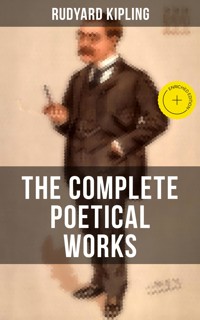
In 'The Complete Poetical Works of Rudyard Kipling', readers are immersed in a collection of Kipling's poetry that showcases his exquisite use of language, powerful imagery, and deep exploration of colonialism and imperialism. Kipling's poems reflect the complexities of his time, offering a critical perspective on British Empire and its impact. His verses are characterized by their rhythmic quality and evocative storytelling, making them a captivating read for poetry enthusiasts and history buffs alike. The inclusion of his iconic poems such as 'If—' and 'The White Man's Burden' provides a comprehensive view of Kipling's poetic prowess. The book serves as a valuable resource for understanding the literary landscape of the late 19th and early 20th centuries, shedding light on the societal views and tensions of the era. Rudyard Kipling's distinctive style and thematic depth make this collection a must-read for those interested in poetry, colonial history, and social commentary. In this enriched edition, we have carefully created added value for your reading experience: - A comprehensive Introduction outlines these selected works' unifying features, themes, or stylistic evolutions. - The Author Biography highlights personal milestones and literary influences that shape the entire body of writing. - A Historical Context section situates the works in their broader era—social currents, cultural trends, and key events that underpin their creation. - A concise Synopsis (Selection) offers an accessible overview of the included texts, helping readers navigate plotlines and main ideas without revealing critical twists. - A unified Analysis examines recurring motifs and stylistic hallmarks across the collection, tying the stories together while spotlighting the different work's strengths. - Reflection questions inspire deeper contemplation of the author's overarching message, inviting readers to draw connections among different texts and relate them to modern contexts. - Lastly, our hand‐picked Memorable Quotes distill pivotal lines and turning points, serving as touchstones for the collection's central themes.
Sie lesen das E-Book in den Legimi-Apps auf:
Seitenzahl: 1037
Veröffentlichungsjahr: 2017
Das E-Book (TTS) können Sie hören im Abo „Legimi Premium” in Legimi-Apps auf:
Ähnliche












The Complete Poetical Works of Rudyard Kipling
Published by
Books
Table of Contents
Introduction
The Complete Poetical Works of Rudyard Kipling assembles the principal verse collections published across his career, presented to offer a coherent view of his achievement in poetry. It includes Departmental Ditties, Ballads and Barrack-Room Ballads, The Seven Seas, An Almanac of Twelve Sports, The Five Nations, Songs From Books, The Years Between, and a gathering of Other Poems. Composed from the late Victorian period into the early twentieth century, these books show an evolving poet attentive to public occasions and private reckonings alike. The purpose of this collection is to provide readers with a single, continuous encounter with the full range of his poetic art.
Although Kipling was also a prolific writer of fiction and journalism, the present volume concerns his poetry, which itself spans diverse kinds. Within these pages stand narrative ballads, songs, dramatic monologues, epigrams, epitaphs, odes, hymnal pieces, inscriptions, and occasional verse. Some poems first appeared alongside his prose, others were written for specific civic or commemorative moments, and many are standalone performances meant for the ear. The selection foregrounds verse that engages with work, duty, travel, war, technology, and the sea. It also shows how Kipling’s lyrics can frame or answer his stories, while remaining complete as poems in their own right.
Departmental Ditties introduces a vein of satirical and social observation that would remain central to Kipling’s verse. These short pieces, rooted in the life of colonial administration, balance lightness of touch with pointed moral scrutiny. They turn on crisp rhyme, compact stanzaic design, and a reporter’s eye for the revealing detail. Bureaucratic routine becomes the subject of comic wit and ethical testing, and the language of office and ordinance is converted into poetry. The poems’ compactness, their relish for professional jargon, and their sympathy for ordinary predicaments foreshadow Kipling’s later interest in the dignity and pitfalls of institutional life.
Ballads and Barrack-Room Ballads extends his focus from desks to drill grounds, giving voice to common soldiers and the communities around them. These are dramatic monologues and songs that rely on memorable refrains, strong cadence, and an ear for everyday speech. The collection’s energy arises from performance: the sense that a speaker addresses a listening crowd. Its subjects include comradeship, discipline, fear, pride, and the cost of service. By writing in a popular ballad idiom while maintaining narrative clarity and technical control, Kipling forged poems that became part of a wider culture of recitation and song.
The Seven Seas shifts the horizon outward to ocean routes and global exchange. Here the poet’s fascination with ships, engines, cargoes, and communications networks becomes a source of metaphor and music. The sea stands for connection and risk, commerce and solitude, and the poems explore both the exhilaration and the strain of movement across distances. Kipling’s command of technical vocabulary animates this world without sacrificing accessibility. The forms are varied but uniformly assured, using chant-like rhythms and ballad stanzas to suggest the pulse of machinery and tide, and to register the moral weight of mastery and dependence across waterways.
An Almanac of Twelve Sports offers a compact calendar of verse that links athletic pastimes to the seasons and to characteristic states of mind. Each miniature calls up the stance, gear, weather, and temperament of a given sport, treating physical skill as a language with its own poise and humor. The poems are concise yet crafted, balancing playfulness with precision. They reveal Kipling’s gift for the vignette and his pleasure in specialized vocabularies. The almanac structure underscores recurring cycles of preparation and test, rest and exertion, making the series an elegant study in timing, discipline, and spirited recreation.
The Five Nations returns to the public stage with a more panoramic register. It considers the responsibilities and pressures of a great power, the uncertainties of diplomacy, and the strains of conflict. The poems here demonstrate Kipling’s capacity for rhetorical address—choral effects, invocations, and compact narratives—while keeping attention fixed on the individuals who bear the weight of collective decisions. The verse moves between celebration and admonition, recognizing skill and courage yet pressing questions of cost and consequence. Its compositional polish, with recurring motifs and measured argument, exemplifies his mature public voice.
Songs From Books gathers poems that appeared originally within Kipling’s prose volumes, where they serve as prefaces, interludes, or songs associated with characters and episodes. Brought together, they form a companionable anthology of voices and scenes that extend the imaginative worlds of his stories. Each poem can stand alone, built with the same care for meter, rhyme, and imagery found in the larger collections. Read as a group, they show how lyric inserts can set tone, foreshadow action, or supply a legend to accompany narrative, demonstrating the fruitful traffic between Kipling’s storytelling and his songcraft.
The Years Between reflects the upheavals of the early twentieth century, notably the experience and aftermath of the First World War. The verse becomes more austere and grave in places, attentive to grief, endurance, and the duties of remembrance. Public themes persist, but the register often narrows to elegy, testimony, and meditation. Formal means are sharpened rather than abandoned: strict meters, controlled repetition, and pared diction reinforce a mood of resolve and accounting. The collection marks a shift from imperial confidence toward a harder reckoning with loss and responsibility in a changed political and moral landscape.
Other Poems completes the record with pieces that lie outside the major groupings: occasional verses, inscriptions, experiments, and late items that reinforce continuities across the career. Here the reader encounters concise epigrams, brief portraits, technical exercises, and poems written for specific moments or places. Far from peripheral, these works illuminate the habits of mind that animate the larger books: curiosity about work and craft, attentiveness to local speech, and an ethic of service tested by circumstance. They help reveal a poet who remained restless in form and subject, and whose smaller-scale poems often carry durable afterthoughts.
Across volumes, unifying concerns emerge with clarity. Kipling’s poetry repeatedly examines duty, labor, and the systems—military, maritime, bureaucratic—that enable and constrain human action. It notices the costs of belonging to such structures and the character formed within them. Stylistically, he favors strong, regular meters; ballad and hymn patterns; refrains that bind community; and a ventriloquism that inhabits distinct voices. Technical diction and colloquial idiom sit side by side, reflecting interest in both specialized crafts and everyday talk. The result is a body of work that is at once public and intimate, meant to be spoken aloud yet attentive to subtle moral turnings.
Kipling’s lasting significance rests on craft and reach. His poems entered public memory, shaped conversations about service and nation, and documented the textures of a world organized by travel, trade, and war. They also pose questions that continue to invite debate, especially where historical attitudes and language diverge from present values. Reading him today benefits from context and care, but the virtues of construction—sound patterning, narrative economy, disciplined imagery—remain instructive and compelling. This collection’s aim is simple: to make accessible the whole arc of Kipling’s verse, so that readers can trace its energies, tensions, and achievements in full.
Author Biography
Rudyard Kipling (1865–1936) was an English poet and storyteller whose work bridged the late Victorian and Edwardian eras, becoming a prominent voice of a globalizing British world. Celebrated and contested in equal measure, he combined memorable rhythms with a reporter’s eye for speech and setting, giving durable form to ballads, epigrams, and narrative verse. His poetry collections circulated widely across the English-speaking world, shaping popular recitation and public debate. Awarded the Nobel Prize in Literature in 1907, he stood at the center of discussions about empire, duty, and modernity, while continuing to refine technical resources—refrain, dialect, and chant—that lent his poems striking immediacy.
Born in Bombay (now Mumbai) and schooled in England at the United Services College, Kipling learned early to shuttle between cultures and registers. Returning to India in the early 1880s, he worked as a journalist in Lahore and Allahabad, assignments that steeped him in the idioms of soldiers, clerks, and administrators. The newsroom’s appetite for compression, anecdote, and telling detail left a permanent mark on his verse. Ballad measures, music-hall cadences, and hymn-like structures recur in his work, with voices that sound overheard rather than oratorical. These habits of ear and craft would guide his first significant poetry volumes and sustain his later experiments.
Departmental Ditties, first assembled in the late 1880s, offered brisk, satiric portraits of Anglo-Indian official life. Its couplets and refrains capture office intrigues, bureaucratic comedy, and the small collisions of duty and desire. Soon after came Ballads and Barrack-Room Ballads, which carried his journalism into verse drama, channeling the speech of rank-and-file soldiers. The poems’ directness and musicality—built on marching tempos and conversational phrasing—won a large readership. Admirers valued the immediacy and craft; critics questioned the politics. Either way, these collections secured Kipling’s reputation as a poet who could make the rhythms of everyday talk bear the weight of public themes.
In The Seven Seas, published in the mid-1890s, Kipling broadened his range to maritime distances and the shared life of a dispersed empire. The book moves from shipboard to harbor, from commercial lanes to migrant crossings, with choruses and chantlike structures that invite communal recitation. An Almanac of Twelve Sports, created alongside the artist William Nicholson, paired concise verses with monthly scenes of popular games and field pursuits. Though often playful, these pieces display the same precision of beat and image that governs his larger canvases. Together, the volumes show a poet adapting his ballad toolkit to spectacle, travel, and seasonal ritual.
The Five Nations, issued in the early 1900s, brought questions of power and responsibility to the fore, reflecting conflicts and imperial entanglements of the era. Its range runs from martial reportage to uneasy prayer, and it contains pieces that stirred international debate, including The White Man’s Burden. Kipling’s formal control—refrains, choruses, and stanzaic architecture—supports a rhetoric that is both exhortatory and cautionary. Many readers found in the book a compelling chronicle of contemporary history; others challenged its premises. The intensity of the reactions testifies to the extent that his poems had become part of the public conversation about empire and citizenship.
Songs From Books (early 1910s) gathered verses that converse with his prose, revealing how he thought across genres: lyrics, choruses, and ballads echo and answer narrative scenes. The Years Between, largely shaped by the First World War, registers endurance, loss, and civic obligation in stripped, measured lines. Personal grief—he lost a son in the conflict—deepens the elegiac turn without diminishing his public voice. Other Poems, spanning subjects and occasions, shows his facility with epigram, monologue, and hymn. Across these collections, a consistent craft emerges: tight stanzaic frames, memorable refrains, and a ventriloquism that can honor, question, or complicate the communities it depicts.
In his later years Kipling lived chiefly in England, continued to publish, and remained a figure of international renown. While readers debated the political implications of his themes, few doubted the tensile strength of his metrics or the clarity of his images. He died in 1936 and was buried at Westminster Abbey, a sign of the place his work had taken in public life. Today his poetry attracts both admiration and scrutiny: it is studied for its technique, its diction, and its crystallization of an age’s assumptions. The collections in this set continue to circulate as touchstones of voice, craft, and argument.
Historical Context
Rudyard Kipling’s poetical career spans the last decades of the Victorian era through the upheavals of the First World War, and the works gathered in The Complete Poetical Works trace that arc. Born in 1865 in British India and active as a journalist before becoming a world-famous writer, Kipling wrote amid the expansion, strain, and self-questioning of the British Empire. The poems reflect shifts from high imperial confidence to anxiety and bereavement, while registering industrial and maritime modernity, mass literacy, and new media. From Departmental Ditties (1886) and Barrack-Room Ballads (1892) to The Seven Seas (1896), The Five Nations (1903), Songs From Books (1912), and The Years Between (1919), the collection mirrors changing political landscapes and technologies.
Kipling’s earliest verse grew from the Anglo-Indian press. Between 1882 and 1889 he worked at the Civil and Military Gazette in Lahore and the Pioneer in Allahabad, absorbing the bureaucratic routines of the Raj and the social world of cantonments and hill stations such as Simla. These poems were shaped by the legacies of the 1857 uprising, debates about legal equality like the Ilbert Bill controversy of 1883, and frontier campaigning after the Second Anglo-Afghan War (1878–1880). Journalism trained him to compress scene and character, and the colonial public sphere—newspapers, clubs, railways, the telegraph—provided the institutions and idioms that animate his early satires and ballads.
Departmental Ditties (first published 1886) reflects the culture of the Indian Civil Service and the colonial departments it administered. The poems turn on promotions, transfers, etiquette, and the pressures of imperial routine, often set against the seasonal migration to hill stations. They draw on a late-Victorian appetite for topical verse and epigram, and on readers’ familiarity with Anglo-Indian slang and official procedure. Pieces like Arithmetic on the Frontier (1886) juxtapose metropolitan calculations with the human costs of campaigning along India’s borders. The book crystallizes a moment when print networks and bureaucratic professionalism defined how imperial authority was imagined and negotiated.
Barrack-Room Ballads (1892) coincided with the popularization of soldierly experience in music halls and cheap print. Following reforms of the British Army in the 1870s–1880s and ongoing small wars on imperial frontiers, the poems adopt a demotic voice that many readers took as the ranker’s perspective. They reached wide audiences through newspapers and recitation, echoing the oral traditions of balladry even as they circulated via modern mass media. The collection tapped debates about discipline, recruitment, and the social status of “Tommy Atkins,” speaking to an era when Britain’s global commitments depended on mobile, professionalized forces and a home front often ambivalent toward them.
Individual poems from Barrack-Room Ballads interpret specific settings and tensions of empire. Danny Deever renders a parade-ground execution with spare dramatic dialogue, distilling the army’s rituals of justice. Tommy contrasts wartime need with peacetime neglect, summarizing late-Victorian anxieties about the soldier’s civic place. Mandalay evokes the British annexation of Burma after 1885 and the texture of garrison life in a newly absorbed territory. Gunga Din centers an Indian water-carrier, reflecting the indispensable labor of colonial auxiliaries. The Ballad of East and West (1889), often printed with these poems, channels frontier encounters and honor codes shaped by North-West frontier warfare and diplomacy.
The Seven Seas (1896) emerged when steam, steel, and global communications reshaped commerce and power. Kipling, writing soon after years in the United States and wide travels, returned repeatedly to ships, engineers, and sea lanes. Poems such as McAndrew’s Hymn (1894) and The Mary Gloster (1894) speak to the technical culture of marine engineering and the fortunes built on shipping. The Suez Canal (opened 1869) and a dense web of coaling stations underwrote imperial logistics. Contemporary naval thought—exemplified by Alfred Thayer Mahan’s writings on sea power—framed public discussion of strategy, and Kipling’s maritime verse captured that late-Victorian fascination with oceanic networks.
Technologies of connection were central to the 1890s. The Deep-Sea Cables (1893) dramatises submarine telegraphy binding continents, anticipating the “All-Red Line” of British-controlled cables completed in 1902. Telegraph offices, postal routes, and regular steamship schedules synchronized information and trade across time zones. Kipling’s rhythms often mimic mechanical pulse and signal, and his speakers include stokers, captains, and shore-side clerks—figures through whom modernity enters everyday life. As Britain negotiated rivalry and partnership with other maritime powers, the poems turned seaborne commerce and communication into metaphors for interdependence and the strains that such interdependence imposed on imperial governance.
An Almanac of Twelve Sports (1898), made with artist William Nicholson, registers the codified, seasonal culture of late-Victorian and Edwardian sport. By the 1890s, rules and national bodies had standardized many games; mass-circulation papers reported fixtures and results; posters and prints marketed athletes and spectacles. Kipling’s brief verses accompany Nicholson’s bold woodcut-influenced images, aligning poetry with graphic design at a moment when advertising and illustrated periodicals were transforming visual culture. The set tracks leisure across the year—boxing, cricket, hunting, and more—glimpsing class codes, urban-rural divides, and the idea of sport as moral training that public schools and voluntary associations increasingly promoted.
The Five Nations (1903) belongs to the high tide and aftermath of the “New Imperialism.” Appearing just after the South African War (Second Boer War, 1899–1902), it addresses empire’s effort, reach, and cost. The title has often been read as gesturing toward Britain and English-speaking polities overseas during an era of imperial federation debates. The book engages shifts in global power following the Spanish–American War (1898) and controversies over colonial “duties,” including the widely discussed The White Man’s Burden (1899), which addressed the United States amid the Philippine–American War (1899–1902). Exploration pieces such as The Explorer (1898) dramatize expansion’s risks and returns.
Kipling’s connection with South Africa shaped poems around 1900. He spent time in Cape Town, associated with Cecil Rhodes, and helped produce The Friend newspaper for British forces at Bloemfontein in 1900. The war provoked fierce public debate in Britain over strategy and policy, including the use of concentration camps for civilians and scorched-earth tactics. His verse from this period champions imperial resolve and soldierly endurance, reflecting the confidence of pro-imperial circles and the work of administrators seeking postwar reconstruction. The poems stand within a broader media environment—war correspondents, relief funds, and patriotic pageantry—that turned distant campaigns into daily news at home.
Kipling’s late-Victorian public role also intersected with royal spectacle and cautionary piety. Recessional (1897), written for Queen Victoria’s Diamond Jubilee year, warned against imperial hubris and invoked a moral accounting before history and God. The poem’s refrain and biblical cadences resonated with congregational hymnody and a readership steeped in scripture. It exemplifies the strain of self-scrutiny within celebrations of power that recurs in later books. Its circulation in newspapers and hymnals underscores how poetry functioned as national commentary, reframing ceremonies through sober remembrance even as Britain marked unprecedented territorial extent and commercial integration.
Songs From Books (1912) gathers verses embedded in Kipling’s fiction for adults and children, aligning with Edwardian enthusiasms for medievalism, folklore, and national history. Poems from Puck of Pook’s Hill (1906) and Rewards and Fairies (1910) traverse episodes of English past—Romans, Normans, Tudors—to connect local landscapes with national memory. If— (1910), widely anthologized thereafter, offered a stoic, public-school ideal of character that many readers embraced. The collection shows how didactic and lyrical aims converged in schoolrooms, scout halls, and family reading, where short, memorable stanzas transmitted a civic vocabulary to a mass, age-graded audience.
The First World War reoriented Kipling’s poetry and public service. The Years Between (1919) includes pieces from 1914–1918 and nearby years, shaped by industrialized slaughter, mass mobilization, and home-front endurance. Personal loss intensified this turn: his only son, John, was killed at the Battle of Loos in 1915. Kipling wrote for recruitment and morale, toured fronts, and produced official prose on naval warfare. He played a central role in the Imperial (now Commonwealth) War Graves Commission from 1917, advising on inscriptions; phrases such as “Their Name Liveth For Evermore” and “Known unto God” became part of commemorative practice, alongside poems like Epitaphs of the War (1919).
The war years also advanced earlier preoccupations with machines and skilled labor into a martial key. The Destroyers (1898) had already celebrated new naval types; wartime poems like The Trade (about submariners) honored perilous, technical service in an era of U-boats, mines, and convoy systems. Airpower, wireless, and motor transport transformed logistics and risk. Kipling’s verse, attentive to craft and routine, often focuses on the work of keeping complex systems functioning under pressure. Its vocabulary—ranks, rates, fittings, and tools—reflects the industrial division of labor that defined twentieth-century conflict and tied victory to maintenance as much as to battlefield elan.
The Years Between also engages fractious domestic and international politics between 1906 and the postwar settlement. Kipling opposed Irish Home Rule and supported Ulster unionism in Ulster 1912. He distrusted revolutionary movements and millenarian rhetoric, themes concentrated in The Gods of the Copybook Headings (1919). These poems speak to anxieties about social unrest, the Russian Revolution of 1917, and the economic dislocation that followed the Armistice. Their biblical and proverbial diction counters idealist schemes with appeals to hard experience, situating the collection amid debates about the League of Nations, reparations, and the durability of liberal and imperial institutions.
Across the books, Kipling’s poetical practice was inseparable from late-nineteenth-century print culture. Cheap editions, syndicated newspaper verse, and public recitation broadened poetry’s reach, while dialect writing and refrain linked print to oral performance. His ballads circulated alongside music-hall songs and patriotic choruses, illustrating how readers encountered poetry in hybrid environments—parlors, barracks, ships, and classrooms. Collaborations with illustrators, as in An Almanac of Twelve Sports, harnessed new visual technologies and marketing. This media ecology helps explain the poems’ mnemonic compression and their role as commentary on current events, from jubilees and wars to industrial feats and colonial scandals.
Kipling’s international fame brought both honors and controversy. He received the Nobel Prize in Literature in 1907, becoming the first English-language laureate and, at the time, its youngest. Admirers valued his technical control and range; critics, then and later, challenged the politics of his imperial vision. In settler societies and Britain, many adopted specific poems for civic rituals; in colonized regions and among anti-imperial readers, responses were more critical, especially to pieces like The White Man’s Burden. Over the twentieth century, his poetry’s craft has remained widely acknowledged even as scholars reassessed its ideological commitments within changing historical frames, including decolonization and world wars’ aftermaths.|The Complete Poetical Works also preserves the internal debates within Kipling’s oeuvre. Recessional’s admonitions sit beside unembarrassed celebration of imperial duty; barrack-room sympathy coexists with hierarchical assumptions; mourning for the war dead tempers calls to endurance. The books document how a single writer could register, and sometimes resist, the prevailing orthodoxies of his milieu. Readers encounter not a monolith but a record of argument shaped by newspapers, parliaments, shipyards, and cemeteries. In this sense the collection functions as an archive of late-Victorian and Edwardian mentalities, refracted through a poet attuned to the grammar of administration, drill, and machine-room rhythm.|Taken together, Departmental Ditties, Ballads and Barrack-Room Ballads, The Seven Seas, An Almanac of Twelve Sports, The Five Nations, Songs From Books, The Years Between, and other pieces map a world knit by cables and hulls yet fractured by rebellion, reform, and mechanized war. They make legible the institutions that sustained empire—civil service, barracks, shipping lines, schools—and the strains those institutions could not contain. Later readers have tested the poems against the historical record: frontier wars, the South African conflict, 1897’s Jubilee, 1914–1918’s catastrophe. The collection endures as both celebration and critique, a contemporaneous commentary continually reinterpreted by new generations.
Synopsis (Selection)
Departmental Ditties
These pointed, playful verses anatomize the manners and machinations of colonial administration in India. Through compact narratives and epigrams about office politics, romantic entanglements, and moral compromise, they argue that small decisions ripple through a vast bureaucracy. The tone is brisk and ironic, showcasing Kipling’s early signatures: tight rhyme, swift scene-setting, and a sting in the final couplet.
Ballads and Barrack-Room Ballads
Written in colloquial voices and marching meters, these ballads inhabit the lives of rank-and-file soldiers and camp-followers. They weigh duty, camaraderie, and authority against fear, loss, and the price of service, often letting refrains carry the emotional argument. The blend of humor and grit, music-hall catchiness and fatalism, established Kipling’s enduring ballad style.
The Seven Seas
Turning from barracks to ocean lanes, these poems chart a world knit together by ships, trade, and communications. They celebrate craft and command while registering the awe and peril of the sea, casting engineers, captains, and crews as protagonists of global movement. The voice widens to an oracular, sometimes mythic register, marrying technical detail to expansive destiny.
An Almanac of Twelve Sports
This cycle offers a month-by-month gallery of sporting scenes, using brisk vignettes to catch motion, risk, and social ritual. Light satire and precise observation give each sport a character sketch, balancing playfulness with moments of sudden intensity. The piece highlights Kipling’s versatility with occasional verse, cadence, and quick caricature.
The Five Nations
Public in scale and argumentative in temper, these poems consider identity, responsibility, and power across far-flung frontiers. They juxtapose odes of confidence with ballads of doubt and cost, testing ideals of discipline and sacrifice against the realities of conflict and governance. The rhetoric is elevated yet grounded in concrete voices and settings, extending themes first heard in the barrack and at sea.
Songs From Books
Gathering lyrics that thread through his narratives, this section distills whole stories into choruses—sea shanties, marching songs, lullabies, and spells. Each piece crystallizes a mood or moral from its parent tale, turning plot into refrain and character into voice. The result is a portable map of Kipling’s fictional world, emphasizing craft, apprenticeship, loyalty, and fate.
The Years Between
Composed in a mood of reckoning, these poems wrestle with national resolve, private grief, and the burdens of leadership during times of strain. Arguments of duty and consequence are staged in public addresses, epitaph-like meditations, and stark ballads. The tone is austere and admonitory, sharpening Kipling’s ethical concerns into terse, memorable forms.
Other Poems
This miscellaneous section ranges widely in subject and form—fables, satires, elegies, hymns to machinery, and character portraits. It showcases experiments with meter, refrain, and persona, from gnomic aphorisms to narrative lay. Recurring preoccupations with work, belonging, empire, and mortality surface in new combinations, rounding out the collection’s arc.
The Complete Poetical Works of Rudyard Kipling
Departmental Ditties
I have eaten your bread and salt, I have drunk your water and wine, The deaths ye died I have watched beside, And the lives that ye led were mine.
Was there aught that I did not share In vigil or toil or ease, One joy or woe that I did not know, Dear hearts across the seas?
I have written the tale of our life For a sheltered people's mirth, In jesting guise—but ye are wise, And ye know what the jest is worth.
General Summary
We are very slightly changed From the semi-apes who ranged India's prehistoric clay; Whoso drew the longest bow, Ran his brother down, you know, As we run men down today.
"Dowb," the first of all his race, Met the Mammoth face to face On the lake or in the cave, Stole the steadiest canoe, Ate the quarry others slew, Died—and took the finest grave.
When they scratched the reindeer-bone Someone made the sketch his own, Filched it from the artist—then, Even in those early days, Won a simple Viceroy's praise Through the toil of other men.
Ere they hewed the Sphinx's visage Favoritism governed kissage, Even as it does in this age.
Who shall doubt the secret hid Under Cheops' pyramid Was that the contractor did Cheops out of several millions? Or that Joseph's sudden rise To Comptroller of Supplies Was a fraud of monstrous size On King Pharoah's swart Civilians?
Thus, the artless songs I sing Do not deal with anything New or never said before.
As it was in the beginning, Is today official sinning, And shall be forevermore.
Army Headquarters
Old is the song that I sing— Old as my unpaid bills— Old as the chicken that kitmutgars bring Men at dak-bungalows—old as the Hills.
Ahasuerus Jenkins of the "Operatic Own" Was dowered with a tenor voice of super-Santley tone.
His views on equitation were, perhaps, a trifle queer; He had no seat worth mentioning, but oh! he had an ear.
He clubbed his wretched company a dozen times a day, He used to quit his charger in a parabolic way, His method of saluting was the joy of all beholders, But Ahasuerus Jenkins had a head upon his shoulders.
He took two months to Simla when the year was at the spring, And underneath the deodars eternally did sing.
He warbled like a bulbul, but particularly at Cornelia Agrippina who was musical and fat.
She controlled a humble husband, who, in turn, controlled a Dept., Where Cornelia Agrippina's human singing-birds were kept From April to October on a plump retaining fee, Supplied, of course, per mensem, by the Indian Treasury.
Cornelia used to sing with him, and Jenkins used to play; He praised unblushingly her notes, for he was false as they: So when the winds of April turned the budding roses brown, Cornelia told her husband: "Tom, you mustn't send him down."
They haled him from his regiment which didn't much regret him; They found for him an office-stool, and on that stool they set him, To play with maps and catalogues three idle hours a day, And draw his plump retaining fee—which means his double pay.
Now, ever after dinner, when the coffeecups are brought, Ahasuerus waileth o'er the grand pianoforte; And, thanks to fair Cornelia, his fame hath waxen great, And Ahasuerus Jenkins is a power in the State.
Study of an Elevation, in Indian Ink
This ditty is a string of lies. But—how the deuce did Gubbins rise?
POTIPHAR GUBBINS, C. E., Stands at the top of the tree; And I muse in my bed on the reasons that led To the hoisting of Potiphar G.
Potiphar Gubbins, C. E., Is seven years junior to Me; Each bridge that he makes he either buckles or breaks, And his work is as rough as he.
Potiphar Gubbins, C. E., Is coarse as a chimpanzee; And I can't understand why you gave him your hand, Lovely Mehitabel Lee.
Potiphar Gubbins, C. E., Is dear to the Powers that Be; For They bow and They smile in an affable style Which is seldom accorded to Me.
Potiphar Gubbins, C. E., Is certain as certain can be Of a highly-paid post which is claimed by a host Of seniors—including Me.
Careless and lazy is he, Greatly inferior to Me.
What is the spell that you manage so well, Commonplace Potiphar G.?
Lovely Mehitabel Lee, Let me inquire of thee, Should I have riz to what Potiphar is, Hadst thou been mated to me?
A Legend
This is the reason why Rustum Beg, Rajah of Kolazai, Drinketh the "simpkin" and brandy peg, Maketh the money to fly, Vexeth a Government, tender and kind, Also—but this is a detail—blind.
RUSTUM BEG of Kolazai—slightly backward native state Lusted for a C. S. I.,—so began to sanitate. Built a Jail and Hospital—nearly built a City drain— Till his faithful subjects all thought their Ruler was insane.
Strange departures made he then—yea, Departments stranger still, Half a dozen Englishmen helped the Rajah with a will, Talked of noble aims and high, hinted of a future fine For the state of Kolazai, on a strictly Western line.
Rajah Rustum held his peace; lowered octroi dues a half; Organized a State Police; purified the Civil Staff; Settled cess and tax afresh in a very liberal way; Cut temptations of the flesh—also cut the Bukhshi's pay;
Roused his Secretariat to a fine Mahratta fury, By a Hookum hinting at supervision of dasturi; Turned the State of Kolazai very nearly upside-down; When the end of May was nigh, waited his achievement crown.
When the Birthday Honors came, Sad to state and sad to see, Stood against the Rajah's name nothing more than C. I. E.!
Things were lively for a week in the State of Kolazai. Even now the people speak of that time regretfully.
How he disendowed the Jail—stopped at once the City drain; Turned to beauty fair and frail—got his senses back again; Doubled taxes, cesses, all; cleared away each new-built thana; Turned the two-lakh Hospital into a superb Zenana;
Heaped upon the Bukhshi Sahib wealth and honors manifold; Clad himself in Eastern garb—squeezed his people as of old.
Happy, happy Kolazai! Never more will Rustum Beg Play to catch the Viceroy's eye. He prefers the "simpkin" peg.
The Story of Uriah
"Now there were two men in one city; the one rich and the other poor."
Jack Barrett went to Quetta Because they told him to. He left his wife at Simla On three-fourths his monthly screw: Jack Barrett died at Quetta Ere the next month's pay he drew.
Jack Barrett went to Quetta. He didn't understand The reason of his transfer From the pleasant mountain-land: The season was September, And it killed him out of hand.
Jack Barrett went to Quetta, And there gave up the ghost, Attempting two men's duty In that very healthy post; And Mrs. Barrett mourned for him Five lively months at most.
Jack Barrett's bones at Quetta Enjoy profound repose; But I shouldn't be astonished If now his spirit knows The reason of his transfer From the Himalayan snows.
And, when the Last Great Bugle Call Adown the Hurnal throbs, When the last grim joke is entered In the big black Book of Jobs, And Quetta graveyards give again Their victims to the air, I shouldn't like to be the man Who sent Jack Barrett there.
The Post That Fitted
Though tangled and twisted the course of true love This ditty explains, No tangle's so tangled it cannot improve If the Lover has brains.
Ere the steamer bore him Eastward, Sleary was engaged to marry An attractive girl at Tunbridge, whom he called "my little Carrie."
Sleary's pay was very modest; Sleary was the other way. Who can cook a two-plate dinner on eight poor rupees a day?
Long he pondered o'er the question in his scantly furnished quarters— Then proposed to Minnie Boffkin, eldest of Judge Boffkin's daughters.
Certainly an impecunious Subaltern was not a catch, But the Boffkins knew that Minnie mightn't make another match.
So they recognised the business and, to feed and clothe the bride, Got him made a Something Something somewhere on the Bombay side.
Anyhow, the billet carried pay enough for him to marry— As the artless Sleary put it:—"Just the thing for me and Carrie."
Did he, therefore, jilt Miss Boffkin—impulse of a baser mind? No! He started epileptic fits of an appalling kind.
[Of his modus operandi only this much I could gather:— "Pears's shaving sticks will give you little taste and lots of lather."]
Frequently in public places his affliction used to smite Sleary with distressing vigour—always in the Boffkins' sight.
Ere a week was over Minnie weepingly returned his ring, Told him his "unhappy weakness" stopped all thought of marrying.
Sleary bore the information with a chastened holy joy,— Epileptic fits don't matter in Political employ,— Wired three short words to Carrie—took his ticket, packed his kit— Bade farewell to Minnie Boffkin in one last, long, lingering fit.
Four weeks later, Carrie Sleary read—and laughed until she wept— Mrs. Boffkin's warning letter on the "wretched epilept."...
Year by year, in pious patience, vengeful Mrs. Boffkin sits Waiting for the Sleary babies to develop Sleary's fits.
PUBLIC WASTE
Walpole talks of "a man and his price." List to a ditty queer— The sale of a Deputy-Acting-Vice- Resident-Engineer, Bought like a bullock, hoof and hide, By the Little Tin Gods on the Mountain Side.
By the Laws of the Family Circle 'tis written in letters of brass That only a Colonel from Chatham can manage the Railways of State, Because of the gold on his breeks, and the subjects wherein he must pass; Because in all matters that deal not with Railways his knowledge is great.
Now Exeter Battleby Tring had laboured from boyhood to eld On the Lines of the East and the West, and eke of the North and South; Many Lines had he built and surveyed—important the posts which he held; And the Lords of the Iron Horse were dumb when he opened his mouth.
Black as the raven his garb, and his heresies jettier still— Hinting that Railways required lifetimes of study and knowledge— Never clanked sword by his side—Vauban he knew not nor drill— Nor was his name on the list of the men who had passed through the "College."
Wherefore the Little Tin Gods harried their little tin souls, Seeing he came not from Chatham, jingled no spurs at his heels, Knowing that, nevertheless, was he first on the Government rolls For the billet of "Railway Instructor to Little Tin Gods on Wheels."
Letters not seldom they wrote him, "having the honour to state," It would be better for all men if he were laid on the shelf. Much would accrue to his bank-book, an he consented to wait Until the Little Tin Gods built him a berth for himself,
"Special, well paid, and exempt from the Law of the Fifty and Five, Even to Ninety and Nine"—these were the terms of the pact: Thus did the Little Tin Gods (long may Their Highnesses thrive!) Silence his mouth with rupees, keeping their Circle intact;
Appointing a Colonel from Chatham who managed the Bhamo State Line (The which was one mile and one furlong—a guaranteed twenty-inch gauge), So Exeter Battleby Tring consented his claims to resign, And died, on four thousand a month, in the ninetieth year of his age!
Delilah
We have another viceroy now,—those days are dead and done Of Delilah Aberyswith and depraved Ulysses Gunne.
Delilah Aberyswith was a lady—not too young— With a perfect taste in dresses and a badly-bitted tongue, With a thirst for information, and a greater thirst for praise, And a little house in Simla in the Prehistoric Days.
By reason of her marriage to a gentleman in power, Delilah was acquainted with the gossip of the hour; And many little secrets, of the half-official kind, Were whispered to Delilah, and she bore them all in mind.
She patronized extensively a man, Ulysses Gunne, Whose mode of earning money was a low and shameful one. He wrote for certain papers, which, as everybody knows, Is worse than serving in a shop or scaring off the crows.
He praised her "queenly beauty" first; and, later on, he hinted At the "vastness of her intellect" with compliment unstinted. He went with her a-riding, and his love for her was such That he lent her all his horses and—she galled them very much.
One day, THEY brewed a secret of a fine financial sort; It related to Appointments, to a Man and a Report. 'Twas almost worth the keeping,—only seven people knew it— And Gunne rose up to seek the truth and patiently pursue it.
It was a Viceroy's Secret, but—perhaps the wine was red— Perhaps an Aged Councillor had lost his aged head— Perhaps Delilah's eyes were bright—Delilah's whispers sweet— The Aged Member told her what 'twere treason to repeat.
Ulysses went a-riding, and they talked of love and flowers; Ulysses went a-calling, and he called for several hours; Ulysses went a-waltzing, and Delilah helped him dance— Ulysses let the waltzes go, and waited for his chance.
The summer sun was setting, and the summer air was still, The couple went a-walking in the shade of Summer Hill. The wasteful sunset faded out in Turkish-green and gold, Ulysses pleaded softly, and— that bad Delilah told!
Next morn, a startled Empire learnt the all-important news; Next week, the Aged Councillor was shaking in his shoes. Next month, I met Delilah and she did not show the least Hesitation in affirming that Ulysses was a "beast."
We have another Viceroy now, those days are dead and done— Of Delilah Aberyswith and most mean Ulysses Gunne!
What Happened
Hurree Chunder Mookerjee, pride of Bow Bazaar, Owner of a native press, "Barrishter-at-Lar," Waited on the Government with a claim to wear Sabres by the bucketful, rifles by the pair.
Then the Indian Government winked a wicked wink, Said to Chunder Mookerjee: "Stick to pen and ink. They are safer implements, but, if you insist, We will let you carry arms wheresoe'er you list."
Hurree Chunder Mookerjee sought the gunsmith and Bought the tubes of Lancaster, Ballard, Dean, and Bland, Bought a shiny bowie-knife, bought a town-made sword, Jingled like a carriage-horse when he went abroad.
But the Indian Government, always keen to please, Also gave permission to horrid men like these— Yar Mahommed Yusufzai, down to kill or steal, Chimbu Singh from Bikaneer, Tantia the Bhil;
Killar Khan the Marri chief, Jowar Singh the Sikh, Nubbee Baksh Punjabi Jat, Abdul Huq Rafiq— He was a Wahabi; last, little Boh Hla-oo Took advantage of the Act—took a Snider too.
They were unenlightened men, Ballard knew them not. They procured their swords and guns chiefly on the spot; And the lore of centuries, plus a hundred fights, Made them slow to disregard one another's rights.
With a unanimity dear to patriot hearts All those hairy gentlemen out of foreign parts Said: "The good old days are back—let us go to war!" Swaggered down the Grand Trunk Road into Bow Bazaar,
Nubbee Baksh Punjabi Jat found a hide-bound flail; Chimbu Singh from Bikaneer oiled his Tonk jezail; Yar Mahommed Yusufzai spat and grinned with glee As he ground the butcher-knife of the Khyberee.
Jowar Singh the Sikh procured sabre, quoit, and mace, Abdul Huq, Wahabi, jerked his dagger from its place, While amid the jungle-grass danced and grinned and jabbered Little Boh Hla-oo and cleared his dah-blade from the scabbard.
What became of Mookerjee? Soothly, who can say? Yar Mahommed only grins in a nasty way, Jowar Singh is reticent, Chimbu Singh is mute. But the belts of all of them simply bulge with loot.
What became of Ballard's guns? Afghans black and grubby Sell them for their silver weight to the men of Pubbi; And the shiny bowie-knife and the town-made sword are Hanging in a Marri camp just across the Border.
What became of Mookerjee? Ask Mahommed Yar Prodding Siva's sacred bull down the Bow Bazaar. Speak to placid Nubbee Baksh—question land and sea— Ask the Indian Congressmen—only don't ask me!
Pink Dominoes
They are fools who kiss and tell"— Wisely has the poet sung. Man may hold all sorts of posts If he'll only hold his tongue.
Jenny and Me were engaged, you see, On the eve of the Fancy Ball; So a kiss or two was nothing to you Or any one else at all.
Jenny would go in a domino— Pretty and pink but warm; While I attended, clad in a splendid Austrian uniform.
Now we had arranged, through notes exchanged Early that afternoon, At Number Four to waltz no more, But to sit in the dusk and spoon.
I wish you to see that Jenny and Me Had barely exchanged our troth; So a kiss or two was strictly due By, from, and between us both.
When Three was over, an eager lover, I fled to the gloom outside; And a Domino came out also Whom I took for my future bride.
That is to say, in a casual way, I slipped my arm around her; With a kiss or two (which is nothing to you), And ready to kiss I found her.
She turned her head and the name she said Was certainly not my own; But ere I could speak, with a smothered shriek She fled and left me alone.
Then Jenny came, and I saw with shame She'd doffed her domino; And I had embraced an alien waist— But I did not tell her so.
Next morn I knew that there were two Dominoes pink, and one Had cloaked the spouse of Sir Julian House, Our big Political gun.
Sir J. was old, and her hair was gold, And her eye was a blue cerulean; And the name she said when she turned her head Was not in the least like "Julian."
The Man Who Could Write
Shun—shun the Bowl! That fatal, facile drink Has ruined many geese who dipped their quills in 't; Bribe, murder, marry, but steer clear of Ink Save when you write receipts for paid-up bills in 't.
There may be silver in the "blue-black"—all I know of is the iron and the gall.
Boanerges Blitzen, servant of the Queen, Is a dismal failure—is a Might-have-been. In a luckless moment he discovered men Rise to high position through a ready pen. Boanerges Blitzen argued therefore—"I, With the selfsame weapon, can attain as high." Only he did not possess when he made the trial, Wicked wit of C-lv-n, irony of L—l.
[Men who spar with Government need, to back their blows, Something more than ordinary journalistic prose.]
Never young Civilian's prospects were so bright, Till an Indian paper found that he could write: Never young Civilian's prospects were so dark, When the wretched Blitzen wrote to make his mark. Certainly he scored it, bold, and black, and firm, In that Indian paper—made his seniors squirm, Quoted office scandals, wrote the tactless truth— Was there ever known a more misguided youth? When the Rag he wrote for praised his plucky game, Boanerges Blitzen felt that this was Fame; When the men he wrote of shook their heads and swore, Boanerges Blitzen only wrote the more:
Posed as Young Ithuriel, resolute and grim, Till he found promotion didn't come to him; Till he found that reprimands weekly were his lot, And his many Districts curiously hot.
Till he found his furlough strangely hard to win, Boanerges Blitzen didn't care to pin: Then it seemed to dawn on him something wasn't right— Boanerges Blitzen put it down to "spite";
Languished in a District desolate and dry; Watched the Local Government yearly pass him by; Wondered where the hitch was; called it most unfair.
That was seven years ago—and he still is there!
Municipal
"Why is my District death-rate low?" Said Binks of Hezabad. "Well, drains, and sewage-outfalls are "My own peculiar fad.
"I learnt a lesson once, It ran "Thus," quoth that most veracious man:—
It was an August evening and, in snowy garments clad, I paid a round of visits in the lines of Hezabad; When, presently, my Waler saw, and did not like at all, A Commissariat elephant careering down the Mall.
I couldn't see the driver, and across my mind it rushed That that Commissariat elephant had suddenly gone musth.
I didn't care to meet him, and I couldn't well get down, So I let the Waler have it, and we headed for the town.
The buggy was a new one and, praise Dykes, it stood the strain, Till the Waler jumped a bullock just above the City Drain; And the next that I remember was a hurricane of squeals, And the creature making toothpicks of my five-foot patent wheels.
He seemed to want the owner, so I fled, distraught with fear, To the Main Drain sewage-outfall while he snorted in my ear— Reached the four-foot drain-head safely and, in darkness and despair, Felt the brute's proboscis fingering my terror-stiffened hair.
Heard it trumpet on my shoulder—tried to crawl a little higher— Found the Main Drain sewage outfall blocked, some eight feet up, with mire; And, for twenty reeking minutes, Sir, my very marrow froze, While the trunk was feeling blindly for a purchase on my toes!
It missed me by a fraction, but my hair was turning grey Before they called the drivers up and dragged the brute away.
Then I sought the City Elders, and my words were very plain. They flushed that four-foot drain-head and—it never choked again!
You may hold with surface-drainage, and the sun-for-garbage cure, Till you've been a periwinkle shrinking coyly up a sewer.
I believe in well-flushed culverts....
This is why the death-rate's small; And, if you don't believe me, get shikarred yourself. That's all.
A Code of Morals
Lest you should think this story true I merely mention I Evolved it lately. 'Tis a most Unmitigated misstatement.
Now Jones had left his new-wed bride to keep his house in order, And hied away to the Hurrum Hills above the Afghan border, To sit on a rock with a heliograph; but ere he left he taught His wife the working of the Code that sets the miles at naught.
And Love had made him very sage, as Nature made her fair; So Cupid and Apollo linked, per heliograph, the pair. At dawn, across the Hurrum Hills, he flashed her counsel wise— At e'en, the dying sunset bore her husband's homilies.
He warned her 'gainst seductive youths in scarlet clad and gold, As much as 'gainst the blandishments paternal of the old; But kept his gravest warnings for (hereby the ditty hangs) That snowy-haired Lothario, Lieutenant-General Bangs.
'Twas General Bangs, with Aide and Staff, who tittupped on the way, When they beheld a heliograph tempestuously at play. They thought of Border risings, and of stations sacked and burnt— So stopped to take the message down—and this is what they learnt—
"Dash dot dot, dot, dot dash, dot dash dot" twice. The General swore.
"Was ever General Officer addressed as 'dear' before? "'My Love,' i' faith! 'My Duck,' Gadzooks! 'My darling popsy-wop!' "Spirit of great Lord Wolseley, who is on that mountaintop?"
The artless Aide-de-camp was mute; the gilded Staff were still, As, dumb with pent-up mirth, they booked that message from the hill; For clear as summer lightning-flare, the husband's warning ran:— "Don't dance or ride with General Bangs—a most immoral man."
[At dawn, across the Hurrum Hills, he flashed her counsel wise— But, howsoever Love be blind, the world at large hath eyes.] With damnatory dot and dash he heliographed his wife Some interesting details of the General's private life.
The artless Aide-de-camp was mute, the shining Staff were still, And red and ever redder grew the General's shaven gill.
And this is what he said at last (his feelings matter not):— "I think we've tapped a private line. Hi! Threes about there! Trot!"
All honour unto Bangs, for ne'er did Jones thereafter know By word or act official who read off that helio.
But the tale is on the Frontier, and from Michni to Mooltan They know the worthy General as "that most immoral man."
The Last Department
Twelve hundred million men are spread About this Earth, and I and You Wonder, when You and I are dead, "What will those luckless millions do?"
None whole or clean, we cry, "or free from stain Of favour." Wait awhile, till we attain The Last Department where nor fraud nor fools, Nor grade nor greed, shall trouble us again.
Fear, Favour, or Affection—what are these To the grim Head who claims our services? I never knew a wife or interest yet Delay that pukka step, miscalled "decease";
When leave, long overdue, none can deny; When idleness of all Eternity Becomes our furlough, and the marigold Our thriftless, bullion-minting Treasury
Transferred to the Eternal Settlement, Each in his strait, wood-scantled office pent, No longer Brown reverses Smith's appeals, Or Jones records his Minute of Dissent.
And One, long since a pillar of the Court, As mud between the beams thereof is wrought; And One who wrote on phosphates for the crops Is subject-matter of his own Report.
These be the glorious ends whereto we pass— Let Him who Is, go call on Him who Was; And He shall see the mallie steals the slab For currie-grinder, and for goats the grass.
A breath of wind, a Border bullet's flight, A draught of water, or a horse's fright— The droning of the fat Sheristadar Ceases, the punkah stops, and falls the night
For you or Me. Do those who live decline The step that offers, or their work resign? Trust me, Today's Most Indispensables, Five hundred men can take your place or mine.
Other Verses
Recessional (A Victorian Ode)
God of our fathers, known of old— Lord of our far-flung battle line— Beneath whose awful hand we hold Dominion over palm and pine—
Lord God of Hosts, be with us yet, Lest we forget—lest we forget[1q]!
The tumult and the shouting dies— The Captains and the Kings depart— Still stands Thine ancient sacrifice, An humble and a contrite heart.
Lord God of Hosts, be with us yet, Lest we forget—lest we forget!
Far-called our navies melt away— On dune and headland sinks the fire— Lo, all our pomp of yesterday Is one with Nineveh and Tyre!
Judge of the Nations, spare us yet, Lest we forget—lest we forget!
If, drunk with sight of power, we loose Wild tongues that have not Thee in awe— Such boastings as the Gentiles use, Or lesser breeds without the Law—
Lord God of Hosts, be with us yet, Lest we forget—lest we forget!
For heathen heart that puts her trust In reeking tube and iron shard— All valiant dust that builds on dust, And guarding calls not Thee to guard.
For frantic boast and foolish word, Thy Mercy on Thy People, Lord! Amen.
The Vampire
The verses—as suggested by the painting by Philip Burne Jones, first exhibited at the new gallery in London in 1897.
A fool there was and he made his prayer (Even as you and I!) To a rag and a bone and a hank of hair (We called her the woman who did not care), But the fool he called her his lady fair (Even as you and I!)
Oh the years we waste and the tears we waste And the work of our head and hand, Belong to the woman who did not know (And now we know that she never could know) And did not understand.
A fool there was and his goods he spent (Even as you and I!) Honor and faith and a sure intent But a fool must follow his natural bent (And it wasn't the least what the lady meant), (Even as you and I!)
Oh the toil we lost and the spoil we lost And the excellent things we planned, Belong to the woman who didn't know why (And now we know she never knew why) And did not understand.
The fool we stripped to his foolish hide (Even as you and I!) Which she might have seen when she threw him aside— (But it isn't on record the lady tried) So some of him lived but the most of him died— (Even as you and I!)
And it isn't the shame and it isn't the blame That stings like a white hot brand.
It's coming to know that she never knew why (Seeing at last she could never know why) And never could understand.
To the Unknown Goddess
Will you conquer my heart with your beauty; my soul going out from afar? Shall I fall to your hand as a victim of crafty and cautious shikar?
Have I met you and passed you already, unknowing, unthinking and blind? Shall I meet you next session at Simla, O sweetest and best of your kind?
Does the P. and O. bear you to meward, or, clad in short frocks in the West, Are you growing the charms that shall capture and torture the heart in my breast?
Will you stay in the Plains till September—my passion as warm as the day? Will you bring me to book on the Mountains, or where the thermantidotes play?
When the light of your eyes shall make pallid the mean lesser lights I pursue, And the charm of your presence shall lure me from love of the gay "thirteen- two";
When the peg and the pig-skin shall please not; when I buy me Calcutta-build clothes; When I quit the Delight of Wild Asses; forswearing the swearing of oaths; As a deer to the hand of the hunter when I turn 'mid the gibes of my friends; When the days of my freedom are numbered, and the life of the bachelor ends.
Ah, Goddess! child, spinster, or widow—as of old on Mars Hill whey they raised To the God that they knew not an altar—so I, a young Pagan, have praised The Goddess I know not nor worship; yet, if half that men tell me be true, You will come in the future, and therefore these verses are written to you.
The Rupaiyat of Omar Kal'vin
[Allowing for the difference 'twixt prose and rhymed exaggeration, this ought to reproduce the sense of what Sir A— told the nation sometime ago, when the Government struck from our incomes two per cent.]
Now the New Year, reviving last Year's Debt, The Thoughtful Fisher casteth wide his Net; So I with begging Dish and ready Tongue Assail all Men for all that I can get.
Imports indeed are gone with all their Dues— Lo! Salt a Lever that I dare not use, Nor may I ask the Tillers in Bengal— Surely my Kith and Kin will not refuse!
Pay—and I promise by the Dust of Spring, Retrenchment. If my promises can bring Comfort, Ye have Them now a thousandfold— By Allah! I will promise Anything!
Indeed, indeed, Retrenchment oft before I swore—but did I mean it when I swore? And then, and then, We wandered to the Hills, And so the Little Less became Much More.
Whether a Boileaugunge or Babylon, I know not how the wretched Thing is done, The Items of Receipt grow surely small; The Items of Expense mount one by one.
I cannot help it. What have I to do With One and Five, or Four, or Three, or Two? Let Scribes spit Blood and Sulphur as they please, Or Statesmen call me foolish—Heed not you.
Behold, I promise—Anything You will. Behold, I greet you with an empty Till— Ah! Fellow-Sinners, of your Charity Seek not the Reason of the Dearth, but fill.
For if I sinned and fell, where lies the Gain Of Knowledge? Would it ease you of your Pain To know the tangled Threads of Revenue, I ravel deeper in a hopeless Skein?
"Who hath not Prudence"—what was it I said, Of Her who paints her Eyes and tires Her Head, And gibes and mocks the People in the Street, And fawns upon them for Her thriftless Bread?
Accursed is She of Eve's daughters—She Hath cast off Prudence, and Her End shall be Destruction... Brethren, of your Bounty Some portion of your daily Bread to Me.
La Nuit Blanche
A much-discerning Public hold The Singer generally sings And prints and sells his past for gold.
Whatever I may here disclaim, The very clever folk I sing to Will most indubitably cling to Their pet delusion, just the same.
I had seen, as the dawn was breaking And I staggered to my rest, Tari Devi softly shaking From the Cart Road to the crest.
I had seen the spurs of Jakko Heave and quiver, swell and sink. Was it Earthquake or tobacco, Day of Doom, or Night of Drink?
In the full, fresh fragrant morning I observed a camel crawl, Laws of gravitation scorning, On the ceiling and the wall; Then I watched a fender walking, And I heard grey leeches sing, And a red-hot monkey talking Did not seem the proper thing.
Then a Creature, skinned and crimson,