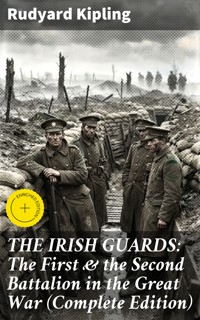
THE IRISH GUARDS: The First & the Second Battalion in the Great War (Complete Edition) E-Book
Rudyard Kipling
0,49 €
Mehr erfahren.
- Herausgeber: Booksell-Verlag
- Kategorie: Geisteswissenschaft
- Sprache: Englisch
In "The Irish Guards: The First & the Second Battalion in the Great War (Complete Edition)," Rudyard Kipling presents a poignant yet unvarnished chronicle of the valiant contributions and sacrifices made by the Irish Guards during World War I. Composed with a keen eye for detail and a lyrical prose style, Kipling interweaves personal narratives, historical context, and intense battle descriptions, crafting a comprehensive and deeply human portrayal of warfare. This edition serves not only as a tribute to the soldiers' courage but also as a reflection on the broader societal impacts of the war, encapsulating the heroism and tragedy that marked this tumultuous period in history. Rudyard Kipling, a renowned English author and poet, was deeply influenced by his own familial ties to the military and his complex relationship with colonialism. His son, John, served in the Irish Guards during the Great War, a tragedy that profoundly affected Kipling and fueled the emotional depth of this work. His experiences as a war correspondent and his literary ambitions converged to create a narrative that is both heartfelt and historically significant, reflecting his intricate understanding of the conflict and its participants. This comprehensive account of the Irish Guards is a must-read for both history enthusiasts and literary scholars alike. Kipling'Äôs ability to capture the essence of bravery under fire and the grim realities of war makes this book not only a critical historical document but also a moving tribute to those who served. Readers will find themselves immersed in the rich tapestry of military history, compelled by Kipling'Äôs evocative storytelling and profound insights. In this enriched edition, we have carefully created added value for your reading experience: - A succinct Introduction situates the work's timeless appeal and themes. - The Synopsis outlines the central plot, highlighting key developments without spoiling critical twists. - A detailed Historical Context immerses you in the era's events and influences that shaped the writing. - An Author Biography reveals milestones in the author's life, illuminating the personal insights behind the text. - A thorough Analysis dissects symbols, motifs, and character arcs to unearth underlying meanings. - Reflection questions prompt you to engage personally with the work's messages, connecting them to modern life. - Hand‐picked Memorable Quotes shine a spotlight on moments of literary brilliance. - Interactive footnotes clarify unusual references, historical allusions, and archaic phrases for an effortless, more informed read.
Das E-Book können Sie in Legimi-Apps oder einer beliebigen App lesen, die das folgende Format unterstützen:
Veröffentlichungsjahr: 2023
Ähnliche















THE IRISH GUARDS: The First & the Second Battalion in the Great War (Complete Edition)
Table of Contents
Introduction
In the mud and thunder of industrial war, identity becomes both shield and burden.
THE IRISH GUARDS: The First & the Second Battalion in the Great War (Complete Edition) endures because it joins the documentary impulse of military history to the shaping intelligence of a major literary artist, producing a record that reads with the gravity of lived experience. Its classic status rests not on invention but on attention: to the rhythm of operations, to the stamina of units under pressure, and to the way a regiment’s character is tested by loss, duty, and time. The result is a work that has long been valued by soldiers, historians, and readers of literature alike.
Rudyard Kipling, already renowned for his prose and for his interest in the lives and speech of servicemen, assembled this regimental history during and after the First World War, when the conflict’s scale demanded new forms of remembrance. The book focuses on the Irish Guards, tracing the wartime service of its First and Second Battalions. As a “complete edition,” it presents the history in a comprehensive form, offering readers a sustained view of how two battalions moved through the war’s shifting phases without reducing them to a single emblematic moment.
The central premise is straightforward and disciplined: to follow the battalions’ actions and circumstances across the Great War, and to preserve a coherent account of what they did and endured. Kipling’s method emphasizes the continuity of service—marches, billets, training, reliefs, advances, and withdrawals—so that the reader sees not only climactic encounters but the persistent work that makes armies function. Without depending on sensationalism, the narrative conveys the cumulative strain of modern campaigning and the demanding interplay between orders, terrain, weather, and chance.
Kipling’s literary impact is evident in the book’s ability to give organized facts a resonant human dimension while remaining anchored in the regiment’s record. He brings to military prose an ear for cadence and a habit of precise observation, qualities that lift the account beyond a mere catalogue. The book’s enduring themes—duty under extreme conditions, comradeship, discipline, and the cost of perseverance—are presented through the steady accumulation of detail, which allows meaning to arise from patterns rather than authorial insistence.
As a work of wartime remembrance, it also addresses how communities and institutions attempt to make sense of mass mobilization and mass casualty. A battalion is both a tactical entity and a social world: officers and men, routine and improvisation, tradition and adaptation. By following the Irish Guards across the war’s duration, the narrative shows how a unit’s identity is maintained even as its personnel change. The book becomes a study in continuity: the ways symbols, training, and shared practice hold amid disruption.
The classic character of the volume is reinforced by its position at the intersection of literature and archival record. Regimental histories can be indispensable but impersonal; memoirs can be vivid but partial. Kipling’s work aims for a different balance, seeking to preserve operational clarity while honoring the collective nature of the battalions’ experience. That balance has helped the book remain readable across generations, not only as reference but as narrative, because it respects the reader’s need for both orientation and emotional truth.
The Great War’s environment—trench systems, artillery dominance, and the grinding logistics of sustaining armies—forms the book’s backdrop, yet the emphasis stays on the battalions’ movement through that environment. Readers are introduced to the idea of war as a sequence of tasks and transitions, where bravery is frequently expressed in endurance and competence rather than spectacle. The narrative’s restraint makes its intensity more credible, allowing the harshness of the period to register without rhetorical excess.
Because Kipling was a writer with a lasting influence on English-language prose, his approach to military history has also been influential: it models how to treat soldiering as a subject worthy of serious stylistic care. Later writers who sought to combine close attention to institutions with narrative momentum found precedents in works like this, where the unit’s story is presented as a continuous argument about responsibility and cohesion. Its influence is less a matter of imitation than of permission—the permission to write history with literary seriousness.
At the same time, the book’s appeal does not depend on specialized knowledge. Kipling provides enough structure for the non-expert to follow the arc of service, while the density of recorded detail rewards readers who return to it for study. The Irish Guards emerge as a lens through which the wider war can be apprehended: not by abstract totals, but by the recurring demands placed on a particular formation. That focus keeps the narrative grounded and prevents it from drifting into generalities.
Reading the book now also highlights an enduring question: how should a society remember a war without simplifying it? Kipling’s emphasis on collective action resists the temptation to treat the conflict as a stage for solitary heroes alone. The battalions’ story, as presented here, underscores the interplay of planning and uncertainty, initiative and obedience, personal courage and institutional discipline. Such themes remain legible to modern readers precisely because they are not tied to a single episode but recur across the war’s long duration.
This edition’s continuing relevance lies in how it invites reflection on service, belonging, and the costs that accompany both. The work offers a way to think about national and regimental identity without turning it into mere celebration, because the narrative is shaped by the hard arithmetic of war’s demands. It also serves as a reminder that history is often preserved through patient compilation and careful language, and that such preservation can itself be an act of respect toward those who bore the burden of events they did not control yet were required to master.
Synopsis
Rudyard Kipling’s THE IRISH GUARDS: The First & the Second Battalion in the Great War (Complete Edition) is a documentary regimental history of two battalions of the Irish Guards during the First World War. Written in a formal, archival mode, it assembles a chronological account of service from mobilization onward, using the regiment as a lens on the British Army’s experience on the Western Front and beyond. The narrative is shaped less by a single argument than by the steady accumulation of operational detail, unit movements, and the changing character of modern war as encountered by this particular formation.
paragraphs
The book opens by situating the Irish Guards as an infantry regiment entering a conflict that quickly becomes industrial in scale. Kipling introduces the battalions’ early organization, their integration into larger formations, and the immediate pressures of deploying to active service. The early sections emphasize how routine soldiering is rapidly overtaken by the demands of expeditionary warfare, with attention to orders, marches, positions, and the administrative realities that determine what a battalion can attempt. The account establishes the regiment’s identity through methodical description rather than dramatic set pieces.
As the chronology advances into sustained combat, Kipling traces how the battalions adapt to trench warfare and the recurring cycle of holding the line, reliefs, and periods out of the front for refit and training. Operations are presented through the movement of companies and the tasks assigned to them, emphasizing coordination with neighboring units, artillery support, and the hazards of exposure, weather, and attrition. The narrative underscores the tension between carefully prepared plans and the uncertain, fragmented visibility of battlefield conditions, where small-unit initiative and endurance often decide immediate outcomes.
Kipling then follows the battalions through successive phases of campaigning in which large offensives and local actions alternate. He records how fighting methods evolve, with increased emphasis on fieldworks, wiring, patrols, and the management of casualties and reinforcements. The book’s regimental viewpoint highlights continuity amid turnover, as experienced soldiers are lost and new drafts arrive, altering unit cohesion and institutional memory. Without turning to personal memoir, the text nonetheless conveys the human cost through careful noting of losses, promotions, and the administrative traces of sacrifice.
A central strand is the emergence and service of the Second Battalion alongside the First, broadening the regiment’s role and increasing the complexity of its commitments. Kipling lays out how two battalions are employed within wider operational plans, sometimes facing different sectors, duties, or tempos of fighting. This expansion brings logistical and leadership challenges, including the need for trained officers and non-commissioned leaders, and the continual task of maintaining effectiveness amid heavy demands. The dual-battalion structure also allows the book to compare parallel experiences within a shared regimental culture.
As the war continues, Kipling’s emphasis on technique and procedure becomes a record of institutional learning. He describes evolving approaches to raids, attacks, defense in depth, and the integration of supporting arms as the army adjusts to battlefield realities. The narrative maintains a neutral tone while highlighting recurring points of friction: the unpredictability of enemy action, the limits of communication, and the strain on men required to execute orders under fire. The regiment’s story is thus also a study in how modern armies translate doctrine into action at the level of battalions and companies.
Interwoven with operations are the administrative and social dimensions of regimental life: the maintenance of rolls, honors and distinctions, the management of replacements, and the steady work of command. Kipling treats the regiment as a corporate body that must endure beyond any single action, and he demonstrates how identity is preserved through records, discipline, and shared traditions. The battalions’ service is presented as a continuous thread, with quieter intervals given meaning as preparation for renewed fighting. This approach keeps the focus on continuity rather than isolated heroics.
The later wartime sections reflect an environment of intensified pressure, in which the battalions confront changing tactical problems and fluctuating strategic circumstances. Kipling’s chronological method emphasizes sequences of movement, engagement, and reorganization, showing how operational demands shape the regiment’s capacity and morale. He records shifts in command and the accumulation of experience, while keeping personal narratives largely subordinate to the collective account. The story remains grounded in verifiable unit activity, reinforcing the sense that the battalions’ history is built from many discrete duties and actions rather than a single climactic episode in the telling.
Historical Context
Rudyard Kipling’s THE IRISH GUARDS: The First & the Second Battalion in the Great War is framed by the dominant institutions of early twentieth‑century Britain: the constitutional monarchy, Parliament, and an imperial state whose armed forces were professionalized and globally deployed. The narrative looks outward from London and the War Office to the Western Front, where British Expeditionary Force (BEF) operations became central after 1914. The Irish Guards, a regiment of the British Army, are presented within the culture of regimental identity, hierarchy, and duty that shaped how soldiers understood their place in the conflict and how the home front interpreted military sacrifice.
The regiment itself belonged to a late‑Victorian military settlement. The Irish Guards were created in 1900 by Queen Victoria in the context of the Second Boer War, alongside other “Guards” expansions intended to honor Irish service. This origin mattered during the First World War because the regiment carried both a specifically Irish label and an unmistakably British institutional form. Kipling’s book, organized as a regimental history of the 1st and 2nd Battalions, reflects the British Army’s reliance on tradition, ceremonial prestige, and the social authority of elite units to sustain morale and public legitimacy during prolonged industrial war.
Kipling’s own position shaped the book’s perspective. He was already famous for imperial verse and fiction when war began in 1914, and he became closely associated with wartime writing and commemoration. The death of his son John Kipling, who served with the Irish Guards and was killed in action during the Battle of Loos in late September 1915, bound the author personally to the regiment and to the grief of bereaved families. That fact gives the work an unmistakable commemorative purpose: it records actions, losses, and endurance in a form meant to be permanent, publicly legible, and respectful of the dead.
The Great War’s origins lay in European rivalries, alliance systems, and crises that culminated in the assassination of Archduke Franz Ferdinand in June 1914 and the subsequent escalation into general war. Britain entered in early August 1914 after Germany violated Belgian neutrality, a commitment linked to nineteenth‑century treaties and to Britain’s strategic interest in preventing hostile control of the Channel coast. Kipling’s regimental narrative echoes this context less through diplomacy than through the sudden conversion of peacetime military routines into urgent mobilization, where professional soldiers formed the nucleus of an army that had to expand rapidly to meet a continental struggle unprecedented in scale.
The BEF that went to France in 1914 was comparatively small, highly trained, and committed to supporting France and Belgium against German advances. Early operations—fighting withdrawals, rapid marches, and defensive actions—exposed British units to intense combat before the war settled into trench lines. The Irish Guards, like other infantry formations, were drawn into this transition from open movement to positional warfare. Kipling’s account reflects the Army’s effort to make sense of this change: battles are narrated as sequences of orders, terrain, and unit performance, showing how discipline and cohesion were expected to compensate for uncertainty and heavy casualties.
By late 1914 and 1915, the Western Front had become a vast system of trenches, wire, strongpoints, and artillery zones stretching from the North Sea to Switzerland. This landscape was shaped by the defensive advantage of modern firepower—machine guns, quick‑firing artillery, and massed rifles—combined with the difficulty of coordinating attacks across broken ground. The book’s emphasis on battalion actions necessarily turns on such realities: holding lines under shellfire, raiding, patrolling, and rotating between front and reserve positions. Its matter‑of‑fact attention to routine danger mirrors how industrialized stalemate became daily life for infantry.
The Irish Guards’ war also unfolded amid Britain’s military expansion. At the outset Britain relied on a professional force, but the scale of casualties and commitments required new armies and new methods. Voluntary enlistment surged in 1914–1915, and the state introduced conscription in 1916. These shifts altered the social composition of units and the relationship between the citizenry and the Army. Kipling’s regimental history, while focused on the Guards, sits inside this broader transformation: the army’s needs demanded both recruitment and the maintenance of elite standards, and a regimental narrative could affirm continuity even as the military system changed dramatically.
The book’s chronology passes through major set‑piece battles that defined British memory of the war. The Battle of Loos in 1915, where Kipling’s son died, was part of a wider Allied offensive effort and is remembered for heavy losses and the contentious use of gas by British forces. The Somme in 1916 became a symbol of attrition and mass sacrifice, with the first day alone producing enormous British casualties. Kipling’s approach, rooted in unit records and testimony, echoes how the Army and public sought meaning in costly operations by highlighting local acts of endurance, leadership, and tactical learning.
Technological and organizational change is an essential backdrop to the Irish Guards’ experience. Artillery dominated the battlefield, and the ability to concentrate, observe, and supply guns became decisive. Communications—field telephones, runners, signals, and increasingly sophisticated staff procedures—shaped whether infantry could receive support or adapt under fire. The introduction of tanks by Britain in 1916 did not remove trench warfare’s brutal logic but signaled experimentation with new means of breaking stalemate. Kipling’s battalion‑level focus reflects this environment: operational outcomes often depended on logistics, timing, and coordination beyond any single unit’s control.
The home front context mattered because the war was fought by mass societies. Britain mobilized its economy for munitions and transport, expanded state direction over labor and industry, and adapted civilian life to shortages and wartime priorities. Women entered many areas of war work in larger numbers, while state propaganda and voluntary organizations encouraged sacrifice and participation. Although Kipling’s narrative remains primarily military, it is implicitly addressed to a public living with casualty lists and rationing, seeking authoritative accounts that connected individual losses to a coherent national effort and that dignified the strain borne by families.
Ireland’s political situation is directly connected to any regiment bearing an Irish name in British service. Before 1914, Irish politics were dominated by debates over Home Rule, with strong nationalist and unionist mobilization and the creation of rival paramilitary formations. During the war, the Easter Rising in Dublin in April 1916 and its aftermath transformed political opinion and accelerated the crisis of British governance in Ireland. Kipling’s book, centered on Irish Guards battalions fighting for Britain, inevitably sits in tension with these developments, showing Irish‑identified soldiers within imperial institutions even as Irish self‑determination became more radicalized.
The later war years brought further turning points. In 1917, the Western Front saw costly offensives such as Third Ypres (Passchendaele) and the shock of upheavals elsewhere: Russia’s revolutions and eventual withdrawal from the war shifted the strategic balance. In 1918, Germany’s spring offensives threatened a breakthrough before Allied counteroffensives, supported by growing American participation, drove German forces back. A regimental history like Kipling’s reflects these phases through the immediate lens of battalions moving between sectors, absorbing replacements, and responding to changing tactical doctrines, while the wider strategic narrative remains a constant pressure behind local events.
The Irish Guards’ identity also intersected with British class structures and military culture. Guards regiments carried a distinctive prestige associated with ceremonial roles and with recruitment patterns that often differed from line regiments. At the same time, trench warfare imposed leveling pressures: the conditions, casualties, and demands of leadership tested all formations. Kipling’s attention to officers and other ranks, to discipline, and to battalion traditions echoes a broader wartime effort to reconcile old hierarchies with new realities. The text’s insistence on competence and steadiness functions as a defense of professional ethos under unprecedented strain.
Kipling’s method reflects the era’s documentary impulse. The First World War generated vast administrative records, after‑action reports, casualty returns, and diaries, and governments and regiments later used these sources to construct official and semi‑official histories. Kipling’s compilation draws on such materials and on accounts shaped by censorship and security concerns during the war. This context is important: contemporaries often lacked full information, and public narratives were influenced by the need to protect morale. The book therefore belongs to a genre that both preserves evidence and frames it, offering a disciplined, institutional memory rather than an unfiltered battlefield chronicle.
Culturally, the war transformed how Britain and the empire spoke about death, duty, and national purpose. Pre‑war confidence in progress and empire met the shock of mass bereavement, and commemoration became a central public practice after 1918, expressed in memorials, ceremonies, and literature. Kipling was involved in commemoration beyond this book, including work connected with war graves and remembrance, and his writing often sought to give formal language to private loss. THE IRISH GUARDS reflects this cultural need by treating individual lives within a collective narrative, insisting on record‑keeping as an ethical response to tragedy.
The end of the war did not resolve the political tensions implicit in the regiment’s Irish designation. The postwar period saw the Irish War of Independence (1919–1921) and the eventual partition of Ireland under the settlement that created the Irish Free State while Northern Ireland remained within the United Kingdom. For British readers, regimental histories published after the war existed alongside debates about empire, citizenship, and the meaning of loyalty. Kipling’s focus on wartime service offers a particular lens on identity—one that foregrounds battlefield comradeship and imperial duty—while historical events outside the trenches were redefining what “Irish” and “British” would mean politically.
Economically and socially, Britain emerged from the war with heavy debt, demographic loss, and a changed relationship between state and society. Expectations of reward for sacrifice fueled demands for veterans’ support, housing, and social reform, while labor unrest and political realignments marked the early 1920s. In that climate, regimental histories served as stabilizing narratives, preserving continuity and honor amid uncertainty. Kipling’s disciplined style and emphasis on collective performance echo an interwar desire to systematize memory: to fix a story of competence, courage, and endurance that could stand against disillusionment and fragmentation in public life.
Author Biography
Rudyard Kipling (1865–1936) was an English writer whose poetry, fiction, and journalism helped define late Victorian and early twentieth‑century popular literature. Closely associated with the British Empire in both subject and outlook, he wrote with a vivid command of dialect, rhythm, and narrative drive that reached readers across age groups. Kipling’s work ranged from short stories and novels to ballads and children’s tales, often combining adventure, moral instruction, and sharply observed settings. He became one of the most widely read English-language authors of his time and remains a consequential, debated figure for his artistry and politics.
Kipling was born in Bombay (now Mumbai) in British India and spent formative years moving between India and England, experiences that later shaped the settings and atmospheres of much of his writing. He was educated in England and later attended the United Services College, a school whose milieu informed his early interest in disciplined institutions and youth under pressure. Beginning as a working journalist in India, he learned tight, reportorial prose and an ear for spoken language, skills that carried into his fiction. His early literary influences included popular verse forms, the short-story tradition, and the practical demands of newspaper deadlines.
In the 1880s, Kipling built his reputation in India through short fiction and verse published in periodicals and quickly gathered into books. His early collections, including “Plain Tales from the Hills,” established him as a sharp chronicler of Anglo-Indian life, mixing irony with sympathy and a brisk pace suited to the short form. At roughly the same time he produced poems that showcased memorable refrains and dramatic monologues. By the end of the decade he had widened his audience beyond India, and his stories’ combination of technical polish and exotic immediacy helped propel him onto an international literary stage.
Kipling’s breakthrough in the 1890s brought major works across genres. “Barrack-Room Ballads” popularized a distinctive voice for common soldiers and contributed to his public image as a poet of imperial service. “The Jungle Book” and “The Second Jungle Book” blended fable, adventure, and moral reflection, while “Kim” offered a capacious novel of travel, espionage, and cultural encounter in the Indian subcontinent. He also wrote “The Man Who Would Be King,” a frequently anthologized tale that probes ambition and illusion. These works displayed his strengths in storytelling economy, scene-setting, and memorable character voices.
Kipling was also a prolific maker of short stories and poems that tested the boundaries between popular and literary writing. Collections such as “The Day’s Work” and “Just So Stories” showed his versatility, moving from adult realism and technical themes to stylized children’s narratives with playful language. “Captains Courageous” exemplified his interest in labor, apprenticeship, and moral formation through adventure. His fiction often foregrounded professional competence, loyalty, and the burdens of responsibility, rendered in a style that combined brisk narration with carefully tuned detail. Even when readers disagreed with his attitudes, critics frequently acknowledged his command of craft and narrative momentum.
His public reputation became closely tied to imperial politics and ideas of duty, authority, and hierarchy, which appear throughout his writing and public verse. Poems such as “If—” became widely quoted for their stoic counsel, while “The White Man’s Burden” has been repeatedly criticized for expressing and reinforcing colonial ideology. Kipling’s work has therefore been read both as an artistic achievement and as an emblem of the cultural assumptions of empire. Over time, scholarship and criticism have revisited him with greater attention to ambiguity, irony, and the tensions between admiration for skill and discomfort with the political implications of certain themes.
In later years Kipling continued to publish stories, poems, and essays, maintaining a public literary presence even as tastes and historical circumstances shifted. He lived through major international upheavals that influenced the tone of his later writing, which could be elegiac and reflective as well as admonitory. Kipling received the Nobel Prize in Literature in 1907, an acknowledgment of his global readership and the force of his imagination in both prose and verse. After his death in 1936, his work remained widely read, adapted, and taught, admired for its language and narrative power while continually reassessed for its entanglement with empire and its enduring cultural influence.
THE IRISH GUARDS: The First & the Second Battalion in the Great War (Complete Edition)
The Irish Guards in the Great War – I
Introduction
These volumes try to give soberly and with what truth is possible, the experiences of both battalions of the Irish Guards from 1914 to 1918. The point of view is the battalions’, and the facts mainly follow the Regimental Diaries, supplemented by the few private letters and documents which such a war made possible, and by some tales that have gathered round men and their actions.
As evidence is released, historians may be able to reconstruct what happened in or behind the battle-line; what motives and necessities swayed the actors; and who stood up or failed under his burden. But a battalion’s field is bounded by its own vision. Even within these limits, there is large room for error. Witnesses to phases of fights die and are dispersed; the ground over which they fought is battered out of recognition in a few hours; survivors confuse dates, places, and personalities, and in the trenches, the monotony of the waiting days and the repetition-work of repairs breed mistakes and false judgments. Men grow doubtful or oversure, and, in all good faith, give directly opposed versions. The clear sight of a comrade so mangled that he seems to have been long dead is burnt in on one brain to the exclusion of all else that happened that day. The shock of an exploded dump, shaking down a firmament upon the landscape, dislocates memory throughout half a battalion; and so on in all matters, till the end of laborious enquiry is too often the opening of fresh confusion. When to this are added the personal prejudices and misunderstandings of men under heavy strain, carrying clouded memories of orders half given or half heard, amid scenes that pass like nightmares, the only wonder to the compiler of these records has been that any sure fact whatever should be retrieved out of the whirlpool of war.
It seemed to him best, then, to abandon all idea of such broad and balanced narratives as will be put forward by experts, and to limit himself to matters which directly touched the men’s lives and fortunes. Nor has he been too careful to correct the inferences of the time by the knowledge of later events. From first to last, the Irish Guards, like the rest of our armies, knew little of what was going on round them. Probably they knew less at the close of the war than at the beginning when our forces were so small that each man felt himself somebody indeed, and so stood to be hunted through the heat from Mons to Meaux, turned again to suffer beneath the Soupir ridges, and endured the first hideous winter of the Salient where, wet, almost weaponless, but unbroken, he helped in the long miracle of holding the line.
But the men of ’14 and ’15, and what meagre records of their day were safe to keep, have long been lost; while the crowded years between remove their battles across dead Belgian towns and villages as far from us as the fights in Homer.
Doubtless, all will be reconstructed to the satisfaction of future years when, if there be memory beyond the grave, the ghosts may laugh at the neatly groomed histories. Meantime, we can take it for granted that the old Regular Army of England passed away in the mud of Flanders in less than a year. In training, morale, endurance, courage, and devotion the earth did not hold its like, but it possessed neither the numbers, guns, nor equipment necessary for the type of war that overtook it. The fact of its unpreparedness has been extolled as proof of the purity of its country’s ideals, which must be great consolation to all concerned. But, how slowly that equipment was furnished, how inadequate were our first attempts at bombs, trench-mortars, duck-boards, wiring, and the rest, may be divined through the loyal and guarded allusions in the Diaries. Nor do private communications give much hint of it, for one of the marvels of that marvellous time was the silence of those concerned on everything that might too much distress their friends at home. The censorship had imposed this as a matter of precaution, but only the spirit of the officers could have backed the law so completely; and, as better days came, their early makeshifts and contrivances passed out of remembrance with their early dead. But the sufferings of our Armies were constant. They included wet and cold in due season, dirt always, occasional vermin, exposure, extreme fatigue, and the hourly incidence of death in every shape along the front line and, later in the furthest back-areas where the enemy aeroplanes harried their camps. And when our Regular troops had been expended, these experiences were imposed upon officers and men compelled to cover, within a few months, the long years of training that should go to the making of a soldier—men unbroken even to the disturbing impact of crowds and like experiences, which the conscript accepts from his youth. Their short home-leaves gave them sudden changes to the tense home atmosphere where, under cover of a whirl of “entertainment” they and their kin wearied themselves to forget and escape a little from that life, on the brink of the next world, whose guns they could hear summoning in the silences between their talk. Yet, some were glad to return—else why should youngsters of three years’ experience have found themselves upon a frosty night, on an ironbound French road, shouting aloud for joy as they heard the stammer of a machine-gun over the rise, and turned up the well-known trench that led to their own dug-out and their brethren from whom they had been separated by the vast interval of ninety-six hours? Many have confessed to the same delight in their work, as there were others to whom almost every hour was frankly detestable except for the companionship that revealed them one to another till the chances of war separated the companions. And there were, too, many, almost children, of whom no record remains. They came out from Warley[1] with the constantly renewed drafts, lived the span of a Second Lieutenant’s life and were spent. Their intimates might preserve, perhaps, memories of a promise cut short, recollections of a phrase that stuck, a chance-seen act of bravery or of kindness. The Diaries give their names and fates with the conventional expressions of regret. In most instances, the compiler has let the mere fact suffice; since, to his mind, it did not seem fit to heap words on the doom.
For the same reason, he has not dealt with each instance of valour, leaving it to stand in the official language in which it was acknowledged. The rewards represent but a very small proportion of the skill, daring, and heroism actually noted; for no volume could hold the full tale of all that was done, either in the way of duty, under constraint of necessity and desire to keep alive, or through joy and pleasure in achieving great deeds.
Here the Irish rank and file by temperament excelled. They had all their race’s delight in the drama of things; and, whatever the pinch-whether ambushed warfare or hand-to-hand shock, or an insolently perfect parade after long divorce from the decencies—could be depended upon to advance the regimental honour. Their discipline, of course, was that of the Guards, which, based upon tradition, proven experience, and knowledge of the human heart, adjusts itself to the spirit of each of its battalions. Though the material of that body might be expended twice in a twelvemonth, the leaven that remained worked on the new supplies at once and from the first. In the dingy out-of-date barracks at Warley the Regimental Reserves gathered and grew into a full-fledged Second Battalion with reserves of its own, and to these the wounded officers and men sent home to be repatched, explained the arts and needs of a war which, apparently always at a stand, changed character every month. After the utter inadequacy of its opening there was a period of handmade bombs and of loaded sticks for close work; of nippers for the abundant wire left uncut by our few guns; of remedies for trench-feet; or medicaments against lockjaw from the grossly manured Belgian dirt, and of fancy timberings to hold up sliding trenches. In due course, when a few set battles, which sometimes gained several hundred yards, had wasted their many thousand lives, infallible forms of attack and defence developed themselves, were tried and generally found wanting, while scientific raids, the evolution of specialists, and the mass of regulated detail that more and more surrounded the life of the trenches, occupied their leisure between actions. Our battalions played themselves into the game at the awful price that must be paid for improvisation, however cheery; enduring with a philosophy that may have saved the war, the deviations and delays made necessary by the demands of the various political and other organisations at home.
In the same spirit they accepted the inevitable breakdowns in the business of war-by-experiment; for it is safe to say that there was hardly an operation in which platoons, companies, regiments, brigades, or divisions were not left with one or both flanks in the air. Among themselves, officers and men discussing such matters make it quite clear how and why such and such units broke, were misled, or delayed on their way into the line. But when a civilian presumes to assist, all ranks unite against his uninformed criticisms. He is warned that, once over the top, no plans hold, for the machine-gun and the lie of the ground dictate the situation to the platoon-commander on whom all things depend and who sees, perhaps, fifty yards about him. There are limits, too, of shock and exhaustion beyond which humanity cannot be pressed without paying toll later. For which cause it may happen that a Division that has borne long agony unflinching, and sincerely believes itself capable of yet more, will, for no reason then apparent (at almost the mere rumour of noises in the night) collapse ignominiously on the same ground where, a month later, with two thirds of its strength casualties, it cuts coolly and cleanly to its goal. And its fellows, who have borne the same yoke, allow for this.
The compiler of these records, therefore, has made little attempt to put forward any theory of what might or should have happened if things had gone according to plan; and has been scrupulous to avoid debatable issues of bad staff-work or faulty generalship. They were not lacking in the war, but the broad sense of justice in all who suffered from them, recognising that all were equally amateurs, saved the depression of repeated failures from turning into demoralisation.
Here, again, the Irish were reported by those who knew them best, to have been lenient in their judgments, though their private speech was as unrestrained as that of any other body of bewildered and overmastered men. “Wearing down” the enemy through a period of four years and three months, during most of which time that enemy dealt losses at least equal to those he received, tested human virtue upon a scale that the world had never dreamed of. The Irish Guards stood to the test without flaw.
They were in no sense any man’s command. They needed minute comprehension, quick sympathy, and inflexible justice, which they repaid by individual devotion and a collective good-will that showed best when things were at their utter worst. Their moods naturally varied with the weather and the burden of fatigues (actions merely kill, while fatigue breaks men’s hearts), but their morale was constant because their unofficial life, on which morale hinges, made for contentment. The discipline of the Guards, demanding the utmost that can be exacted of the man, requires of the officer unresting care of his men under all conditions. This care can be a source of sorrow and friction in rigid or over-conscientious hands, till, with the best will in the world, a battalion may be reduced to the mental state of nurse-harried children. Or, conversely, an adored company commander, bold as a lion, may, for lack of it, turn his puzzled company into a bear-garden. But there is an elasticity in Celtic psychology that does not often let things reach breaking-point either way; and their sense of humour and social duty—it is a race more careful to regard each other’s feelings than each other’s lives—held them as easily as they were strictly associated. A jest; the grave hearing out of absurd complaints that might turn to tragedy were the hearing not accorded; a prompt soothing down of gloomy, inured pride; apiece of flagrant buffoonery sanctioned, even shared, but never taken advantage of, went far in dark days to build up that understanding and understood inner life of the two battalions to which, now, men look back lovingly across their civilian years. It called for a devotion from all, little this side of idolatry; and was shown equally by officers, N.C.O.’s, and men, stretcher-bearers, cooks, orderlies, and not least by the hard-bit, fantastic old soldiers, used for odd duties, who faithfully hobbled about France alongside the rush of wonderful young blood.
Were instances given, the impression might be false, for the tone and temper of the time that set the pace has gone over. But while it lasted, the men made their officers and the officers their men by methods as old as war itself; and their Roman Catholic priests, fearless even in a community none too regardful of Nature’s first law, formed a subtle and supple link between both. That the priest, ever in waiting upon Death or pain, should learn to magnify his office was as natural as that doctors and front-line commanders should find him somewhat under their feet when occasion called for the secular, not the spiritual, arm. That Commanding Officers, to keep peace and save important pillars of their little society, should first advise and finally order the padre not to expose himself wantonly in forward posts or attacks, was equally of a piece with human nature; and that the priests, to the huge content of the men, should disregard the order (“What’s a casualty compared to a soul?”) was most natural of all. Then the question would come up for discussion in the trenches and dug-outs, where everything that any one had on his mind was thrashed out through the long, quiet hours, or dropped and picked up again with the rise and fall of shell-fire. They speculated on all things in Heaven and earth as they worked in piled filth among the carcases of their fellows, lay out under the stars on the eves of open battle, or vegetated through a month’s feeding and idleness between one sacrifice and the next.
But none have kept minutes of those incredible symposia that made for them a life apart from the mad world which was their portion; nor can any pen recreate that world’s brilliance, squalor, unreason, and heaped boredom. Recollection fades from men’s minds as common life closes over them, till even now they wonder what part they can ever have had in the shrewd, man-hunting savages who answered to their names so few years ago.
It is for the sake of these initiated that the compiler has loaded his records with detail and seeming triviality, since in a life where Death ruled every hour, nothing was trivial, and bald references to villages, billets, camps, fatigues, and sports, as well as hints of tales that can never now fully be told, carry each their separate significance to each survivor, intimate and incommunicable as family jests.
As regards other readers, the compiler dares no more than hope that some of those who have no care for old history, or that larger number who at present are putting away from themselves odious memories, may find a little to interest, or even comfort, in these very details and flatnesses that make up the unlovely, yet superb, life endured for their sakes.
Mons To La Bassée
At 5 P.M. on Tuesday, August 4, 1914, the 1st Battalion of the Irish Guards received orders to mobilize for war against Germany. They were then quartered at Wellington Barracks and, under the mobilization scheme, formed part of the 4th (Guards) Brigade, Second Division, First Army Corps. The Brigade consisted of:
The 2nd Battalion Grenadier Guards. The 2nd Battalion Coldstream Guards. The 3rd Battalion Coldstream Guards. The 1st Battalion Irish Guards.
Mobilization was completed on August 8. Next day, being Sunday, the Roman Catholics of the Battalion paraded under the Commanding Officer, Lieut.Colonel the Hon. G. H. Morris, and went to Westminster Cathedral where Cardinal Bourne preached; and on the morning of the 11th August Field-Marshal Lord Roberts and Lady Aileen Roberts made a farewell speech to them in Wellington Barracks. This was the last time that Lord Roberts saw the Battalion of which he was the first Commander-in-Chief.
On the 12th August the Battalion entrained for Southampton in two trains at Nine Elms Station, each detachment being played out of barracks to the station by the band. They were short one officer, as 2nd Lieutenant St. J. R. Pigott had fallen ill, and an officer just gazetted—2nd Lieutenant Sir Gerald Burke, Bart.—could not accompany them as he had not yet got his uniform. They embarked at Southampton on a hot still day in the P.&0. S.S. Novara[5]. This was a long and tiring operation, since every one was new to embarkation-duty, and, owing to the tide, the ship’s bulwarks stood twenty-five feet above the quay. The work was not finished till 4 P.M. when most of the men had been under arms for twelve hours. Just before leaving, Captain Sir Delves Broughton, Bart., was taken ill and had to be left behind. A telegram was sent to Headquarters, asking for Captain H. Hamilton Berners to take his place, and the Novara cleared at 7 P.M. As dusk fell, she passed H.M.S. Formidable[6] off Ryde and exchanged signals with her. The battle ship’s last message to the Battalion was to hope that they would get “plenty of fighting.” Many of the officers at that moment were sincerely afraid that they might be late for the war!
The following is the list of officers who went out with the Battalion that night:
Lieut.-Col. Hon. G. H. Morris
Commanding Officer.
Major H. F. Crichton
Senior Major.
Captain Lord Desmond FitzGerald
Adjutant.
Lieut. E. J. F. Gough
Transport Officer.
Lieut. E. B. Greer
M. Gun Officer.
Hon. Lieut. H. Hickie
Quartermaster.
Lieut. H. J. S. Shields (R.A.M.C.)
Medical. Officer.
Lieut. Hon. Aubrey Herbert, M.P.
Interpreter.
No. 1 Company.
Capt. Hon. A. E. Mulholland.
Lieut. C. A. S. Walker.
Capt. Lord John Hamilton.
2nd Lieut. N. L. Woodroffe.
Lieut. Hon. H. R. Alexander.
2nd Lieut. J. Livingstone-Learmonth.
No. 2 Company.
Major H. A. Herbert Stepney.
Lieut. J. S. N. FitzGerald.
Lieut. W. E. Hope.
Capt. J. N. Guthrie.
2nd Lieut. O. Hughes-Onslow.
Lieut. E. J. F. Gough.
No. 3 Company.
Capt. Sir Delves Broughton, Bart. (replaced by Capt. H. Hamilton Berners).
Lieut. Hon. Hugh Gough.
Lieut. Lord Guernsey.
2nd Lieut. Viscount Castlerosse.
Capt. Hon. T. E. Vesey.
No. 4 Company.
Capt. C. A. Tisdall.
Lieut. Lord Robert Innes-Ker.
Capt. A. A. Perceval.
Lieut. W. C. N. Reynolds.
2nd Lieut. J. T. P. Roberts.
Lieut. R. Blacker-Douglass.
Details at the Base.
Capt. Lord Arthur Hay.
2nd Lieut. Sir Gerald Burke, Bart.
They reached Havre at 6 A.M. on August 13, a fiercely hot day, and, tired after a sleepless night aboard ship, and a long wait, in a hot, tin-roofed shed, for some missing men, marched three miles out of the town to Rest Camp No. 2 “in a large field at Sanvic, a suburb of Havre at the top of the hill.” Later, the city herself became almost a suburb to the vast rest-camps round it. Here they received an enthusiastic welcome from the French, and were first largely introduced to the wines of the country, for many maidens lined the steep road and offered bowls of drinks to the wearied.
Next day (August 14) men rested a little, looking at this strange, bright France with strange eyes, and bathed in the sea; and Captain H. Berners, replacing Sir Delves Broughton, joined. At eleven o’clock they entrained at Havre Station under secret orders for the Front. The heat broke in a terrible thunderstorm that soaked the new uniforms. The crowded train travelled north all day, receiving great welcomes everywhere, but no one knowing what its destination might be. After more than seventeen hours’ slow progress by roads that were not revealed then or later, they halted at Wassigny, at a quarter to eleven on the night of August 15, and, unloading in hot darkness, bivouacked at a farm near the station.
On the morning of August 16 they marched to Vadencourt, where, for the first time, they went into billets. The village, a collection of typical white-washed tiled houses with a lovely old church in the centre, lay out pleasantly by the side of a poplar-planted stream. The 2nd Coldstream Guards were also billeted here; the Headquarters of the 4th Guards Brigade, the 2nd Grenadier Guards, and 3rd Coldstream being at Grougis. All supplies, be it noted, came from a village of the ominous name of Boue, which—as they were to learn through the four winters to follow—means “mud.”
At Vadencourt they lay three days while the men were being inoculated against enteric[4]. A few had been so treated before leaving Wellington Barracks, but, in view of the hurried departure, 90 per cent. remained to be dealt with. The Diary remarks that for two days “the Battalion was not up to much.” Major H. Crichton fell sick here.
On the 20th August the march towards Belgium of the Brigade began, via Etreux and Fesmy (where Lieutenant and Quartermaster Hickie went sick and had to be sent back to railhead) to Maroilles, where the Battalion billeted, August 21, and thence, via Pont sur Sambre and Hargnies, to La Longueville, August 22. Here, being then five miles east of Malplaquet, the Battalion heard the first sound of the guns of the war, far off; not knowing that, at the end of all, they would hear them cease almost on that very spot.
At three o’clock in the morning of August 23 the Brigade marched via Riez de l’Erelle into Belgian territory and through Blaregnies towards Mons[2] where it was dimly understood that some sort of battle was in the making. But it was not understood that eighty thousand British troops with three hundred guns disposed between Condé, through Mons towards Binche, were meeting twice that number of Germans on their front, plus sixty thousand Germans with two hundred and thirty guns trying to turn their left flank, while a quarter of a million Germans, with close on a thousand guns, were driving in the French armies on the British right from Charleroi to Namur, across the Meuse and the Sambre. This, in substance, was the situation at Mons. It supplied a sufficient answer to the immortal question, put by one of the pillars of the Battalion, a drill sergeant, who happened to arrive from home just as that situation had explained itself, and found his battalion steadily marching south. “Fwhat’s all this talk about a retreat[1q]?” said he, and strictly rebuked the shouts of laughter that followed.1
The Brigade was first ordered to take up a position at Bois Lahant, close to the dirtier suburbs of Mons which is a fair city on a hill, but the order was cancelled when it was discovered that the Fifth Division was already there. Eventually, the Irish Guards were told to move from the village of Quevy le Petit, where they had expected to go into billets, to Harveng. Here they were ordered, with the 2nd Grenadier Guards, to support the Fifth Division on a chalk ridge from Harmignies to the Mons road, while the other two battalions of the Brigade (the 2nd and 3rd Coldstream Guards) took up position north-east of Harveng. Their knowledge of what might be in front of them or who was in support was, naturally, small. It was a hot, still evening, no Germans were visible, but shrapnel fell ahead of the Battalion as it moved in artillery formation across the rolling, cropped lands. One single far-ranging rifle-bullet landed with a phtt in the chalk between two officers, one of whom turning to the other laughed and said, “Ah! Now we can say we have been under fire.” A few more shells arrived as the advance to the ridge went forward, and the Brigade reached the seventh kilometre-stone on the Harmignies–Mons road, below the ridge, about 6 P.M. on the 23rd August. The Irish Rifles, commanded by Colonel Bird, D.S.O., were fighting here, and Nos. 1 and 2 Companies of the Irish Guards went up to reinforce it. This was the first time that the Battalion had been personally shelled and five men were wounded. The guns ceased about dusk, and there was very little fire from the German trenches, which were rather in the nature of scratch-holes, ahead of them. That night, too, was the first on which the troops saw a searchlight[7] used. They enjoyed also their first experience of digging themselves in, the which they did so casually that veterans of after years would hold up that “trench” as a sample of “the valour of ignorance.” At midnight, the Irish Rifles were ordered to retire while the Irish Guards covered their retirement; but so far they had been in direct contact with nothing.
The Battalion heard confusedly of the fall of Namur and, it may be presumed, of the retirement of the French armies on the right of the British. There was little other news of any sort, and what there was, not cheering. On front and flank of the British armies the enemy stood in more than overwhelming strength, and it came to a question of retiring, as speedily as might be, before the flood swallowed what remained. So the long retreat of our little army began.
The large outlines of it are as follows: The entire British Force, First and Second Army Corps, fell back to Bavai—the First without serious difficulty, the Second fighting rear-guard actions through the day. At Brava the two Corps diverged, not to unite again till they should reach Betz on the 1st September. The Second Army Corps, reinforced by the Fourth Division, took the roads through Le Quesnoy, Solesme, Le Cateau, St. Quentin, Ham, Nesle, Noyon, and Crépy-en-Valois; the First paralleling them, roughly, through Landrecies, Vadencourt, La Fère, Pasly by Soissons, and Villers-Cotterêts.
At 2 o’clock in the morning of August 24 the Battalion, “having covered the retirement of all the other troops,” retired through the position which the 2nd and 3rd Coldstream Guards had taken up, to Quevy le Petit, where it was ordered, with the 2nd Grenadiers, to entrench another position north of Quevy le Petit (from the third kilometre-stone on the Genly–Quevy le Petit road to the tenth kilometre-stone on the Mons–Bettignies road). This it did while the whole of the Second Division retired through the position at 4 P.M., the Battalion acting as rear-guard. Their notion of “digging-in” was to cut fire-steps in the side of the handy bank of any road. At nine o’clock that night the Battalion “came out of Belgium by the same road that it had marched into Belgium” through Blaregnies, past Bavai where the First and Second Army Corps diverged, and through La Longueville to Malgarni, where they bivouacked in an orchard “having been forty-four hours under arms.” Here the first mail from England arrived, and was distributed by torchlight under the apple-trees in the warm night.
On the afternoon of August 25 the Battalion reached Landrecies, an unlovely, long-streeted town in closely cultivated country. The German pressure was heavy behind them, and that evening the 3rd Coldstream Guards on outpost duty to the north-west of Landrecies, on the Mormal road, were attacked, and, as history shows, beat off that attack in a night-fight of some splendour. The Battalion turned out and blocked the pavé entrance to the town with improvised barricades, which they lined, of stones, tables, chairs, carts, and pianos; relieved the Coldstream at 1.30 A.M., August 26; and once again covered the retirement of the Brigade out of the town towards Etreux. The men were very tired, so weary indeed that many of them slept by the roadside while waiting to relieve the Coldstreams at Landrecies fight. That night was the first they heard wounded men scream. A couple of Irish Guards officers, sleeping so deeply that only the demolition by shell-fire of the house next door waked them, were left behind here, but after twenty-four hours of fantastic and, at that time, almost incredible adventures, rejoined safely next day. It was recorded also that one of the regimental drums was seen and heard going down Landrecies main street in the darkness, strung on the fore-leg of a gun-horse who had stepped into it as a battery went south. A battalion cooker, the sparks flying from it, passed like a fire-engine hastening to a fire, and men found time to laugh and point at the strange thing.
At Etreux, where with the rest of the Brigade the Battalion entrenched itself after the shallow pattern of the time, it had its first sight of a German aeroplane which flew over its trenches and dropped a bomb that “missed a trench by twenty yards.” The Battalion fired at it, and it “flew away like a wounded bird and eventually came down and was captured by another division.” Both sides were equally inexperienced in those days in the details of air war. All that day they heard the sound of what they judged was “a battle in the direction of Le Cateau.” This was the Second Army Corps and a single Division of the Third Corps under Smith-Dorrien interrupting our retirement to make a stand against four or more German Army Corps and six hundred guns. The result of that action caused the discerning General von Kluck to telegraph that he held the Expeditionary Force “surrounded by a ring of steel,” and Berlin behung itself with flags. This also the Battalion did not know. They were more interested in the fact that they had lost touch with the Second Division; and that their Commanding Officer had told the officers that, so far as he could make out, they were surrounded and had better dig in deeper and wait on. As no one knew particularly where they might be in all France, and as the night of the 26th was very wet, the tired men slept undisturbedly over the proposition, to resume their retreat next day (August 27) down the valley of the Sambre, through Vénérolles, Tupigny, Vadencourt, Noyales, to the open glaring country round Mont d’Origny where the broad road to St. Quentin crosses the river. It was in reserve that day, and the next (August 28) was advance-guard to the Brigade as the retirement continued through Châtillon, Berthenicourt, and Moy to Vendeuil and the cross-roads west of the Vendeuil–La Fère road while the Brigade marched on to Bertaucourt. After the Brigade had passed, the Battalion acted as rear-guard into Bertaucourt. Here No. 2 Company, under Major Stepney, was sent to Beautor to assist a section of the Royal Engineers in demolishing a bridge across the river there—an operation performed without incident—and in due course joined up with the Battalion again. By this time, the retreat, as one who took part in it says, had become “curiously normal”—the effect, doubtless, of that continued over-exertion which reduces men to the state of sleep-walkers. There was a ten minutes’ halt every hour, on which the whole Battalion dropped where it stood and slept. At night, some of them began to see lights, like those of comfortable billets by the roadside which, for some curious reason or other, could never be reached. Others found themselves asleep, on their feet, and even when they lay down to snatch sleep, the march moved on, and wearied them in their dreams. Owing to the heat and the dust, many suffered from sore feet and exhaustion, and, since ambulance accommodation was limited, they had to be left behind to follow on if, and as best, they could. But those who fell out were few, and the Diary remarks approvingly that “on the whole the Battalion marched very well and march-discipline was good.” Neither brigade nor battalion commanders knew anything of what was ahead or behind, but it seemed that, since they could not get into Paris before the Germans and take first-class tickets to London, they would all be cut off and destroyed; which did not depress them unduly. At all events, the Battalion one evening forgot its weariness long enough to take part in the chase and capture of a stray horse of Belgian extraction, which, after its ample lack of manners and mouth had been proved, they turned over for instruction and reformation to the Transport.
From Bertaucourt, then, where the Battalion spent another night in an orchard, it marched very early on the 30th August to Terny via Deuillet, Servais, Basse Forêt de Coucy, Folembray, Coucy-le-Château, then magnificent and untouched—all closer modelled country and, if possible, hotter than the bare lands they had left. Thence from Terny to Pasly, N.W. of Soissons. Here they lay down by moonlight in a field, and here an officer dreamed that the alarm had been given and that they must move on. In this nightmare he rose and woke up all platoon-officers and the C.O.; next, laboriously and methodically, his own company, and last of all himself, whom he found shaking and swearing at a man equally drunk with fatigue.
On the 31st August the Battalion took position as right flank-guard from 9 A.M. to 3 P.M. on the high ground near Le Murger Farm and bivouacked at Soucy: So far, there had been little fighting for them since Landrecies, though they moved with the comforting knowledge that an unknown number of the enemy, thoroughly provided with means of transportation, were in fixed pursuit, just on the edge of a sky-line full of unseen guns urging the British always to move back.