Erhalten Sie Zugang zu diesem und mehr als 300000 Büchern ab EUR 5,99 monatlich.
- Herausgeber: Musaicum Books
- Kategorie: Für Kinder und Jugendliche
- Sprache: Englisch
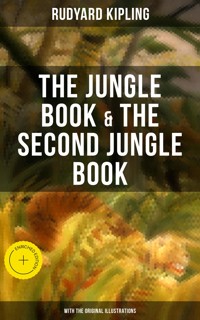
Rudyard Kipling's 'The Jungle Book & The Second Jungle Book (With the Original Illustrations)' transports the reader to the enchanting world of the jungle, where animals speak and human values are intricately woven into each tale. Written in a delightful and engaging narrative style, Kipling's storytelling prowess shines through as he explores themes of nature, friendship, and the essence of being through the adventures of Mowgli and other jungle creatures. The vivid illustrations accompanying the text enhance the reading experience, bringing the exotic setting to life in the reader's imagination. Kipling's rich prose and detailed descriptions evoke a sense of wonder and nostalgia, making this classic collection a timeless treasure in the literary world. Rudyard Kipling's deep connection to India, where he spent his formative years, lends authenticity and depth to the jungle setting in his works. His observations of Indian wildlife and culture inspired the vivid characters and landscapes in 'The Jungle Book' and 'The Second Jungle Book', creating a captivating fusion of folklore and storytelling. I highly recommend this collection to readers of all ages who seek adventure, wisdom, and the magic of storytelling in the timeless tales of the jungle. In this enriched edition, we have carefully created added value for your reading experience: - A comprehensive Introduction outlines these selected works' unifying features, themes, or stylistic evolutions. - The Author Biography highlights personal milestones and literary influences that shape the entire body of writing. - A Historical Context section situates the works in their broader era—social currents, cultural trends, and key events that underpin their creation. - A concise Synopsis (Selection) offers an accessible overview of the included texts, helping readers navigate plotlines and main ideas without revealing critical twists. - A unified Analysis examines recurring motifs and stylistic hallmarks across the collection, tying the stories together while spotlighting the different work's strengths. - Reflection questions inspire deeper contemplation of the author's overarching message, inviting readers to draw connections among different texts and relate them to modern contexts. - Lastly, our hand‐picked Memorable Quotes distill pivotal lines and turning points, serving as touchstones for the collection's central themes.
Sie lesen das E-Book in den Legimi-Apps auf:
Seitenzahl: 614
Veröffentlichungsjahr: 2017
Das E-Book (TTS) können Sie hören im Abo „Legimi Premium” in Legimi-Apps auf:
Ähnliche



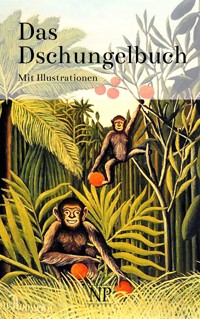

The Jungle Book & The Second Jungle Book (With the Original Illustrations)
Published by
Books
Table of Contents
Introduction
This collection unites Rudyard Kipling’s The Jungle Book (1894) and The Second Jungle Book (1895) with the original illustrations, presenting together the complete pair of volumes that established his most enduring imaginative world. Rather than a single novel, these books comprise interlinked tales and accompanying songs that together form a coherent cycle. Read in sequence, they trace the breadth of Kipling’s animal fables and the full span of the Mowgli narratives as they first appeared in book form. Restoring the contemporary artwork alongside the text helps recover the visual language that early readers knew, and it situates the stories in their first published context.
The scope of this edition is deliberately comprehensive for the Jungle Books: all stories and the interleaved verses from both volumes are provided, allowing the reader to follow recurring characters and motifs without interruption. Several of these tales first appeared individually in periodicals before being gathered and arranged by Kipling for book publication. As literature, they belong primarily to short fiction, with lyric and ballad-like poems framing or echoing each prose narrative. That dual form—story and song—signals the books’ hybrid identity as adventure, fable, and folk-inflected art, crafted for the page yet resonant with an oral storytelling cadence.
Within these covers the reader meets a wide range of beings and places. The best known thread follows Mowgli, a human child who lives among the wolves of an Indian jungle and learns the customs that govern the lives of animals and people. Other tales stand alone while enlarging the same imaginative territory: a mongoose guards a household, an elephant boy witnesses the rituals of the great herd, and a seal seeks a safe rookery far from hunters. The result is a mosaic of forests, villages, camps, and coasts that together define the reach of Kipling’s mythic geography.
Though varied in setting and cast, the stories share unifying themes. Chief among them is the idea of law: the explicit and implicit codes by which communities endure. Belonging and estrangement recur, as characters test the limits of their identities, learn the duties of kinship, and discover the costs of freedom. Courage, cunning, memory, and speech are treated as tools for survival as well as markers of character. The tales invite reflection on how knowledge is acquired—through instruction, initiation, and experience—and on the tension between instinct and discipline that shapes both animal and human societies.
Kipling’s style, compact and musical, underwrites these concerns. He favors vivid naming, ceremonial phrases, and recurring refrains that give the narratives a ritual pulse. The prose moves with the clarity of fable yet attends to concrete detail—sounds in the brush, tracks in dust, the shift of light at dusk. Dialogue is brisk, the narrative voice assured, and the embedded songs supply commentary, irony, or lament. This interplay of lyric and tale yields a storytelling grammar in which action carries meaning, and meaning returns as chant or proverb-like assertion, without pausing the momentum of adventure.
Another signature is the interplay of perspective. Kipling often writes from the vantage of animals, allowing their imagined speech to articulate a moral order that is distinct from, yet intelligible to, the human reader. He couples this with a child’s-eye point of view in the Mowgli cycle, balancing wonder with instruction. The created world feels continuous because its terms—names, customs, hierarchies—are consistently applied. Anthropomorphism is used not to tame nature but to propose a parallel civility, one that illuminates human conduct by analogy rather than by simple allegory.
The books are anchored in and around the landscapes of British-ruled India and adjacent seas during the late nineteenth century. They deploy words, place-names, and practices drawn from that milieu, and they inevitably bear the marks of their time. Readers and scholars have long discussed the works’ attitudes toward power, hierarchy, and empire. Engaging the Jungle Books today benefits from historical awareness: the stories’ vitality and craft coexist with perspectives shaped by their context. Recognizing that complexity enables a richer reading—one that appreciates the artistry while considering the implications of the world it imagines.
Although composed for a wide audience, the Jungle Books have proven especially resonant for young readers, without surrendering depth for adults. The narratives offer the excitement of pursuit, discovery, and cunningly resolved danger, yet they also stage questions about authority, loyalty, and the making of a self within competing communities. Education here is not merely didactic; it is experiential, as characters weigh rule against necessity and learn the price of misjudgment. The clarity of the storytelling invites entry, while the layers of implication reward return visits across different stages of life.
The original illustrations that accompanied early editions are an integral part of that experience. Artists including John Lockwood Kipling and W. H. Drake contributed images that shaped how readers first pictured the jungle, its inhabitants, and the rhythms of the tales. Their drawings—vignettes, full-page plates, and decorative initials—interact with the prose, guiding attention, clarifying action, and amplifying mood. Restoring these images preserves the historical conversation between text and art. It also highlights how line, silhouette, and gesture helped establish a visual canon for characters and scenes that later adaptations would echo or revise.
Within Kipling’s wider body of work—which includes verse, short stories set in India and elsewhere, travel writing, and later fiction—the Jungle Books occupy a central place. They exemplify his gift for compression, memorable naming, and narrative drive, and they contributed decisively to his international reputation, which culminated in the Nobel Prize in Literature in 1907. Their influence on animal fiction, children’s literature, and popular culture has been lasting, inspiring innumerable reinterpretations across print and performance without diminishing the force of the original compositions.
The present gathering invites continuous reading across both volumes so that echoes become audibly clear: a lesson stated in one story reverberates in another; a theme begun in the first book finds variation in the second. The arrangement preserves Kipling’s alternation of prose and song, respecting the pacing and tonal shifts he devised. Approached sequentially or dipped into selectively, the books reward attention to voice, to recurring images of track and trail, and to the ways communities define themselves through shared speech and tested custom.
To open these pages is to enter a world that feels at once elemental and carefully made. Forest and village, cliff and shore, campfire and council place are rendered with economy and force, and the moral landscape is as legible as the physical one. This edition offers the Jungle Books in the fullness of their original design—stories and songs, word and image—so that new readers and returning admirers can encounter their vigor anew. May the journey through these companion volumes be absorbing, provocative, and, above all, worthy of the long life these tales have already led.
Author Biography
Rudyard Kipling (1865–1936) was an English writer and poet whose career bridged the late Victorian and Edwardian eras. Born in British India and later based largely in Britain and the United States at different times, he became one of the most widely read authors in English. He worked across short fiction, verse, and children’s literature, combining brisk narrative craft with memorable aphorisms and songs. The Jungle Book and The Second Jungle Book remain his most enduring works for younger readers, presenting animal fables set in India with sharp moral contours. Celebrated in his lifetime and awarded the Nobel Prize in Literature, he has since inspired admiration and debate.
His early formation mixed colonial experience with rigorous schooling. Kipling spent his earliest years in Bombay (now Mumbai), then was educated in England, notably at the United Services College in Devon, a school intended for sons of military officers. In his late teens he returned to the Indian subcontinent to work as a journalist, learning deadlines, observation, and economy of style at newspapers in Lahore and Allahabad. That training sharpened his eye for detail and ear for dialect, and the diverse voices and landscapes of India left a lasting mark on his imagery, tone, and themes of belonging and estrangement.
Journalism soon gave way to fiction. His early stories, first published in India, established a distinctive voice that traveled well when he moved back to London in the late 1880s, where he rapidly achieved literary fame. In the early 1890s he lived for a period in New England, a productive stretch during which he wrote The Jungle Book (1894) and The Second Jungle Book (1895). These collections drew on Indian settings and oral-tale rhythms while benefiting from his reporter’s precision. They were enthusiastically received by both children and adults, cementing his reputation as a master of concise narrative and memorable character sketches.
The Jungle Books interweave animal tales, songs, and linked episodes. Best known are the Mowgli stories, featuring a human child raised among wolves under the guidance of Baloo and Bagheera and in conflict with Shere Khan. Across these pieces, Kipling explored the tension between personal freedom and communal codes often summarized as the “Law of the Jungle.” The collections balance adventure with reflection, using fable to test ideas of loyalty, identity, and the costs of power. Their poise between folk wisdom and modern sensibility helped place them at the heart of English-language children’s literature, while their Indian milieu offered readers vivid, stylized landscapes.
Beyond these tales, Kipling’s poetry and short fiction reached large audiences and shaped public discourse. Volumes such as Barrack-Room Ballads gave voice to soldiers’ speech; poems like Recessional and The White Man’s Burden expressed views of empire that have drawn sustained argument; and If— became an emblem of stoic self-command for many readers. Across forms, he returned to themes of duty, discipline, and the demands of community. The Jungle Books fit within this pattern, translating codes of conduct into animal lore and campfire song. His concise diction, refrains, and rhythmic storytelling reinforced the didactic undercurrents while leaving room for irony and ambiguity.
Kipling’s public stature grew in the early twentieth century. He was awarded the Nobel Prize in Literature in 1907, recognized for narrative power, imagination, and versatility. He traveled widely and engaged with civic causes, writing about technology, work, and war. During and after the First World War he contributed to commemorative efforts and worked with the organization responsible for British and Commonwealth war graves, shaping language used in memorial contexts. Though his popularity remained high, critical responses became more divided as attitudes toward empire shifted. Nevertheless, he continued to publish prose and verse that sustained his position in the Anglophone canon.
Kipling died in 1936, by then a global figure whose name evoked both technical mastery and ideological controversy. The Jungle Book and The Second Jungle Book have never left print, circulating through countless editions, translations, and adaptations across media. Their images—the boy among wolves, the measured cadence of jungle law, songs that frame each tale—remain part of world storytelling. Today readers approach his work with a dual lens: the pleasures of craft and mythmaking, and the need to reckon with imperial contexts. That combination keeps his legacy active, ensuring his stories are discussed, reimagined, and taught to new generations.
Historical Context
Rudyard Kipling’s Jungle Books emerged in the late Victorian era, when the British Empire reached its widest extent and debates about its purpose filled newspapers, clubs, and schools. Born in 1865 in Bombay and educated in England, Kipling returned to India in 1882 as a journalist, absorbing colonial administration, frontier news, and urban and rural lifeways. The Jungle Book (1894) and The Second Jungle Book (1895) crystallize that transimperial moment. They were composed during a period of brisk industrial growth, expansive print culture, and faith in ordered systems—scientific, bureaucratic, and moral—while also registering the tensions that accompanied imperial governance and cultural contact across Asia and beyond.
The books reflect the social geography of the British Raj, established after the 1857–58 uprising and Crown rule from 1858. Imperial institutions—survey and settlement systems, codified law, census-taking, and standardized education—reshaped landscapes and communities. Kipling’s years with the Civil and Military Gazette in Lahore and the Pioneer in Allahabad gave him access to official rhetoric and vernacular undercurrents alike. Forests and frontier districts, frequently reported in the press, appear as spaces that seem wild yet are mapped, named, and administered. The stories’ attention to codes, boundaries, and jurisdiction echoes an age preoccupied with governance, classification, and the projection of authority into remote regions.
Victorian science powerfully framed the era’s imagination. Darwin’s evolutionary ideas (popularized after 1859) and the vogue for natural history encouraged readers to see animal societies as patterned and intelligible. The Jungle Books’ recurring emphasis on laws, signals, and ecological niches aligns with this climate of systematizing thought, even as the tales remain literary fictions. Meanwhile, colonial forestry became a state priority: the Indian Forest Department was organized in 1864 under Dietrich Brandis, and Forest Acts in 1865 and 1878 expanded regulation. The notion that nature could be surveyed, conserved, and exploited under expert oversight helped shape depictions of the jungle as both an ecosystem and a governed domain.
Technological networks threaded through Kipling’s world. Railways spread rapidly across the subcontinent after the 1850s, while the telegraph compressed distances between Indian stations and London offices. These systems altered patterns of labor, trade, and travel and fed a transoceanic press. Many Jungle Book tales first appeared in British and American periodicals in 1893–1894 before collection, demonstrating how modern print markets fostered short, tightly crafted narratives. Fast distribution cultivated a readership that recognized references to cantonments, hill stations, and frontier columns. The stories’ brisk pacing and modular form suited a period when information, people, and commodities circulated with unprecedented speed.
Anglo-Indian domestic life formed another crucial context. Bungalows, gardens, and compound walls defined the everyday topography of officials and railway employees, often set against surrounding forests, fields, and nullahs. Encounters with snakes, jackals, and mongooses belonged to a recognized colonial repertoire of hazards and helpers. A tale like Rikki-Tikki-Tavi, set around a household, mirrors fears and habits of this milieu without relying on technical detail. Labor systems—particularly those involving elephants and their handlers—also linked households to larger extractive enterprises. The result is a narrative world that moves between verandas and thickets, capturing the thresholds where imperial homes met older ecologies and livelihoods.
Kipling wrote amid a flourishing market for children’s and family reading in English. The later nineteenth century saw popular adventure stories, moral verse, and anthologized “readers” used in schools and parlors. Works by authors such as Lewis Carroll and Robert Louis Stevenson had demonstrated that children’s literature could combine entertainment, linguistic play, and ethical instruction. The Jungle Books adopt a similar elasticity—mixing prose with ballads and gnomic maxims—reflecting Victorian pedagogical habits that prized memorable aphorisms. Their initial magazine placements and subsequent book forms targeted multigenerational audiences, aligning with a period when publishers increasingly segmented and branded literature for juveniles, families, and circulating libraries.
Military infrastructure underpinned imperial rule, and it inflects several stories. The late Victorian Indian Army depended on animals—elephants, mules, camels, horses—for transport and logistics, particularly during recurring frontier campaigns. Her Majesty’s Servants, set around a military encampment, echoes contemporary discussions of discipline, supply, and the interdependence of species and soldiers. The tale refrains from technical reportage, yet it resonates with readers familiar with cantonment routines, mobilization orders, and the theater of reviews and night pickets. Such scenes reflect a culture that cast obedience, steadiness, and service as virtues, tying military order to broader narratives of imperial stability and duty.
Geopolitical anxieties also shadowed the era. The “Great Game” between Britain and Russia in Central Asia shaped official imagination, cartography, and popular fiction about borders and intelligence. While the Jungle Books are not espionage narratives, their borderlands—ravines, passes, coasts—carry the atmosphere of surveillance, signaling, and contested thresholds common in late-nineteenth-century writing. Codes of conduct, oaths, and the management of secret knowledge reflect preoccupations with loyalty and information in a world of shifting alliances and new communications. The sense that safety depends on trusted networks and disciplined cooperation marked both political thinking and the ethical drama of many contemporary tales.
Debates over imperial ideology grew more pointed in the 1880s and 1890s. The Indian National Congress was founded in 1885, articulating constitutional grievances and reform demands; vernacular and English-language presses hosted vigorous argument about representation, taxation, and legal parity. At the same time, social theories that ranked peoples and cultures circulated widely in Britain. The Jungle Books do not resolve these arguments, but their attention to belonging, initiation, and boundary-crossing mirrors contested ideas of status and community. An outsider figure learning rules, negotiating rival claims, and confronting shifting loyalties reflects, in literary form, the wider struggle to define membership and authority in a layered colonial society.
Language and translation were lived facts of colonial India. Administrators, soldiers, and journalists navigated Hindi, Urdu, Punjabi, and other languages alongside English; official life depended on interpreters, petitions, and multilingual signage. Kipling’s prose incorporates Hindustani terms and idioms familiar to Anglo-Indian readers, while also presenting them to a metropolitan audience as markers of place. This practice sits within broader Orientalist habits—cataloging, glossing, and aestheticizing the subcontinent for European readers—yet it also records genuine linguistic contact. The era’s appetite for ethnographic detail and “local color” shaped reception, making the Jungle Books legible as both adventure and curated encounter with Indian and transoceanic settings.
Environmental history forms a persistent backdrop. Colonial hunting culture glamorized tiger and pig-sticking expeditions, while officials and sportsmen helped found natural history societies, notably the Bombay Natural History Society in 1883. Scientific cataloging accelerated, including The Fauna of British India series from 1888, which fixed species like the dhole in public discourse. The White Seal, set far from India, reflects globalized extractive economies and conservation controversies; the Bering Sea sealing disputes culminated in international arbitration in 1893. Such contexts clarify why the books oscillate between wonder at animal life and awareness of human predation, regulation, and commodity chains extending from forests to world markets.
Victorian fascination with comparative religion and ascetic practices also informs the collection. Scholars such as Max Müller popularized translations and studies of Asian scriptures from the 1870s onward, while missionaries, reformers, and Orientalists debated ethics and polity. Stories that juxtapose governance, renunciation, and catastrophe echo conversations about worldly responsibility versus spiritual authority across India’s princely states and colonial bureaucracies. A narrative like The Miracle of Purun Bhagat—without divulging plot—draws on recognizable figures of the time: administrators, advisers, and holy men. The tale’s moral horizon reflects an era compelled by the power of renunciation, even as it relied on expanding administrative reach and rational planning.
The books track the social economy of the forest as a site of labor. Colonial regimes organized timber extraction, elephant capture (through kheddah operations), and road building that drew on specialized local expertise. Disputes over grazing, wood rights, and village boundaries were common in settlement records. Several Jungle Book tales circle around the pressure points where cultivation, law, and wilderness meet, attentive to the consequences when boundaries shift. Although the narratives personalize these tensions through animals and a handful of human communities, contemporary readers would have recognized the larger context: land revenue systems, expanding cultivation, and state attempts to rationalize resource use amid competing customary claims.
The Jungle Book (1894) and The Second Jungle Book (1895) were written largely during Kipling’s residence in Vermont after his 1892 marriage to Caroline Balestier. Working from Naulakha, his house near Brattleboro, he participated in a transatlantic literary economy. The 1891 U.S. International Copyright Act helped stabilize American publication for British authors, and the Jungle Books appeared in both Britain and the United States almost simultaneously. Their settings in India and the North Pacific, composed in New England, exemplify late nineteenth-century cultural flows: manuscripts, proofs, and illustrations traveling by steamship and post, and stories shaped to meet the tastes of readers on both sides of the Atlantic.
Illustration was integral to the books’ first reception. Advances in reproduction—wood engraving giving way to halftone processes—enabled detailed animal studies and decorative devices. The original editions featured work by W. H. Drake, John Lockwood Kipling, and Paul Frenzeny, whose images supplied visual taxonomy and narrative cues: pelt textures, gaits, and tools rendered with quasi-ethnographic care. John Lockwood Kipling’s long engagement with Indian crafts and design (including his tenure at Lahore’s Mayo School of Arts) informed the books’ ornamental vocabulary. The pairing of text and image situated the volumes within a Victorian visual culture that prized both scientific exactitude and picturesque staging.
Contemporary readers responded enthusiastically, and early twentieth-century schools excerpted poems and episodes for moral and elocutionary training. Over time, reactions diversified. Critics sympathetic to empire praised the books’ celebration of discipline and service; others resisted their hierarchies. George Orwell’s 1942 essay on Kipling registered a mid-century ambivalence—admiration for technical mastery alongside censure of imperial attitudes. Film, radio, and later animation (notably mid-twentieth-century American adaptations) recast the stories for new audiences, often softening political textures. These adaptations, while broadening reach, also shaped popular memory, detaching many readers from the late Victorian contexts that originally informed the tales’ symbols and structures.
Modern scholarship has reread the Jungle Books through postcolonial, environmental, and childhood studies lenses. After Indian independence in 1947, anti-colonial perspectives scrutinized racialized language, paternalism, and the alignment of “law” with imperial order. Environmental historians highlighted the texts’ archival value for reconstructing attitudes toward wildlife, forestry, and animal labor before twentieth-century conservation regimes such as Project Tiger. Children’s literature specialists examined the mechanics of initiation, play, and rule-making. These strands do not exhaust the collection but clarify its layered historical commentary: a record of late nineteenth-century beliefs about nature and society that subsequent generations question, revise, and sometimes reclaim for different ethical ends.
Synopsis (Selection)
The Jungle Book
A suite of interlinked animal fables centered on Mowgli, a human child raised by wolves, alongside standalone adventures featuring a courageous mongoose, a determined seal, and wise elephants. Through jungle lessons and perilous encounters, the stories establish the Law of the Jungle and explore belonging, courage, and the pull between human society and wild kinship. Kipling’s brisk, rhythmic storytelling and vivid natural lore, complemented by the volume’s original illustrations, create an adventurous yet morally attentive tone.
The Second Jungle Book
This continuation follows Mowgli into harder trials and broader responsibilities while adding further episodes from the animal world. The tales probe the costs of leadership and freedom, the limits of law, and the consequences of power and revenge, giving the sequence a darker, more reflective cast. Stylistically consistent with the first volume—swift episodes, chant-like verses, and sharp animal characterization—it extends and deepens themes of identity, duty, and the uneasy border between human and wild.
The Jungle Book & The Second Jungle Book (With the Original Illustrations)
The Jungle Book
The Jungle Book
Mowgli's Brothers
IT was seven o'clock of a very warm evening in the Seeonee hills when Father Wolf woke up from his day's rest, scratched himself, yawned, and spread out his paws one after the other to get rid of the sleepy feeling in the tips. Mother Wolf lay with her big gray nose dropped across her four tumbling, squealing cubs, and the moon shone into the mouth of the cave where they all lived. "Augrh!" said Father Wolf, "it is time to hunt again"; and he was going to spring downhill when a little shadow with a bushy tail crossed the threshold and whined: "Good luck go with you, O Chief of the Wolves; and good luck and strong white teeth go with the noble children, that they may never forget the hungry in this world."
It was the jackal—Tabaqui, the Dish-licker—and the wolves of India despise Tabaqui because he runs about making mischief, and telling tales, and eating rags and pieces of leather from the village rubbish-heaps. They are afraid of him too, because Tabaqui, more than any one else in the jungle, is apt to go mad, and then he forgets that he was ever afraid of any one, and runs through the forest biting everything in his way. Even the tiger hides when little Tabaqui goes mad, for madness is the most disgraceful thing that can overtake a wild creature. We call it hydrophobia, but they call it dewanee—the madness—and run.
"Enter, then, and look," said Father Wolf, stiffly; "but there is no food here."
"For a wolf, no," said Tabaqui; "but for so mean a person as myself a dry bone is a good feast. Who are we, the Gidur-log [the Jackal People], to pick and choose?" He scuttled to the back of the cave, where he found the bone of a buck with some meat on it, and sat cracking the end merrily.
"All thanks for this good meal," he said, licking his lips. "How beautiful are the noble children! How large are their eyes! And so young too! Indeed, indeed, I might have remembered that the children of kings are men from the beginning."
Now, Tabaqui knew as well as any one else that there is nothing so unlucky as to compliment children to their faces; and it pleased him to see Mother and Father Wolf look uncomfortable.
Tabaqui sat still, rejoicing in the mischief that he had made, and then he said spitefully:
"Shere Khan, the Big One, has shifted his hunting-grounds. He will hunt among these hills during the next moon, so he has told me."
Shere Khan was the tiger who lived near the Waingunga River, twenty miles away.
"He has no right!" Father Wolf began angrily. "By the Law of the Jungle he has no right to change his quarters without fair warning. He will frighten every head of game within ten miles; and I—I have to kill for two, these days."
"His mother did not call him Lungri [the Lame One] for nothing," said Mother Wolf, quietly. "He has been lame in one foot from his birth. That is why he has only killed cattle. Now the villagers of the Waingunga are angry with him, and he has come here to make our villagers angry. They will scour the jungle for him when he is far away, and we and our children must run when the grass is set alight. Indeed, we are very grateful to Shere Khan!"
"Shall I tell him of your gratitude?" said Tabaqui.
"Out!" snapped Father Wolf. "Out, and hunt with thy master. Thou hast done harm enough for one night."
"I go," said Tabaqui, quietly. "Ye can hear Shere Khan below in the thickets. I might have saved myself the message."
Father Wolf listened, and in the dark valley that ran down to a little river, he heard the dry, angry, snarly, singsong whine of a tiger who has caught nothing and does not care if all the jungle knows it.
"The fool!" said Father Wolf. "To begin a night's work with that noise! Does he think that our buck are like his fat Waingunga bullocks?"
"H'sh! It is neither bullock nor buck that he hunts to-night," said Mother Wolf; "it is Man." The whine had changed to a sort of humming purr that seemed to roll from every quarter of the compass. It was the noise that bewilders wood-cutters, and gipsies sleeping in the open, and makes them run sometimes into the very mouth of the tiger.
"Man!" said Father Wolf, showing all his white teeth. "Faugh! Are there not enough beetles and frogs in the tanks that he must eat Man—and on our ground too!"
The Law of the Jungle, which never orders anything without a reason, forbids every beast to eat Man except when he is killing to show his children how to kill, and then he must hunt outside the hunting-grounds of his pack or tribe. The real reason for this is that man-killing means, sooner or later, the arrival of white men on elephants, with guns, and hundreds of brown men with gongs and rockets and torches. Then everybody in the jungle suffers. The reason the beasts give among themselves is that Man is the weakest and most defenseless of all living things, and it is unsportsmanlike to touch him. They say too—and it is true—that man-eaters become mangy, and lose their teeth.
The purr grew louder, and ended in the full-throated "Aaarh!" of the tiger's charge.
Then there was a howl—an untigerish howl—from Shere Khan. "He has missed," said Mother Wolf. "What is it?"
Father Wolf ran out a few paces and heard Shere Khan muttering and mumbling savagely, as he tumbled about in the scrub.
"The fool has had no more sense than to jump at a wood-cutters' camp-fire, so he has burned his feet," said Father Wolf, with a grunt. "Tabaqui is with him."
"Something is coming uphill," said Mother Wolf, twitching one ear. "Get ready."
The bushes rustled a little in the thicket, and Father Wolf dropped with his haunches under him, ready for his leap. Then, if you had been watching, you would have seen the most wonderful thing in the world—the wolf checked in mid-spring. He made his bound before he saw what it was he was jumping at, and then he tried to stop himself. The result was that he shot up straight into the air for four or five feet, landing almost where he left ground.
"Man!" he snapped. "A man's cub. Look!"
Directly in front of him, holding on by a low branch, stood a naked brown baby who could just walk—as soft and as dimpled a little thing as ever came to a wolf's cave at night. He looked up into Father Wolf's face and laughed.
"Is that a man's cub?" said Mother Wolf. "I have never seen one. Bring it here."
A wolf accustomed to moving his own cubs can, if necessary, mouth an egg without breaking it, and though Father Wolf's jaws closed right on the child's back not a tooth even scratched the skin, as he laid it down among the cubs.
"How little! How naked, and—how bold!" said Mother Wolf, softly. The baby was pushing his way between the cubs to get close to the warm hide. "Ahai! He is taking his meal with the others. And so this is a man's cub. Now, was there ever a wolf that could boast of a man's cub among her children?"
"I have heard now and again of such a thing, but never in our pack or in my time," said Father Wolf. "He is altogether without hair, and I could kill him with a touch of my foot. But see, he looks up and is not afraid."
The moonlight was blocked out of the mouth of the cave, for Shere Khan's great square head and shoulders were thrust into the entrance. Tabaqui, behind him, was squeaking: "My Lord, my Lord, it went in here!"
"Shere Khan does us great honor," said Father Wolf, but his eyes were very angry. "What does Shere Khan need?"
"My quarry. A man's cub went this way," said Shere Khan. "Its parents have run off. Give it to me."
Shere Khan had jumped at a wood-cutter's camp-fire, as Father Wolf had said, and was furious from the pain of his burned feet. But Father Wolf knew that the mouth of the cave was too narrow for a tiger to come in by. Even where he was, Shere Khan's shoulders and fore paws were cramped for want of room, as a man's would be if he tried to fight in a barrel.
"The Wolves are a free people," said Father Wolf. "They take orders from the Head of the Pack, and not from any striped cattle-killer. The man's cub is ours—to kill if we choose."
"Ye choose and ye do not choose! What talk is this of choosing? By the Bull that I killed, am I to stand nosing into your dog's den for my fair dues? It is I, Shere Khan, who speak!"
The tiger's roar filled the cave with thunder. Mother Wolf shook herself clear of the cubs and sprang forward, her eyes, like two green moons in the darkness, facing the blazing eyes of Shere Khan.
"And it is I, Raksha [the Demon], who answer. The man's cub is mine, Lungri—mine to me! He shall not be killed. He shall live to run with the Pack and to hunt with the Pack; and in the end, look you, hunter of little naked cubs—frog-eater—fish-killer, he shall hunt thee! Now get hence, or by the Sambhur that I killed (I eat no starved cattle), back thou goest to thy mother, burned beast of the jungle, lamer than ever thou camest into the world! Go!"
Father Wolf looked on amazed. He had almost forgotten the days when he won Mother Wolf in fair fight from five other wolves, when she ran in the Pack and was not called the Demon for compliment's sake. Shere Khan might have faced Father Wolf, but he could not stand up against Mother Wolf, for he knew that where he was she had all the advantage of the ground, and would fight to the death. So he backed out of the cave-mouth growling, and when he was clear he shouted:
"Each dog barks in his own yard! We will see what the Pack will say to this fostering of man-cubs. The cub is mine, and to my teeth he will come in the end, O bush-tailed thieves!"
Mother Wolf threw herself down panting among the cubs, and Father Wolf said to her gravely:
"Shere Khan speaks this much truth. The cub must be shown to the Pack. Wilt thou still keep him, Mother?"
"Keep him!" she gasped. "He came naked, by night, alone and very hungry; yet he was not afraid! Look, he has pushed one of my babes to one side already. And that lame butcher would have killed him, and would have run off to the Waingunga while the villagers here hunted through all our lairs in revenge! Keep him? Assuredly I will keep him. Lie still, little frog. O thou Mowgli,—for Mowgli, the Frog, I will call thee,—the time will come when thou wilt hunt Shere Khan as he has hunted thee!"
"But what will our Pack say?" said Father Wolf.
The Law of the Jungle lays down very clearly that any wolf may, when he marries, withdraw from the Pack he belongs to; but as soon as his cubs are old enough to stand on their feet he must bring them to the Pack Council, which is generally held once a month at full moon, in order that the other wolves may identify them. After that inspection the cubs are free to run where they please, and until they have killed their first buck no excuse is accepted if a grown wolf of the Pack kills one of them. The punishment is death where the murderer can be found; and if you think for a minute you will see that this must be so.
Father Wolf waited till his cubs could run a little, and then on the night of the Pack Meeting took them and Mowgli and Mother Wolf to the Council Rock—a hilltop covered with stones and boulders where a hundred wolves could hide. Akela, the great gray Lone Wolf, who led all the Pack by strength and cunning, lay out at full length on his rock, and below him sat forty or more wolves of every size and color, from badger-colored veterans who could handle a buck alone, to young black three-year-olds who thought they could. The Lone Wolf had led them for a year now. He had fallen twice into a wolf-trap in his youth, and once he had been beaten and left for dead; so he knew the manners and customs of men.
There was very little talking at the Rock. The cubs tumbled over one another in the center of the circle where their mothers and fathers sat, and now and again a senior wolf would go quietly up to a cub, look at him carefully, and return to his place on noiseless feet. Sometimes a mother would push her cub far out into the moonlight, to be sure that he had not been overlooked. Akela from his rock would cry: "Ye know the Law—ye know the Law! Look well, O Wolves!" And the anxious mothers would take up the call: "Look—look well, O Wolves!"
At last—and Mother Wolf's neck-bristles lifted as the time came—Father Wolf pushed "Mowgli, the Frog," as they called him, into the center, where he sat laughing and playing with some pebbles that glistened in the moonlight.
Akela never raised his head from his paws, but went on with the monotonous cry, "Look well!" A muffled roar came up from behind the rocks—the voice of Shere Khan crying, "The cub is mine; give him to me. What have the Free People to do with a man's cub?"
Akela never even twitched his ears. All he said was, "Look well, O Wolves! What have the Free People to do with the orders of any save the Free People? Look well!"
There was a chorus of deep growls, and a young wolf in his fourth year flung back Shere Khan's question to Akela: "What have the Free People to do with a man's cub?"
Now the Law of the Jungle lays down that if there is any dispute as to the right of a cub to be accepted by the Pack, he must be spoken for by at least two members of the Pack who are not his father and mother.
"Who speaks for this cub?" said Akela. "Among the Free People, who speaks?" There was no answer, and Mother Wolf got ready for what she knew would be her last fight, if things came to fighting.
Then the only other creature who is allowed at the Pack Council—Baloo, the sleepy brown bear who teaches the wolf cubs the Law of the Jungle; old Baloo, who can come and go where he pleases because he eats only nuts and roots and honey—rose up on his hind quarters and grunted.
"The man's cub—the man's cub?" he said. "I speak for the man's cub. There is no harm in a man's cub[1q]. I have no gift of words, but I speak the truth. Let him run with the Pack, and be entered with the others. I myself will teach him."
"We need yet another," said Akela. "Baloo has spoken, and he is our teacher for the young cubs. Who speaks besides Baloo?"
A black shadow dropped down into the circle. It was Bagheera, the Black Panther, inky black all over, but with the panther markings showing up in certain lights like the pattern of watered silk. Everybody knew Bagheera, and nobody cared to cross his path; for he was as cunning as Tabaqui, as bold as the wild buffalo, and as reckless as the wounded elephant. But he had a voice as soft as wild honey dripping from a tree, and a skin softer than down.
"O Akela, and ye, the Free People," he purred, "I have no right in your assembly; but the Law of the Jungle says that if there is a doubt which is not a killing matter in regard to a new cub, the life of that cub may be bought at a price. And the Law does not say who may or may not pay that price. Am I right?"
"Good! good!" said the young wolves, who are always hungry. "Listen to Bagheera. The cub can be bought for a price. It is the Law."
"Knowing that I have no right to speak here, I ask your leave."
"Speak then," cried twenty voices.
"To kill a naked cub is shame. Besides, he may make better sport for you when he is grown. Baloo has spoken in his behalf. Now to Baloo's word I will add one bull, and a fat one, newly killed, not half a mile from here, if ye will accept the man's cub according to the Law. Is it difficult?"
There was a clamor of scores of voices, saying: "What matter? He will die in the winter rains. He will scorch in the sun. What harm can a naked frog do us? Let him run with the Pack. Where is the bull, Bagheera? Let him be accepted." And then came Akela's deep bay, crying: "Look well—look well, O Wolves!"
Mowgli was still playing with the pebbles, and he did not notice when the wolves came and looked at him one by one. At last they all went down the hill for the dead bull, and only Akela, Bagheera, Baloo, and Mowgli's own wolves were left. Shere Khan roared still in the night, for he was very angry that Mowgli had not been handed over to him.
"Ay, roar well," said Bagheera, under his whiskers; "for the time comes when this naked thing will make thee roar to another tune, or I know nothing of Man."
"It was well done," said Akela. "Men and their cubs are very wise. He may be a help in time."
"Truly, a help in time of need; for none can hope to lead the Pack forever," said Bagheera.
Akela said nothing. He was thinking of the time that comes to every leader of every pack when his strength goes from him and he gets feebler and feebler, till at last he is killed by the wolves and a new leader comes up—to be killed in his turn.
"Take him away," he said to Father Wolf, "and train him as befits one of the Free People."
And that is how Mowgli was entered into the Seeonee wolf-pack for the price of a bull and on Baloo's good word.
Now you must be content to skip ten or eleven whole years, and only guess at all the wonderful life that Mowgli led among the wolves, because if it were written out it would fill ever so many books. He grew up with the cubs, though they of course were grown wolves almost before he was a child, and Father Wolf taught him his business, and the meaning of things in the jungle, till every rustle in the grass, every breath of the warm night air, every note of the owls above his head, every scratch of a bat's claws as it roosted for a while in a tree, and every splash of every little fish jumping in a pool, meant just as much to him as the work of his office means to a business man. When he was not learning he sat out in the sun and slept, and ate, and went to sleep again; when he felt dirty or hot he swam in the forest pools; and when he wanted honey (Baloo told him that honey and nuts were just as pleasant to eat as raw meat) he climbed up for it, and that Bagheera showed him how to do.
Bagheera would lie out on a branch and call, "Come along, Little Brother," and at first Mowgli would cling like the sloth, but afterward he would fling himself through the branches almost as boldly as the gray ape. He took his place at the Council Rock, too, when the Pack met, and there he discovered that if he stared hard at any wolf, the wolf would be forced to drop his eyes, and so he used to stare for fun.
At other times he would pick the long thorns out of the pads of his friends, for wolves suffer terribly from thorns and burs in their coats. He would go down the hillside into the cultivated lands by night, and look very curiously at the villagers in their huts, but he had a mistrust of men because Bagheera showed him a square box with a drop-gate so cunningly hidden in the jungle that he nearly walked into it, and told him it was a trap.
He loved better than anything else to go with Bagheera into the dark warm heart of the forest, to sleep all through the drowsy day, and at night see how Bagheera did his killing. Bagheera killed right and left as he felt hungry, and so did Mowgli—with one exception. As soon as he was old enough to understand things, Bagheera told him that he must never touch cattle because he had been bought into the Pack at the price of a bull's life. "All the jungle is thine," said Bagheera, "and thou canst kill everything that thou art strong enough to kill; but for the sake of the bull that bought thee thou must never kill or eat any cattle young or old. That is the Law of the Jungle." Mowgli obeyed faithfully.
And he grew and grew strong as a boy must grow who does not know that he is learning any lessons, and who has nothing in the world to think of except things to eat.
Mother Wolf told him once or twice that Shere Khan was not a creature to be trusted, and that some day he must kill Shere Khan; but though a young wolf would have remembered that advice every hour, Mowgli forgot it because he was only a boy—though he would have called himself a wolf if he had been able to speak in any human tongue.
Shere Khan was always crossing his path in the jungle, for as Akela grew older and feebler the lame tiger had come to be great friends with the younger wolves of the Pack, who followed him for scraps, a thing Akela would never have allowed if he had dared to push his authority to the proper bounds. Then Shere Khan would flatter them and wonder that such fine young hunters were content to be led by a dying wolf and a man's cub. "They tell me," Shere Khan would say, "that at Council ye dare not look him between the eyes"; and the young wolves would growl and bristle.
Bagheera, who had eyes and ears everywhere, knew something of this, and once or twice he told Mowgli in so many words that Shere Khan would kill him some day; and Mowgli would laugh and answer: "I have the Pack and I have thee; and Baloo, though he is so lazy, might strike a blow or two for my sake. Why should I be afraid?"
It was one very warm day that a new notion came to Bagheera—born of something that he had heard. Perhaps Ikki, the Porcupine, had told him; but he said to Mowgli when they were deep in the jungle, as the boy lay with his head on Bagheera's beautiful black skin: "Little Brother, how often have I told thee that Shere Khan is thy enemy?"
"As many times as there are nuts on that palm," said Mowgli, who, naturally, could not count. "What of it? I am sleepy, Bagheera, and Shere Khan is all long tail and loud talk, like Mao, the Peacock."
"But this is no time for sleeping. Baloo knows it, I know it, the Pack know it, and even the foolish, foolish deer know. Tabaqui has told thee too."
"Ho! ho!" said Mowgli. "Tabaqui came to me not long ago with some rude talk that I was a naked man's cub, and not fit to dig pig-nuts; but I caught Tabaqui by the tail and swung him twice against a palm-tree to teach him better manners."
"That was foolishness; for though Tabaqui is a mischief-maker, he would have told thee of something that concerned thee closely. Open those eyes, Little Brother! Shere Khan dares not kill thee in the jungle for fear of those that love thee; but remember, Akela is very old, and soon the day comes when he cannot kill his buck, and then he will be leader no more. Many of the wolves that looked thee over when thou wast brought to the Council first are old too, and the young wolves believe, as Shere Khan has taught them, that a man-cub has no place with the Pack. In a little time thou wilt be a man."
"And what is a man that he should not run with his brothers?" said Mowgli. "I was born in the jungle; I have obeyed the Law of the Jungle; and there is no wolf of ours from whose paws I have not pulled a thorn. Surely they are my brothers!"
Bagheera stretched himself at full length and half shut his eyes. "Little Brother," said he, "feel under my jaw."
Mowgli put up his strong brown hand, and just under Bagheera's silky chin, where the giant rolling muscles were all hid by the glossy hair, he came upon a little bald spot.
"There is no one in the jungle that knows that I, Bagheera, carry that mark—the mark of the collar; and yet, Little Brother, I was born among men, and it was among men that my mother died—in the cages of the King's Palace at Oodeypore. It was because of this that I paid the price for thee at the Council when thou wast a little naked cub. Yes, I too was born among men. I had never seen the jungle. They fed me behind bars from an iron pan till one night I felt that I was Bagheera, the Panther, and no man's plaything, and I broke the silly lock with one blow of my paw, and came away; and because I had learned the ways of men, I became more terrible in the jungle than Shere Khan. Is it not so?"
"Yes," said Mowgli; "all the jungle fear Bagheera—all except Mowgli."
"Oh, thou art a man's cub," said the Black Panther, very tenderly; "and even as I returned to my jungle, so thou must go back to men at last,—to the men who are thy brothers,—if thou art not killed in the Council."
"But why—but why should any wish to kill me?" said Mowgli.
"Look at me," said Bagheera; and Mowgli looked at him steadily between the eyes. The big panther turned his head away in half a minute.
"That is why," he said, shifting his paw on the leaves. "Not even I can look thee between the eyes, and I was born among men, and I love thee, Little Brother. The others they hate thee because their eyes cannot meet thine; because thou art wise; because thou hast pulled out thorns from their feet—because thou art a man."
"I did not know these things," said Mowgli, sullenly; and he frowned under his heavy black eyebrows.
"What is the Law of the Jungle? Strike first and then give tongue. By thy very carelessness they know that thou art a man. But be wise. It is in my heart that when Akela misses his next kill,—and at each hunt it costs him more to pin the buck,—the Pack will turn against him and against thee. They will hold a jungle Council at the Rock, and then—and then ... I have it!" said Bagheera, leaping up. "Go thou down quickly to the men's huts in the valley, and take some of the Red Flower which they grow there, so that when the time comes thou mayest have even a stronger friend than I or Baloo or those of the Pack that love thee. Get the Red Flower."
By Red Flower Bagheera meant fire, only no creature in the jungle will call fire by its proper name. Every beast lives in deadly fear of it, and invents a hundred ways of describing it.
"The Red Flower?" said Mowgli. "That grows outside their huts in the twilight. I will get some."
"There speaks the man's cub," said Bagheera, proudly. "Remember that it grows in little pots. Get one swiftly, and keep it by thee for time of need."
"Good!" said Mowgli. "I go. But art thou sure, O my Bagheera"—he slipped his arm round the splendid neck, and looked deep into the big eyes—"art thou sure that all this is Shere Khan's doing?"
"By the Broken Lock that freed me, I am sure, Little Brother."
"Then, by the Bull that bought me, I will pay Shere Khan full tale for this, and it may be a little over," said Mowgli; and he bounded away.
"That is a man. That is all a man," said Bagheera to himself, lying down again. "Oh, Shere Khan, never was a blacker hunting than that frog-hunt of thine ten years ago!"
Mowgli was far and far through the forest, running hard, and his heart was hot in him. He came to the cave as the evening mist rose, and drew breath, and looked down the valley. The cubs were out, but Mother Wolf, at the back of the cave, knew by his breathing that something was troubling her frog.
"What is it, Son?" she said.
"Some bat's chatter of Shere Khan," he called back. "I hunt among the plowed fields to-night"; and he plunged downward through the bushes, to the stream at the bottom of the valley. There he checked, for he heard the yell of the Pack hunting, heard the bellow of a hunted Sambhur, and the snort as the buck turned at bay. Then there were wicked, bitter howls from the young wolves: "Akela! Akela! Let the Lone Wolf show his strength. Room for the leader of our Pack! Spring, Akela!"
The Lone Wolf must have sprung and missed his hold, for Mowgli heard the snap of his teeth and then a yelp as the Sambhur knocked him over with his fore foot.
He did not wait for anything more, but dashed on; and the yells grew fainter behind him as he ran into the crop-lands where the villagers lived.
"Bagheera spoke truth," he panted, as he nestled down in some cattle-fodder by the window of a hut. "To-morrow is one day for Akela and for me."
Then he pressed his face close to the window and watched the fire on the hearth. He saw the husbandman's wife get up and feed it in the night with black lumps; and when the morning came and the mists were all white and cold, he saw the man's child pick up a wicker pot plastered inside with earth, fill it with lumps of red-hot charcoal, put it under his blanket, and go out to tend the cows in the byre.
"Is that all?" said Mowgli. "If a cub can do it, there is nothing to fear"; so he strode around the corner and met the boy, took the pot from his hand, and disappeared into the mist while the boy howled with fear.
"They are very like me," said Mowgli, blowing into the pot, as he had seen the woman do. "This thing will die if I do not give it things to eat"; and he dropped twigs and dried bark on the red stuff. Half-way up the hill he met Bagheera with the morning dew shining like moonstones on his coat.
"Akela has missed," said the panther. "They would have killed him last night, but they needed thee also. They were looking for thee on the hill."
"I was among the plowed lands. I am ready. Look!" Mowgli held up the fire-pot.
"Good! Now, I have seen men thrust a dry branch into that stuff, and presently the Red Flower blossomed at the end of it. Art thou not afraid?"
"No. Why should I fear? I remember now—if it is not a dream—how, before I was a wolf, I lay beside the Red Flower, and it was warm and pleasant."
All that day Mowgli sat in the cave tending his fire-pot and dipping dry branches into it to see how they looked. He found a branch that satisfied him, and in the evening when Tabaqui came to the cave and told him, rudely enough, that he was wanted at the Council Rock, he laughed till Tabaqui ran away. Then Mowgli went to the Council, still laughing.
Akela the Lone Wolf lay by the side of his rock as a sign that the leadership of the Pack was open, and Shere Khan with his following of scrap-fed wolves walked to and fro openly, being flattered. Bagheera lay close to Mowgli, and the fire-pot was between Mowgli's knees. When they were all gathered together, Shere Khan began to speak—a thing he would never have dared to do when Akela was in his prime.
"He has no right," whispered Bagheera. "Say so. He is a dog's son. He will be frightened."
Mowgli sprang to his feet. "Free People," he cried, "does Shere Khan lead the Pack? What has a tiger to do with our leadership?"
"Seeing that the leadership is yet open, and being asked to speak—" Shere Khan began.
"By whom?" said Mowgli. "Are we all jackals, to fawn on this cattle-butcher? The leadership of the Pack is with the Pack alone."
There were yells of "Silence, thou man's cub!" "Let him speak; he has kept our law!" And at last the seniors of the Pack thundered: "Let the Dead Wolf speak!"
When a leader of the Pack has missed his kill, he is called the Dead Wolf as long as he lives, which is not long, as a rule.
Akela raised his old head wearily:
"Free People, and ye too, jackals of Shere Khan, for twelve seasons I have led ye to and from the kill, and in all that time not one has been trapped or maimed. Now I have missed my kill. Ye know how that plot was made. Ye know how ye brought me up to an untried buck to make my weakness known. It was cleverly done. Your right is to kill me here on the Council Rock now. Therefore I ask, 'Who comes to make an end of the Lone Wolf?' For it is my right, by the Law of the Jungle, that ye come one by one."
There was a long hush, for no single wolf cared to fight Akela to the death. Then Shere Khan roared: "Bah! What have we to do with this toothless fool? He is doomed to die! It is the man-cub who has lived too long. Free People, he was my meat from the first. Give him to me. I am weary of this man-wolf folly. He has troubled the jungle for ten seasons. Give me the man-cub, or I will hunt here always, and not give you one bone! He is a man—a man's child, and from the marrow of my bones I hate him!"
Then more than half the Pack yelled: "A man—a man! What has a man to do with us? Let him go to his own place."
"And turn all the people of the villages against us?" snarled Shere Khan. "No; give him to me. He is a man, and none of us can look him between the eyes."
Akela lifted his head again, and said: "He has eaten our food; he has slept with us; he has driven game for us; he has broken no word of the Law of the Jungle."
"Also, I paid for him with a bull when he was accepted. The worth of a bull is little, but Bagheera's honor is something that he will perhaps fight for," said Bagheera in his gentlest voice.
"A bull paid ten years ago!" the Pack snarled. "What do we care for bones ten years old?"
"Or for a pledge?" said Bagheera, his white teeth bared under his lip. "Well are ye called the Free People!"
"No man's cub can run with the people of the jungle!" roared Shere Khan. "Give him to me."