Erhalten Sie Zugang zu diesem und mehr als 300000 Büchern ab EUR 5,99 monatlich.
- Herausgeber: Cheapest Books
- Kategorie: Für Kinder und Jugendliche
- Sprache: Englisch
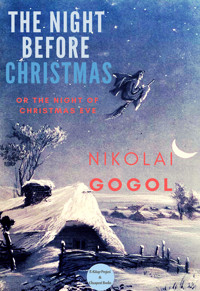
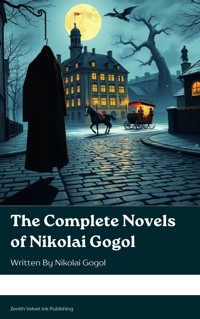
"The devil flew up to the moon, reached out and tried to grab it, but must have burned his fingers, for he hopped on one leg, sucking on his hand. He walked around it and tried again from the other side, and again jumped back. But the sly one didn't give up: he suddenly grabbed the moon with both hands and, juggling it like a hot pancake, stuffed it in his pocket, and flew off as though nothing had happened. In our village of Dikanka, no one noticed the theft. True, when the district scribe crawled out of the tavern on all fours he thought he saw the moon dancing in the sky, but who would believe him?" And in the and of the story, good wins in the most unexpected way.. [N. G.]
Sie lesen das E-Book in den Legimi-Apps auf:
Seitenzahl: 94
Veröffentlichungsjahr: 2023
Das E-Book (TTS) können Sie hören im Abo „Legimi Premium” in Legimi-Apps auf:
Ähnliche











The Night Before Christmas
“Or The Night of Christmas Eve”
By
NIKOLAI GOGOL
Translated by Constance Garnett
ILLUSTRATED &
PUBLISHED BY
e-KİTAP PROJESİ & CHEAPEST BOOKS
www.cheapestboooks.com
www.facebook.com/EKitapProjesi
Copyright, 2019 by e-Kitap Projesi
Istanbul
ISBN: 978-605-7566-19-5
©
About Author:
Nikolai Gogol (1809–1852) was a novelist and political satirist. Born in Sorochintsi, Ukraine, he grew up on his parents’ country estate. In 1828 Gogol, an aspiring writer, settled in St. Petersburg, with a certificate attesting his right to “the rank of the 14th class.” To support himself Gogol worked minor governmental jobs and wrote occasionally for periodicals. Although he was interested in literature, he also dreamed of becoming an actor. However, the capital of Russia did not welcome him with open arms and his early narrative poem, Hans Küchelgarten (1829), turned out to be a disaster.
In the midst of a largely unsuccessful tenure as Professor of Medieval History at the University of St. Petersburg in 1834, and in the years that followed that tenure’s conclusion, Gogol wrote with great energy. Having met writer Alexander Pushkin during this time, his literary ambitions achieved new heights. The presentation, on 19 April 1836, of his comedy The Government Inspector (Revizor) was so successful that he finally came to believe in his literary vocation. The comedy, a violent satire of Russian provincial bureaucracy, was staged thanks only to the intervention of the emperor, Nicholas I.
From 1836 to 1848 Gogol lived abroad, traveling through Germany and Switzerland. He spent the winter of 1836–1837 in Paris, among Russian expatriates and Polish exiles, frequently meeting the Polish poets Adam Mickiewicz and Bohdan Zaleski. He eventually settled in Rome. For much of the twelve years from 1836 Gogol was in Italy. He studied art, read Italian literature and developed a passion for opera. He mingled with Russian and other visitors, and in 1838 met Count Ioseph Vielhorskiy, the 23-year-old son of the official who had brought Gogol’s Government Inspector to the attention of the emperor. Vielhorsky was travelling in hopes of curing his tuberculosis. Gogol became deeply attached to the young man and attended him in his illness, but in 1839 Vielhorsky died. Gogol left an account of this time in his Nights at the Villa.
Pushkin’s death produced a strong impression on Gogol. His principal work during years following Pushkin’s death was the satirical epic Dead Souls. Concurrently, he worked at other tasks – recast Taras Bulba and The Portrait, completed his second comedy, Marriage (Zhenitba), wrote the fragment Rome and his most famous short story, The Overcoat.
His work, a blend of Russian realism and a kind of enigmatic surrealism entirely his own (a surrealism demonstrated in the New Directions Pearl, The Night Before Christmas) left a permanent stamp on Russian literature, leading Dostoevsky to famously declare, “We all came out from under Gogol’s overcoat.”
* * *
THE LAST DAY BEFORE CHRISTMAS HAD PASSED.
A clear winter night had come; the stars peeped out; the moon rose majestically in the sky to light good people and all the world so that all might enjoy singing kolyadki and praising the Lord.It was freezing harder than in the morning; but it was so still that the crunch of the snow under the boot could be heard half a mile away. Not one group of lads had appeared under the cottage windows yet; only the moon peeped in at them stealthily as though calling to the girls who were dressing up in their best to make haste and run out on the crunching snow. At that moment the smoke rose in puffs from a cottage chimney and passed like a cloud over the sky, and a witch, astride a broomstick, rose up in the air together with the smoke.
If the assessor of Sorotchintsy, in his cap edged with lambskin and cut like an Uhlan’s, in his dark blue greatcoat lined with black astrakhan, had driven by at that moment with his three hired horses and the fiendishly plaited whip with which it is his habit to urge on his coachman, he would certainly have noticed her, for there is not a witch in the world who could elude the eyes of the Sorotchintsy assessor. He can count on his fingers how many little pigs every peasant-woman’s sow has farrowed and how much linen is lying in her chest and just which of her clothes and household belongings her goodman pawns on Sunday at the tavern. But the Sorotchintsy assessor did not drive by, and, indeed, what business is it of his? He has his own district. Meanwhile, the witch rose so high in the air that she was only a little black patch gleaming up aloft. But wherever that little patch appeared, there the stars one after another vanished. Soon the witch had gathered a whole sleeveful of them. Three or four were still shining. All at once from the opposite side another little patch appeared, grew larger, began to lengthen out, and was no longer a little patch. A short-sighted man would never have made out what it was, even if he had put the wheels of the Commissar’s chaise on his nose by way of spectacles. At first it looked like a regular German: The narrow little face, continually twisting and turning and sniffing at everything, ended in a little round heel, like our pigs’ snouts; the legs were so thin, that if the mayor of Yareskovo had had legs like that, he would certainly have broken them in the first Cossack dance. But behind he was for all the world a district attorney in uniform, for he had a tail as long and pointed as the uniform coat-tails are nowadays. It was only from the goat-beard under his chin, from the little horns sticking upon his forehead, and from his being no whiter than a chimney-sweep, that one could tell that he was not a German or a district attorney, but simply the devil, who had one last night left him to wander about the wide world and teach good folk to sin. On the morrow when the first bells rang for matins, he would run with his tail between his legs straight off to his lair.
Meanwhile the devil stole silently up to the moon and stretched his hand out to seize it, but drew it back quickly as though he were scorched, sucked his fingers and danced about, then ran up from the other side and again skipped away and drew back his hand. But in spite of all his failures the sly devil did not give up his tricks. Running up, he suddenly seized the moon with both hands; grimacing and blowing, he kept flinging it from one hand to the other, like a peasant who has picked up an ember for his pipe with bare fingers; at last, he hurriedly put it in his pocket and ran on as though nothing had happened.
No one in Dikanka noticed that the devil had stolen the moon. It is true the district clerk, coming out of the tavern on all fours, saw the moon for no reason whatever dancing in the sky, and he swore he had to the whole village; but people shook their heads and even made fun of him. But what motive led the devil to this lawless act? Why, this was how it was; he knew that the rich Cossack, Tchub, had been invited by the sacristan to a supper of frumenty at which a kinsman of the sacristan’s, who had come from the bishop’s choir, wore a dark blue coat and could take the very lowest bass-note, the mayor, the Cossack Sverbyguz and some others were to be present, and at which besides the Christmas frumenty there were to be mulled vodka, saffron vodka and good things of all sorts. And meanwhile his daughter, the greatest beauty in the village, was left at home, and there was no doubt that the blacksmith, a very strong and fine young fellow, would pay her a visit, and him the devil hated more than Father Kondrat’s sermons. In his spare time the blacksmith had taken up painting and was reckoned the finest artist in the whole countryside. Even the Cossack officer L——ko, who was still strong and hearty in those days, sent for him to Poltava expressly to paint a paling fence round his house. All the bowls from which the Cossacks of Dikanka supped their beetroot soup had been painted by the blacksmith. He was a God-fearing man and often painted ikons of the saints: even now you may find his Luke the Evangelist in the church of T. But the triumph of his art was a picture painted on the church wall in the chapel on the right. In it he depicted St. Peter on the Day of Judgment with the keys in his hand driving the Evil Spirit out of hell: the frightened devil was running in all directions, foreseeing his doom, while the sinners, who had been imprisoned before, were chasing him and striking him with whips, blocks of wood and anything they could get hold of. While the artist was working at this picture and painting it on a big wooden board, the devil did all he could to hinder him; he gave him a nudge on the arm, unseen, blew some ashes from the forge in the smithy and scattered them on the picture; but, in spite of it all, the work was finished, the picture was brought into the church and put on the wall of the side-chapel, and from that day the devil has sworn to revenge himself on the blacksmith.
He had only one night left to wander upon earth; but he was looking for some means of venting his wrath on the blacksmith that night. And that was why he made up his mind to steal the moon, reckoning that old Tchub was lazy and slow to move, and the sacristan’s cottage a good long step away: the road passed by cross paths beside the mills and the graveyard and went round a ravine. On a moonlit night mulled vodka and saffron vodka might have tempted Tchub; but in such darkness it was doubtful whether anyone could drag him from the stove and bring him out of the cottage. And the blacksmith, who had for a long time been on bad terms with him, would on no account have ventured, strong as he was, to visit the daughter when the father was at home.