8,49 €
Mehr erfahren.
- Herausgeber: Titan Books
- Kategorie: Fantasy und Science-Fiction
- Serie: LA Trilogy
- Sprache: Englisch
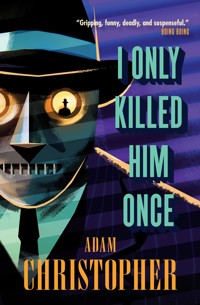
Another Hollywood night, another job for electric-detective-turned-robotic-hitman Raymond Electromatic. The target is a tall man in a black hat, and while Ray completes his mission successfully, he makes a startling discovery―one he soon forgets when his 24-hour memory tape loops to the end and is replaced with a fresh reel…Time is running out for Ray and Ada, and if Ray and Ada want to survive their enemies, they need to do exactly what the man in the black hat says. A man that Raymond Electromatic has already killed.
Das E-Book können Sie in Legimi-Apps oder einer beliebigen App lesen, die das folgende Format unterstützen:
Seitenzahl: 268
Veröffentlichungsjahr: 2018
Ähnliche













Contents
Cover
Also available from Adam Christopher and Titan Books
Title Page
Copyright
Dedication
1
2
3
4
5
6
7
8
9
10
11
12
13
14
15
16
17
18
19
20
21
22
23
24
25
26
27
28
29
Acknowledgments
Also Available from Titan Books
I ONLY KILLED HIM ONCE
Also available from Adam Christopher and Titan Books
THE SPIDER WARS
The Burning Dark
The Machine Awakes
The Dead Stars (January 2019)
THE LA TRILOGY
Made to Kill
Killing is My Business
I Only Killed Him Once
ELEMENTARY
The Ghost Line
Blood and Ink
I Only Killed Him OncePrint edition ISBN: 9781783296897E-book edition ISBN: 9781783296903
Published by Titan BooksA division of Titan Publishing Group Ltd144 Southwark Street, London SE1 0UP
First edition: July 20182 4 6 8 10 9 7 5 3 1
This is a work of fiction. Names, characters, places, and incidents either are the product of the author’s imagination or are used fictitiously, and any resemblance to actual persons, living or dead, business establishments, events, or locales is entirely coincidental. The publisher does not have any control over and does not assume any responsibility for author or third-party websites or their content.
Copyright © 2018 by Seven Wonders Limited. All rights reserved.
No part of this publication maybe reproduced, stored in a retrieval system, or transmitted, in any form or by any means without the prior written permission of the publisher, nor be otherwise circulated in any form of binding or cover other than that in which it is published and without a similar condition being imposed on the subsequent purchaser.
A CIP catalogue record for this title is available from the British Library.
Did you enjoy this book? We love to hear from our readers. Please email us at: [email protected], or write to us at the above address.
To receive advance information, news, competitions, and exclusive offers online, please sign up for the Titan newsletter on our website.www.titanbooks.com
For Sandra
As to the ending or denouement not being a surprise—what ending is?
—Raymond Chandler, 1954
I ONLY KILLED HIM ONCE
1
They say you should never start with the weather, but look, it was a dark and stormy night and I don’t care who knows it.
I was sitting in my car and my car was sitting in a parking lot, and me and the car and the parking lot were all gathered together for this little meeting in Hollywood, California. It was raining, and when I say the rain was heavy, think pounding waves and crashing seas and a full couple of inches of water being buffeted into an impressive surf all across the flat tarmacadam that surrounded my car and all the other cars that were lined up outside the restaurant.
There had been a warning about the weather. Apparently it was on the television. Ada had told me about it. The day was one for the books, the television said. I didn’t know if that was true. I didn’t remember the weather earlier than six this morning. It had been raining then too and the rain had only gotten worse.
I didn’t much like the rain but Ada said it was good for business, and as I sat in the car and listened to the tempest I had to say I agreed with her. People move fast in the rain—they move fast and they keep their heads down and they don’t have much on their minds except getting from point A to point B without getting their ankles wet. Whatever else was going on around them could take a hike, at least while the heavens were open and the angels were rinsing their togas.
I had put the radio on when I had set off out of the garage underneath the building on the corner of Cahuenga Pass and Hollywood Boulevard where I had my office and no sooner had I taken a right turn when the deejay told me to turn back around and park my car and settle in for an evening of hot cocoa and cold show tunes from decades past.
I ignored his advice and I kept driving. I had a job to do and tonight was the best night to do it and come hell or high water I was going to get it done.
High water it was. The drive across town had been long and arduous and the capabilities of my Buick’s windshield wipers were now sorely in question.
The restaurant was a diner called—according to the huge construction of multicolored neon letters that floated in the black, wet air some distance over the roof of the establishment—Pepi’s. The sign flashed and strobed and buzzed in the rain, the electrified gases within those tubes producing the illusion of a moving arrow pointing down into the parking lot. The sign also featured a series of concentric ellipses expanding outward around what looked like a representation of the owner’s signature. The sign was so bright it lit up the rain around it, making a whole patch of night air glow, surrounding itself with a fuzzy halo.
I liked the sign. It wasn’t just a functional piece of street furniture. The sign was a work of art by someone who clearly loved their job. I thought it was great and it was actually pretty welcoming, particularly with the greater Los Angeles area apparently engulfed in a cyclone, although the way the sign was buffeted in the wind was less than comforting. The whole thing was stuck on a pole so thin and insubstantial I was of half a mind to move my car in case it came down on top of it.
I didn’t. The wind blew up and then it calmed down into a kind of rhythm and the sign wobbled but stayed up. As I sat in my car watching the restaurant, I found myself watching the sign almost as often. I wondered if I could have a sign like that for my office. Something smaller, of course, but I had some wall space available. Maybe I’d need to move the filing cabinet. Sure, it would be a strange thing, but then the only person who was ever in the office was me because it wasn’t a real office, not really. It was a hangover, nothing more, from a previous life when the Electromatic Detective Agency had been exactly that and nothing more and I was an electronic private eye and nothing more.
Now I was an electronic private killer, and nobody came to the office, but I still thought a neon sign would be a nice thing to have. Call it an art installation. It was 1965, after all. Maybe Ada would like it too.
Then I focused my optics on the job at hand. Things were starting to happen in the diner, and I hadn’t come out in a flood just to get my tires wet while I admired a street sign.
Pepi’s was a long, low building made out of curved aluminum siding with a mirrorlike finish, the metal and the water that flowed down it reflecting the multicolored wonder of the neon sign. The walls were ridged like a trailer, although as far as I could tell the building wasn’t built to move. It had a red roof that wasn’t quite flat and big red double doors and windows all around three sides that were also big and also framed in red. There was an awning stretched out along the whole front of the joint. The awning bounced in the wind and the rain sprayed back up into the air in a mist so thick that when the neon sign flashed red it looked like Pepi had set his grill too high and lit the place afire.
I checked my watch and then I checked my internal chronometer just to be sure. They both told me it was coming up on nine in the evening. But despite the hour and despite the weather the place was doing steady business. From my position behind the wheel I could see into Pepi’s pretty well, the rain so heavy it ran what was effectively a single, solid sheet down the windshield, which did nothing to my view except to make it ripple a little.
Inside the restaurant were five occupied tables, three by the front windows and two farther back, and I could see three waitresses moving around in red-and-white uniforms. There was a young man in white busy behind the main counter and behind him there was another man working the grill. My view was so good I could even read the menus that hung over the counter if I zoomed in a little.
The three tables at the front were booths. The one nearest the restaurant’s doors was occupied by a trio, two teenage girls dressed like cheerleaders and one teenage boy dressed like a jock. He had red hair and one of the girls was a blonde and the other a brunette and they laughed and drank their milkshakes and all was right with the world.
In the next booth along sat an older couple. She was blond and wore a dress almost the same color as her hair. What hair the man had left was mouse brown and he wore glasses and they were both more interested in their chicken salads than each other.
The next booth was empty. The one after that had, until a minute ago, been home to just one man. He was wearing a black suit with a black tie and white shirt. I’d gotten into position after he had come in, but I assumed the long, wet black coat hanging on the chromium hook by the doors was his, as was the black hat with black band that sat on the table in front of him. He’d been there awhile, and despite the persuasive nature of Pepi’s servers, he had yet to order anything and any conversation he’d had with the staff had been short and to the point, but on a night like this Pepi and his staff were clearly pleased enough to have some company so the black-suited customer had been permitted to stay without giving the place his custom.
A couple of times the man in the booth had looked out of the windows and he had looked straight at me, but I knew I was safe. The lights inside the restaurant were bright and white, and while the parking lot was lit in moving reds and yellows and blues by Pepi’s magical neon sign, that helped me a great deal, given I was sitting inside a dark car behind a windshield slick with water. I didn’t need to breathe, on account of the fact that I was a wonder of electronic wizardry and mechanical genius, so none of the windows were in any danger of fogging up. If the guy at the booth had been looking at me all he would have seen was the shape of a largish car like all the other largish cars in the lot and the mirrored shapes of the big neon letters reflected back at him from the windshield.
The man had piloted his booth solo for a good half hour when he was joined by someone, although it wasn’t that someone that had got my attention. It was the reaction of everyone else in the restaurant when he walked through the doors.
He’d driven into the lot in a small, low car with a sharp front and big wheels and no backseat to speak of. He’d parked close to the main doors, not in a slot allocated for vehicles but at an angle that suggested he either owned the place or thought he did. That left him only a few yards to swim to the entrance, which he did with a beige trench coat pulled up and over his head. That coat made it onto the chromium hook alongside the black coat, and that’s when people started getting excited.
It was the teenagers first. The two girls had their backs toward the door and their eyes locked on the jock, and when I zoomed in I could see the disappointed confusion scudding across their faces as the jock’s eyes went up, followed by his chin, followed by his athletic behind as he lifted himself up, just a few inches, to get a better look at the newcomer. Of the two girls, the blond one turned first, and then almost as quickly her hand shot out and she grabbed the shoulder of her friend and pulled her around too. Their milkshake nearly went over but the trio had suddenly lost all interest in it.
The object of their attention walked across the length of the diner, from my right to my left. As he passed the booth of kids I zoomed out, my optics skipping as they tried to get a focus on the newcomer’s jacket. It was plaid, yellow and white and black, and there was some red too and maybe some green and it played merry havoc with my vertical hold. No wonder the kids were mesmerized by him. The CIA could use the pattern of the fabric to brainwash a foreign agent.
There was something about him that I couldn’t quite put a finger on. As I watched I reached for the yellow legal pad on the passenger seat next to me and with a mechanical pencil I made a note or two.
Memory like mine, I found it paid to take notes.
The older lady in the middle booth saw the newcomer from the corner of her eye and those eyes followed him as he made his way across the restaurant. While the jock stared and the cheerleaders whispered to each other, the woman just smiled, and she looked happy and relaxed and she looked like she was remembering an old story from long ago and maybe she was imagining she wasn’t in Pepi’s diner on a wet and wild night with a man, perhaps her husband, who continued to work at his salad and didn’t look up.
The newcomer reached the man in the booth. He gave a nod and slid in sideways. His jaw was as square as cut glass and when he spoke about a million white teeth did their best to outshine what I supposed he thought was a sport coat. He smiled as he talked and when the waitress came over he smiled some more. The waitress took an awful long time with the order, and when she went back to the diner’s counter her first port of call wasn’t the kitchen but the other servers, who were all standing and looking and smiling with shoulders hunched, heads ducked down, their bodies together in a way that was not entirely dissimilar to the reaction of the cheerleaders at the first booth. The older guy with the glasses was missing out. I wondered if I should walk up to the glass and knock, tell him to stop fussing with his lettuce and mayo and take a good look behind him.
As for me, who the newcomer was I didn’t know and I didn’t care. But the other guy in the booth, the man with the black hair and expression as friendly as the weather, I knew three things about.
First, that his name was Touch Daley.
Second, that he was a G-man.
Third, that I was going to kill him.
2
Touch Daley and his guest stayed at the table in the window a real long time. As they talked, Daley’s expression went through a whole range of emotions from depressingly gloomy to vaguely disgusted. I couldn’t blame him, sitting opposite a jacket like the one his guest was wearing. I also didn’t blame him for not eating or drinking. While his companion had a burger with fries and a Coke in a glass bottle with a long, striped straw, Daley settled in with a big mug of hot coffee and a stainless steel carafe of the stuff at his elbow.
He didn’t touch either of them.
I couldn’t hear what they were saying but then again I didn’t need to. Maybe if I really tried hard I could make a fair stab at lip reading but, again, why bother. I had no idea who the guy in the jacket was and it didn’t matter. I was here for Mr. Daley. All I had to do was sit and wait, and I could do both quite nicely from the comfort and dryness of my car.
Not that I needed much comfort. I was six feet and ten inches of bronzed titanium alloy made to a secret government recipe. Underneath that alloy was a lot of magical gadgetry, state of the art you’d call it, although I had no idea what that meant. Because what was inside me was not art but pure science, the end product of years of research and development and experimentation.
I guess any sufficiently advanced technology is indistinguishable from art. I pondered that sentiment for a while and I decided I liked it. I wondered if it was something that Professor Thornton used to say. It sounded like it was.
As for me being the end product, I really was. I was the last robot off the production line, the date of my activation the official closing date of the federal robot program: March 26, 1959. I was the most advanced machine the human race had ever built, and I was the only one of my kind. I guess a lot of money had been spent already, and if there was one thing government pencil-pushers didn’t like much at all it was spending a lot of money. They needed a return on their investment and I guess the Professor had promised them the world. So they allowed him to keep the doors of Thornton Industrial Electronics and Research open just a little bit longer. Figuratively speaking. That operation in Pasadena was just one of several sites the Department of Robot Labor had authorized Thornton to run with federal funding, and he had others that ran just fine without their help, including his own personal lab somewhere near a beach in Southern California that probably also counted as state of the art.
The laboratory. Not the beach.
And then that last little project was done and that project was me, the last robot in the world, the sole survivor of a decade and a half of a robot workforce that had come and gone. Thornton Industrial Electronics and Research was mothballed along with everything else. Including the good professor.
That much I knew. It was on my permanent store, a repository of useful information that I needed to operate in a world of humans. I knew what cows were and how airplanes worked and the best recipe for a gimlet (half gin and half Rose’s lime juice and nothing else and don’t let anyone tell you otherwise).
And that was just fine. It was my other memory that was an issue. Professor Thornton, genius he truly was, built a compact reel-to-reel memory tape that sat in my not insubstantial chest cavity. The micro tape in question had the capacity to record everything I did during a single day. But twenty-four hours, and that was it. When my time was up, the tape came out and I was given a clean one and the world was born anew.
A fact that made the yellow legal pad currently sitting on my knee an interesting, not to say vital, development.
It had been on the passenger seat of the car when I had gotten into it back at the garage. It was about half done, the pages neatly torn off the top but leaving a ragged ribbon next to the glue. The top few pages on the remaining pad had the impression of writing on them, and if I held the pad up and tilted it to the light I could see some of it, even read a little. Cycling through filters on my optics made a little difference but not much, but what was legible wasn’t anything I could understand, anyway. It was mostly single words, some circled—several times in a couple of cases—and I could make out a lot of question marks and even an arrow or two connecting short statements. What the notes were about was a mystery.
But I did know one thing. The notes were mine. I didn’t remember making them but I knew my handwriting when I saw it. I must have left the notepad out in the open on the seat like that to get my attention the next day. Given how much of the pad was used it occurred to me that I had been doing it awhile.
If only I had written something a little clearer. Ray’s Little Book of Secrets would have been more useful.
So I sat in the car and I kept the notepad on my knee and I switched my attention back to the diner. As I watched Touch Daley and his buddy I ignored the growing desire for a carafe of coffee of my own. I pondered getting a container to go, but that would mean getting wet and the coffee would steam up my windows, which would make surveillance more difficult than it was right now, so I let it slide. And besides, I wasn’t entirely sure I wanted Touch Daley—or anyone else in the diner, for that matter—to see me. A robot walking into a restaurant in the middle of a storm and asking for coffee to go was something I could imagine people would tend to remember when asked, and in my line of work it was fairly important that people didn’t remember me at all.
So I sat and I watched. Touch’s coffee must have been getting cold. The guy in the jacket had finished his food and got a carafe of his own. That seemed like a waste but then it wasn’t on my dime so what did I care.
Touch Daley. He had an interesting name. A nickname perhaps. Or perhaps not. This was Hollywood, after all. I didn’t know what branch of the federal government he worked for but he looked like the kind of man who worked for a certain kind of agency, the ones that were full of a certain kind of man and had a certain kind of way of dressing them, all black hats and black coats and narrow ties. The kind of agency where smiling was forbidden, where the training program involved practicing an array of expressions from mildly annoyed to slightly angry.
At least, that’s what came to mind when I watched him, and I didn’t know why it did so I just put it down to another little gift from Professor Thornton. I was doing a lot of that today. It was an easy explanation and maybe a lazy one, but the truth was that in order to give me a mind and a personality all of my own, Thornton had used his own as a template. How that actually worked I didn’t know because that information was locked away in a part of my permanent store that I didn’t need to access, the area that was filled with raw program codes and machine algorithms that told my microswitches which way was up.
But having Thornton’s template meant that I had a part of Thornton with me all the time and it meant that I enjoyed the smell of pipe tobacco and had opinions about baseball and the Fermi paradox. And maybe Thornton had watched too many cheap TV thrillers, ones filled with actors wrapped in black suits doing the best interpretation of men like Touch Daley.
Or maybe Thornton had dealt with his fair share of government agents in dark suits during his time at the lab. Given the nature of his work, that seemed a distinct likelihood—maybe he’d even dealt with Touch Daley. Because the name certainly rang a bell.
That was also something that happened sometimes. I called them fragments, and they usually rose up in my circuits like a slowly increasing voltage, giving me hunches or vague ideas. Less often they came as flashes that for a nanosecond took over all my sensory inputs and put me somewhere else, sometime else.
These fragments and flashes were an artifact, nothing more than electric dreams caused by my memory systems operating at the very edge of technology. The small tape in my chest was one of only a small number and they were all reused in rotation after being copied onto larger archive tapes. These big tapes were stored in a secret room hidden behind the office. But the erasure of the smaller, portable tapes was never perfect, and sometimes data got stuck in the cracks and sometimes I could read that data and I got ideas.
Or feelings. Like now. Because there was no flash and no vision but I had a feeling that I knew who Touch Daley was. But it didn’t matter anyway. Not to the job. All I had to do was find Touch Daley and make sure he never had another cup of coffee after tonight.
So far I was halfway home.
But I wrote some notes anyway. As I wrote them I wondered where the rest of the pad was. I must have written a hundred pages and hidden them somewhere. And I knew that each and every day I would have made the same discovery and come to the same conclusions.
I looked up at the diner. The rain had eased and the diner was empty now apart from Daley and the guy in the jacket and the man who had previously been running the grill. He was now standing behind the counter and watching his last two customers. He was dressed in an apron and garrison cap sharp enough for a parade at West Point and he had a neat little gray moustache. He must have been the legendary Pepi himself. The lips under that moustache of his were twisting this way and that and he had his arms folded and he sometimes checked his watch. He was clearly eager to shut up shop and get back home to punch out a few army drills.
My target didn’t seem to notice. He was still talking and maybe his peripheral vision was being dazzled by the other guy’s jacket. The other guy just grinned and jammed the last of his French fries into his mouth. He shook his head while he grinned. Something was amusing. Whatever Daley was selling, the guy in the jacket wasn’t buying.
I think I liked him, whoever he was. Apart from the fact that he was making a short job long and I had to get back to the office by dawn.
But then some of that luck I had been thinking about knocked on my door and walked right in. Touch Daley stopped talking and he picked up his hat and adjusted the brim with two long fingers and then he put the hat on while the other guy sat there watching and chewing his fries and enjoying the show. Then Touch Daley stood up and left the table and his coffee carafe and his untouched coffee mug and he turned and headed to the door. Pepi didn’t move from the counter but he watched him go. The other guy started to get busy with napkins and then he waved a hand to get Pepi’s attention.
But my optics were on Touch Daley. He paused at the chromium hook to get his black coat and then he put it on and then he opened the doors and he tripped down the steps of the diner without any particular concern for the weather. I found myself putting the notepad back on the passenger seat and leaning forward over the wheel as I watched him.
But he didn’t head for the parking lot. Instead he skirted the silver side of the diner and walked right past the window where my guy was giving Pepi another order. Then Touch Daley hit the street and he turned his back to me and he walked off into the night under the flashing colors of the neon sign. A moment later he had vanished into the hazy dark.
I was surprised he hadn’t come by car. The diner wasn’t far from anywhere, but the night was not a friendly one and I was of the opinion that people didn’t walk anywhere in Los Angeles.
Showed what I knew.
But then again, he could have parked his car around the corner. The meeting hardly seemed a secret and my guy had parked his sportsmobile practically by the milkshake machine, but maybe Touch Daley was just following procedure. I glanced around the parking lot. There were still several cars around mine but none of them belonged to anybody in the diner, given that there was only Pepi and the other guy left and it seemed unlikely that Pepi kept a fleet of mid-priced sedans lined up outside his restaurant so he could look out over his automotive empire while he worked.
Touch Daley had either stashed his vehicle in a dark and narrow alley or maybe he had a comrade waiting, accelerator gunning, headlights low, sitting tight until his boss came back and gave the order for blast off.
Or maybe the damp had got into my neutronic ignition line and was giving me funny ideas. I had a job to do and sitting in the rain in a parking lot was not the way to do it.
I started my car and I kept the headlights off as I eased back clear out of my slot and then I danced a leather-clad bronzed-titanium toe on the gas as I rolled the car as quietly as I could to the exit. Out of the glare of the neon the night opened up around me and looking right I saw a tall dark shape I knew was my target walking down the sidewalk, his back to me, the rain bouncing off his hat and his shoulders like he didn’t have a care in the world.
He was about to have a care, all right.
It was late. The street was clear. As was the sidewalk. I knew this part of town well and I knew just the right kind of places nearby that would come in handy for a job like mine.
I turned left and turned the lights on and turned my speed up and the shape of Touch Daley loomed bigger in my windshield as I came in for my final approach.
3
Later I sat in the car awhile in the garage underneath my office. The rain had picked up again and I could hear the roar of it on the street outside even from down the garage ramp. There were still a few hours until dawn. I had some time left.
Time to do some thinking.
Maybe even time to do a little of that detective work I used to be good at in a previous life.
In point of fact I sat in the car long enough for the telephone at my elbow to ring twice. I knew who it was and I ignored it both times. It wasn’t that Ada was worried. She might have been the boss, a computer the size of a good-sized room who ran the operation and got me to do the legwork, but despite my not insignificant limitations I was a big robot and I could look after myself and Ada knew that.
But she would also know that I was in the garage. She would be wondering what I was doing down there, sitting in my car with the engine off, listening to the rain, contemplating the night.
Contemplating the job.
I felt a condenser click. I felt a logic gate flip. I felt the voltage surge in a circuit or two.
The job.